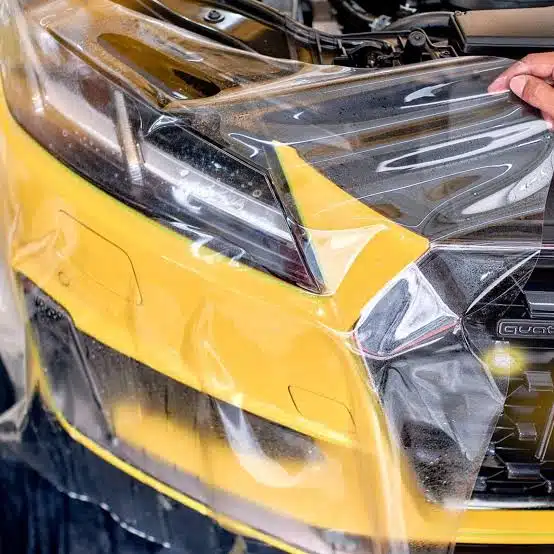
Home » Headlight Paint Protection Film: Clearer, Better-Protected Headlights
Recent Posts
Headlight Paint Protection Film: Clearer, Better-Protected Headlights
A vehicle’s headlights live in one of the toughest places on the entire car.
Every time you drive, the front of the vehicle is exposed to small stones, sand, insects, road grime, water, salt, harsh sunlight and repeated washing. The hood and bumper usually get most of the attention when people talk about vehicle protection, but the headlights are sitting in exactly the same impact zone.
That is why headlight paint protection film has become an increasingly important part of modern automotive protection.
A good clear headlight film creates a transparent sacrificial layer over the outer lens. Instead of allowing every piece of road grit, bug splatter or light abrasion to contact the factory lens directly, the protective film takes much of that everyday wear first.
For new vehicles, the goal is simple: keep a clear lens clear.
For vehicles with professionally restored headlights, the goal is slightly different: protect the renewed surface so that it is not immediately exposed to the same conditions that caused deterioration before.
And for automotive film distributors, detailing studios and professional installers, headlight protection represents another practical application for high-quality TPU film.
But not every product called “headlight film” does the same job.
Some films are primarily designed to change appearance. Some are thin decorative films. Others are engineered as a real protective layer against road wear. Material quality, optical clarity, surface coating, adhesive performance, thickness, stretch behavior and installation quality all matter.
This guide explains what headlight paint protection film is, how it works, what it can and cannot do, how it compares with other forms of headlight protection, and what professionals should look for when choosing a headlight protection film supplier.
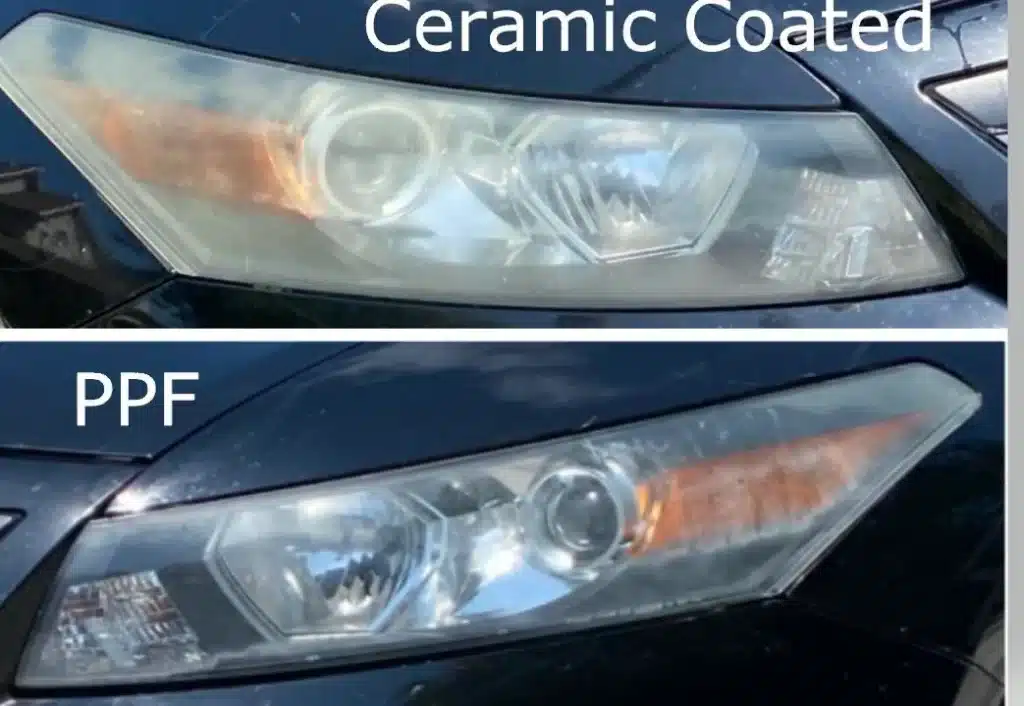
Table of Contents
What Is Headlight Paint Protection Film?
Headlight paint protection film is a transparent or lightly modified protective film applied to the exterior surface of an automotive headlight lens.
Despite the name, there is obviously no painted surface on most modern headlight lenses. The phrase comes from the automotive paint protection film industry because headlight protection uses many of the same material and coating technologies found in protective films used on vehicle body panels.
A modern headlight protection film is usually designed to act as a replaceable outer barrier.
Think about the difference between an exposed lens and a protected lens.
On an unprotected headlight, airborne grit, sand, insects and washing contact the original surface directly. Over thousands of miles, tiny impacts and abrasions can accumulate. At the same time, sunlight continually reaches the polycarbonate lens and its factory protective coating.
With a suitable clear protective film installed, much of that environmental contact reaches the film before it reaches the original headlight surface.
This is why you will see several related search terms used for essentially the same category, including headlight protection film, headlight clear film, headlight lens protection film, PPF for headlights, headlight PPF, TPU headlight film and sometimes clear bra for headlights.
The exact construction varies between manufacturers, but a quality TPU headlight film normally combines a transparent polyurethane layer, a functional surface coating and a pressure-sensitive adhesive designed for automotive applications.
The important point is that the film must do more than simply stick to the lamp.
It needs to remain clear.
It needs to conform to curved lamp shapes.
It needs to resist normal environmental exposure.
It needs enough physical strength to provide useful protection.
And it needs an adhesive system that allows professional installation without introducing excessive haze, distortion or visible defects.
That combination is what separates purpose-designed headlight protection film from ordinary decorative film.
Why Modern Headlights Need Extra Protection
Modern headlights are impressive pieces of automotive engineering, but their exterior lenses still have to survive a very unfriendly environment.
Most modern headlamp lenses use polycarbonate because the material is lightweight, impact resistant, moldable and optically transparent. Those properties allow vehicle designers to create the complex shapes seen on modern cars.
The trade-off is that polycarbonate requires protection against scratching and UV-related deterioration. Factory lenses therefore normally include a protective surface treatment. Independent automotive research has documented that prolonged ultraviolet exposure and abrasion from road grit contribute to headlamp-lens deterioration.
Road debris never really stops
One large stone is easy to notice.
Thousands of microscopic impacts are not.
A headlight can be hit by tiny particles of gravel, sand and road debris every time the vehicle travels at speed. Most individual impacts will not break the lens, but repeated exposure can gradually create surface pitting and visible wear.
Vehicles that spend a large amount of time on highways, construction routes, rural roads or dusty roads often face greater exposure.
The same reason drivers choose paint protection film for a front bumper also applies to the headlights directly beside it.
The front of the vehicle is simply where road impact happens.
UV exposure is a long-term problem
Sunlight works more slowly than a stone, but a vehicle can spend thousands of hours outside.
Polycarbonate is susceptible to deterioration under prolonged ultraviolet exposure. Manufacturers address this with protective treatments on the lens surface, but environmental exposure and abrasion can gradually affect the condition of that surface.
Once aging becomes visible, the lens may begin looking cloudy, yellowed or dull.
This is more than an appearance problem. Severe headlamp deterioration can reduce useful light output. Independent testing has shown substantial reductions in illumination from heavily deteriorated lenses compared with new assemblies, although the amount of deterioration varies widely from vehicle to vehicle.
A UV-resistant headlight protection film therefore has two roles: it provides another layer between environmental exposure and the original lens while also shielding the surface from some of the abrasion that can wear on the factory finish.
Bugs and road contamination are surprisingly aggressive
Drive during warm weather and look at the front bumper after a long trip.
The headlights often receive the same collection of insect remains, dirt and road contamination.
The problem is not only contamination itself. It is also the cleaning that follows.
A driver who aggressively scrubs dried bug residue from an unprotected plastic lens may introduce fine scratches. A smoother, easy-clean film surface can reduce the need for aggressive scrubbing, provided the film has an appropriate top coating.
Washing creates wear too
Not all scratches come from dramatic events.
Dirty wash mitts, rough towels, automatic brushes and abrasive cleaning methods can all create fine marks over time.
On a self-healing TPU protective film, certain light surface marks can become less visible when the film is warmed. That does not mean deep cuts magically disappear, but it does help the protection layer maintain a cleaner surface through normal use.
That is one reason self-healing technology has become such an important industry term in premium automotive paint protection film.
How Does Headlight PPF Work?
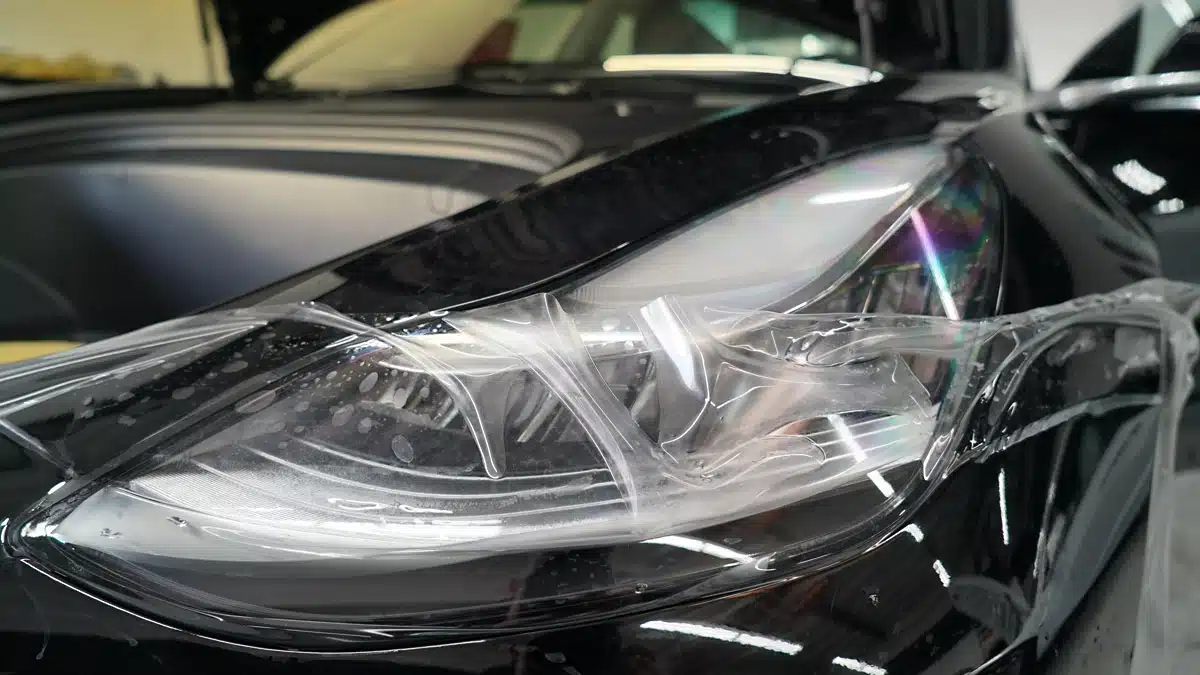
The easiest way to understand headlight PPF is to think of it as a transparent sacrificial surface.
The original lens remains underneath.
The protection film takes the daily exposure.
When properly selected and professionally installed, the film follows the shape of the headlight so closely that it should not dominate the appearance of the lamp.
Several layers or functional components work together.
The TPU layer provides physical protection
TPU stands for thermoplastic polyurethane.
In automotive protective films, TPU is valued because it can combine transparency, flexibility, elongation and resistance to physical wear.
That flexibility matters on modern headlights because very few headlamp assemblies are flat.
Many contain sharp changes in curvature, narrow corners, raised sections and complex three-dimensional shapes. A film that cannot stretch and recover consistently may be difficult to install cleanly.
TPU also provides the physical body of the film. When sand or small debris strikes the surface, the protective layer takes the contact first.
That does not make a headlight indestructible.
A large or high-energy impact can still damage the film or the lamp underneath. No responsible film manufacturer should describe a thin flexible film as an absolute shield against every possible stone impact.
The useful benefit is reduction of ordinary surface damage and everyday road wear.
The top coat controls surface behavior
A high-quality headlight protection film is more than raw TPU.
The top coating can influence gloss, stain resistance, hydrophobic behavior, scratch resistance and self-healing performance.
This layer is particularly important because it is what the outside environment actually touches.
If the top coat performs well, water and contamination are easier to remove, light surface marks are less troublesome, and the lens remains easier to maintain.
The adhesive keeps everything optically consistent
Adhesive is easy to overlook, but poor adhesive can ruin an otherwise good film.
The adhesive must create consistent contact between the film and the headlight lens without producing obvious distortion, cloudiness or irregular texture.
It must also allow installers enough working control to position the film properly.
For distributors and installation shops, adhesive consistency from roll to roll can be just as important as the TPU itself. A product that performs perfectly in one batch and behaves differently in the next creates installation problems, wasted material and customer complaints.
Optical clarity matters more on headlights
A slight texture that might go unnoticed on a painted door can become much more obvious on a lamp.
Headlights emit light through the surface being protected.
That makes haze, clarity, adhesive uniformity and surface finish especially important.
The objective of clear headlight protection is to protect the lens without making the protection itself the first thing people notice.
The Main Benefits of PPF for Headlights
People sometimes think of PPF for headlights as a small cosmetic accessory.
It makes more sense to think of it as preventive surface protection.
It helps reduce rock-chip and road-grit damage
The front of a moving car is continually meeting airborne debris.
A TPU protection layer gives small debris something else to strike before it reaches the original headlight surface.
This is especially relevant for drivers who spend a large amount of time on high-speed roads, behind trucks, on gravel routes or in areas where sand and road grit are common.
The protective film may itself become marked over time. That is not necessarily a failure.
A sacrificial film is supposed to receive wear that would otherwise reach the substrate underneath.
It helps protect the original lens surface
Keeping the factory lens in good condition is usually easier than restoring it after heavy deterioration.
Headlight restoration can improve an already cloudy surface, but prevention begins earlier.
Installing clear paint protection film while the headlights are still in excellent condition gives the film a clean surface to preserve.
That is why new-car installation makes sense.
The film cannot reverse existing oxidation. It can only protect the condition underneath it.
It adds another layer of UV defense
UV exposure is one of the main factors associated with aging of polycarbonate headlamp lenses. Road abrasion contributes as well.
A properly engineered UV-resistant film adds another protective layer between sunlight and the headlight surface.
The wording “adds another layer” matters.
No film should be treated as permanent immunity from aging. Film quality, climate, vehicle storage, maintenance, installation quality and the condition of the original lens all influence long-term results.
It can reduce everyday surface scratching
Fine wash marks and light abrasions tend to accumulate gradually.
A self-healing TPU film gives those small marks a replaceable surface to occur on.
Heat-activated self-healing technology is intended for minor marks in the film surface. It will not repair a deep puncture, a major cut or physical damage to the headlight underneath.
That distinction is worth explaining clearly to customers.
It can make headlights easier to clean
Road grime, bugs and contamination are unavoidable.
An automotive film with a well-designed hydrophobic or easy-clean top surface can make routine cleaning easier because contamination has less opportunity to bond strongly to the original lens.
Cleaning still matters.
Hydrophobic does not mean maintenance-free.
It simply improves surface behavior and can reduce the amount of scrubbing required during normal washing.
It preserves the factory appearance
For many drivers, the ideal headlight modification is one nobody notices.
Clear headlight paint protection film is intended to protect rather than dramatically alter the vehicle’s appearance.
That makes it attractive for luxury vehicles, performance vehicles, new cars, collector cars and daily drivers where maintaining a clean factory look is more important than creating a dark or colored lighting effect.
Can Headlight Paint Protection Film Help Prevent Yellowing?
This is one of the most common questions people search before buying headlight protection film.
The answer needs a little more explanation than simply “yes.”
Headlight yellowing is associated with deterioration of the protective surface and polycarbonate material under long-term environmental exposure, particularly UV radiation. Abrasion and road wear can also contribute to degradation of the lens surface.
A high-quality UV-resistant protective film can help by adding another barrier over the original headlight.
It also shields the lens from some of the physical abrasion that would otherwise contact the factory surface directly.
However, headlight protection should be presented as risk reduction, not a promise that the headlamp can never age.
A vehicle stored indoors most of the time lives a very different life from a vehicle parked outdoors every day in intense sun.
A weekend vehicle experiences different exposure from a highway fleet vehicle.
Film quality also matters. A low-grade film that develops haze, discoloration or adhesive problems simply replaces one appearance issue with another.
For this reason, professional buyers should consider weathering resistance and optical stability alongside basic features such as thickness.
The best time to protect a lens is when it is already clear.
If the lens is yellow before installation, putting transparent film over it will simply allow you to see yellow plastic through transparent film.
Protection is not restoration.
Does Headlight PPF Reduce Headlight Brightness?
With headlight protection, optical performance should always come before appearance.
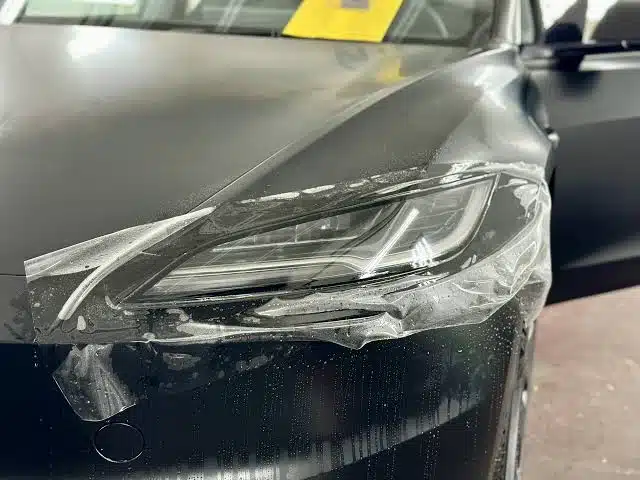
A quality clear film should be designed to minimize interference with the light passing through the lens. The installer also needs to avoid contamination, trapped solution, wrinkles, adhesive irregularities and excessive stretch that could affect appearance.
The safest approach for street-driven vehicles is to use a purpose-designed, high-clarity product appropriate for automotive lighting.
Tinted film is a different conversation.
Any material designed to intentionally darken a lamp reduces some amount of transmitted light by definition. How much is acceptable depends on product characteristics and local regulations.
In the United States, federal lighting requirements include the principle that additional vehicle equipment must not impair the effectiveness of required lighting equipment, while state-level rules can add further restrictions.
For that reason, distributors and installers selling headlight film internationally should avoid giving customers a universal statement that every shade is legal everywhere.
Local lighting rules should always be checked.
Clear protection and cosmetic tint are not the same product objective.
Does Protective Film Trap Heat Around the Headlight?
This is another common concern, particularly with modern high-output lighting systems.
There is no single answer that applies to every lamp and every film construction.
Headlights vary dramatically in design, heat management and light source. Protective films also vary in thickness, composition, adhesive and optical properties.
A properly engineered headlight film is thin compared with the overall headlamp assembly, but professional installers should still use products intended for automotive lighting applications and follow the film manufacturer’s technical guidance.
Do not assume an ordinary decorative vinyl is interchangeable with TPU headlight protection simply because both materials can physically stick to a lens.
For professional shops, compatibility matters more than improvisation.
Headlight PPF vs Headlight Tint vs Ceramic Coating vs Restoration
Several products are discussed online under the broad heading of “headlight protection,” but they solve different problems.
Understanding those differences makes it easier to recommend the right service.
| Solution | Main Purpose | Rock-Chip Protection | Helps With UV Exposure | Changes Appearance | Repairs Existing Haze |
|---|---|---|---|---|---|
| Headlight PPF | Physical surface protection | Strongest physical barrier of these options | Can help when designed with UV-resistant properties | Minimal with clear film | No |
| Headlight tint film | Mainly appearance and styling | Depends on material and construction | Depends on product | Yes | No |
| Ceramic-type surface coating | Surface slickness and easier maintenance | Limited physical impact protection | Depends on product | Usually minimal | No |
| Headlight restoration | Correct existing oxidation and haze | No sacrificial impact layer by itself | Depends on final protective treatment | Restores clarity | Yes |
The biggest mistake is expecting one product to do the job of another.
A ceramic surface treatment and TPU protection film are not physically equivalent. A thin liquid-applied coating can improve surface behavior, but it does not provide the same flexible sacrificial layer as paint protection film.
Restoration has another completely different role.
If a headlight is already badly oxidized, restoration addresses the existing damage.
Protective film addresses future exposure.
That is why a restored headlight may later receive clear protection, once the restoration process and surface condition are suitable for film installation.
Headlight tint is primarily an aesthetic choice unless the product is specifically engineered to combine appearance modification with TPU-level protection.
When selling to professional customers, separating these categories avoids unrealistic expectations and makes product positioning much clearer.
When Should You Install PPF on Headlights?
The ideal time is before visible deterioration becomes established.
A brand-new or well-preserved headlight gives the installer the best starting point.
There is no heavy oxidation to hide, no peeling surface treatment to complicate adhesion and no deep pitting that remains visible underneath the transparent film.
This is why headlight protection is often offered together with front-end paint protection film installation.
The customer is already protecting the bumper and hood from the same road environment, so the headlights are a logical extension of the package.
Restored lenses can also be candidates, but the installer must first understand exactly how they were restored.
Sanding, polishing, clear coatings, sealants and other treatments can all affect the final surface.
Installing adhesive film onto a poorly prepared or unstable coating can create problems later.
Cracked lenses, internal moisture and structural lamp damage are different issues entirely.
Protective film does not repair a leaking housing.
It does not stop an existing crack from being a crack.
And it should not be used to hide a headlight that requires mechanical repair or replacement.
Good installers know when not to install film.
That judgment builds more long-term customer trust than simply applying material to every lens that enters the shop.
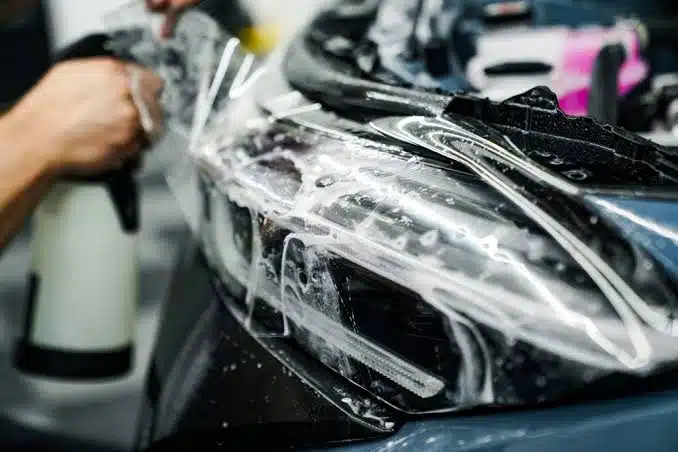
How Professional Headlight Film Installation Works
Headlight film looks simple when an experienced technician installs it, but modern lamp geometry can make the process surprisingly technical.
Deep compound curves create tension. Narrow corners can lift. Too much stretch can affect optical consistency. Contamination becomes easy to see on a transparent lens.
A typical professional workflow looks like this:
- Inspect the lens first. The installer checks for oxidation, pitting, cracking, peeling coatings, old film, adhesive residue and internal moisture. Existing defects should be identified before installation because transparent film will not hide them.
- Clean and decontaminate the surface. Bugs, road film, oil, wax, sealant and cleaner residue need to be removed. Even a tiny particle can remain visible beneath a clear film.
- Prepare the film pattern. Depending on the shop and application, the film may be plotter-cut from a vehicle-specific pattern or carefully prepared for the individual headlight shape. Accurate sizing reduces unnecessary trimming around the lamp.
- Position the film. A controlled installation solution allows the film to be moved into the correct position before full adhesive contact is established.
- Set initial anchor points. The installer establishes stable areas before working toward more complex curves. Proper tension management is critical because stretching one area changes tension somewhere else.
- Squeegee solution and air outward. Controlled overlapping passes remove installation fluid while bringing the adhesive evenly into contact with the lens.
- Manage curves with controlled heat and stretch. TPU can conform around complex geometry, but unnecessary stretching should be avoided. A professional installer uses the minimum amount of tension needed to achieve a smooth fit.
- Finish the edges. Edge placement has a major effect on long-term appearance. The film needs clean contact around the perimeter without excessive tension trying to pull it back.
- Inspect optical appearance. The installer checks the film from several angles and with the lights on and off, looking for contamination, haze, creases, trapped solution or distorted areas.
- Allow the installation to settle. Immediately after wet installation, some small moisture pockets or slight visual variation may need time to dissipate. The customer should follow the installer’s aftercare instructions before aggressive washing.
The process sounds straightforward on paper.
The difference between average and excellent work appears in tension management, edge finishing and contamination control.
That is why installer training matters just as much as film quality.
Common Headlight Film Installation Mistakes
One of the most common mistakes is applying film over a headlight that is not ready for protection.
If oxidation is already present, the installer has not solved the underlying appearance problem.
The film simply preserves what is beneath it.
Another mistake is stretching too aggressively.
TPU is flexible, but flexibility should not become an excuse to pull film excessively across complex lamp shapes. Overstretching can create unnecessary tension at edges and may change the appearance of the film.
Poor cleaning is another frequent cause of problems.
A headlight is at the front of the vehicle, which means it collects silicone-based detailing products, wax, insects, road grime and traffic film. Adhesion problems near an edge may be caused by contamination that was never fully removed.
Cutting also requires care.
Professional shops increasingly prefer accurate pre-cut patterns where appropriate because they reduce the amount of blade work around the vehicle.
Then there is the environment.
Trying to install clear film in a dusty, windy space creates an obvious problem: every particle trapped beneath the film becomes easier to see once the job is finished.
Finally, installers sometimes treat headlights exactly like painted body panels.
The basic application principles may be similar, but optical requirements are more demanding.
A headlight is not simply another glossy panel.
It is an optical component.
That should influence product choice, installation technique and final inspection.
How to Maintain Headlight Paint Protection Film
Maintenance does not need to be complicated.
The most important rule is to treat the film as a protective surface, not as something that needs aggressive polishing every time it becomes dirty.
Use a mild automotive wash solution and clean microfiber material.
Remove insect residue and road contamination before it sits on the surface for extended periods.
Avoid rough abrasive pads.
When using a pressure washer, do not place the nozzle extremely close to film edges.
An edge that is repeatedly blasted at short distance has a much greater chance of being disturbed than a properly washed surface.
Customers should also inspect the headlights periodically.
If a film is damaged deeply by an impact, develops severe edge lifting or begins showing optical deterioration, it should be evaluated rather than ignored.
One of the advantages of a sacrificial layer is that the protective material can be replaced when necessary.
That is preferable to allowing badly worn protection to remain simply because it is still physically attached to the lens.
Self-healing film should also be understood correctly.
Heat can help light scratches in a compatible top coat relax.
It cannot rebuild film that has been cut through.
And it cannot repair physical damage beneath the film.
Explaining this clearly prevents unrealistic expectations.
How to Choose a High-Quality Headlight Paint Protection Film
Choosing headlight film based only on a product name or marketing phrase is risky.
Professional buyers should evaluate the actual film construction and how consistently it performs in installation.
Start with optical clarity
The film goes over a lighting component.
Clarity should therefore be one of the first things you evaluate.
Place a sample on a clean lens or transparent test panel and inspect it from different angles and under different lighting conditions.
Look for haze.
Look for excessive texture.
Look for adhesive distortion.
Then compare the sample before and after stretching.
A film that looks clear when unstretched but becomes visibly distorted under normal installation tension may create problems on highly curved headlights.
Evaluate TPU quality
Good TPU should provide a useful combination of flexibility, toughness and transparency.
Installers should be able to conform it to realistic headlight shapes without fighting excessive memory or experiencing unpredictable stretch.
Material consistency is especially important for distributors.
A shop can learn how one product behaves.
It is much harder to train technicians around a product whose behavior changes from shipment to shipment.
Look closely at the top coat
The top coat is responsible for much of what customers touch and see after installation.
Ask about scratch resistance, self-healing behavior, stain resistance, water behavior and environmental durability.
Then test those claims yourself.
Professional distributors should not rely entirely on a catalog.
Samples exist for a reason.
Install them.
Wash them.
Expose them.
Stretch them.
Let installers work with them.
Real installation feedback often reveals more than a long feature sheet.
Examine adhesive behavior
Too little adhesion can lead to edge problems.
Too aggressive an adhesive can make repositioning difficult and increase the risk of installation marks.
The best balance depends on the product and installation method.
Curved headlights are particularly useful for adhesive testing because they quickly reveal whether the film wants to remain in place once tension has been introduced.
Consider thickness as part of the system
Thickness is important for physical protection, but it should never be evaluated alone.
A thicker product with poor clarity or poor conformability is not automatically better.
The right question is whether the entire film structure provides a suitable balance between impact protection, optical performance, flexibility and installation behavior.
Ask for test data
Professional buyers should look beyond adjectives such as “premium,” “ultra,” “super” or “professional grade.”
Ask for measurable information.
Optical properties, elongation, gloss, hydrophobic performance, thickness, weathering evaluation, peel behavior and other technical data can help distributors compare products more objectively.
Test batch consistency
For a distributor, consistency may be one of the most valuable qualities of all.
Customers can adapt to a film that has a specific installation personality.
They cannot easily adapt to constant variation.
When sampling a potential supplier, test more than one production batch when possible and pay attention to liner release, adhesive feel, stretching, gloss and surface appearance.
That is how you evaluate a manufacturing partner rather than simply evaluating one lucky sample.
What B2B Buyers Should Look for in a Headlight Film Manufacturer
The requirements of a retail customer and a distributor are very different.
A retail customer needs a good installation.
A distributor needs the product to remain good repeatedly.
That means manufacturing capability matters.
A reliable supplier should be able to communicate clearly about material structure, coating, adhesive, production tolerances and quality control rather than relying entirely on marketing language.
Custom product development can also matter for different markets.
Headlight film requirements may vary depending on climate, target customer, installer preference and local regulations.
One distributor may prioritize maximum optical clarity.
Another may need specific surface behavior.
Another may serve customization shops that require different visual effects.
The supplier should understand those differences.
Logistics and technical communication also affect the real business relationship.
An excellent film that is difficult to reorder, poorly documented or inconsistent from shipment to shipment creates problems downstream.
Installers remember bad rolls.
Distributors deal with the complaints.
For that reason, a serious B2B evaluation should include the factory and quality system behind the product, not just the finished sample in your hand.
Who Benefits Most from PPF for Headlights?
Almost any vehicle can benefit from protection, but certain driving conditions make the value easier to see.
Highway commuters face constant high-speed debris.
Vehicles used on long-distance routes encounter more insects, grit and weather exposure.
Cars stored outdoors receive more sunlight than vehicles kept in enclosed parking.
Off-road and rural vehicles see additional dust, sand, gravel and vegetation.
Luxury and performance vehicles often use complex headlamp assemblies where maintaining the original appearance is especially important.
New vehicles are another obvious category.
Installing clear protection while a lens is still nearly perfect is easier than waiting for obvious surface damage and trying to correct it later.
The same logic applies to professionally restored headlights.
Once the lens has been restored to an acceptable condition, protecting that renewed surface can make more sense than immediately putting it back into an unprotected environment.
Is Headlight PPF Worth It?
Whether a product is “worth it” depends on the customer’s driving conditions and expectations, but the protection concept is straightforward.
Headlights are exposed surfaces.
Road debris hits them.
Sun reaches them.
Washing touches them.
Contamination collects on them.
A transparent sacrificial film puts another layer between those conditions and the original lens.
That does not mean the film can stop every type of damage.
It cannot guarantee that a headlight will never break.
It cannot reverse existing yellowing.
It cannot repair internal moisture problems.
And it does not eliminate the need for proper cleaning.
What it does provide is preventive surface protection in one of the highest-exposure areas of the vehicle.
For drivers already protecting the front bumper, hood and fenders with automotive paint protection film, leaving the headlights completely exposed can seem like an unfinished front-end protection strategy.
Clear Headlight Protection Is Different From Cosmetic Tint
Search results often mix headlight protection film and headlight tint together.
That can be confusing.
Protection-focused clear film is selected primarily for physical and environmental protection while retaining the original appearance of the lamp.
Tint is selected primarily because the customer wants the lamp to look darker or different.
A TPU film can potentially combine styling and protection depending on its construction, but the objectives should still be separated.
This matters for safety and regulation.
The darker a lighting film becomes, the more attention needs to be given to visible light transmission and local rules.
For shops working across several states or countries, the simplest policy is to avoid making blanket legal claims.
Lighting regulations differ.
The product may be the same, while the legal environment is not.
For protection-focused applications, high optical clarity remains the logical priority.
Why TPU Has Become Important in Headlight Protection
TPU is now one of the most important material terms in the automotive film market.
There is a practical reason.
Headlight lenses are highly curved.
They need a material that can conform without becoming brittle.
They also sit in a high-impact location, so physical durability matters.
At the same time, the film must remain transparent enough for an optical application.
That combination of flexibility, toughness and clarity makes TPU particularly suitable for premium protection film construction.
The supplied industry reference also describes advanced headlight protective films using self-healing TPU and highlights resistance to road debris, UV exposure, light scratches and environmental contamination.
However, the words “TPU film” alone do not guarantee quality.
TPU grade varies.
Coatings vary.
Adhesives vary.
Manufacturing control varies.
Two products can both be described as TPU while producing completely different installation experiences.
For a professional buyer, the question should therefore be “How good is this TPU film system?” rather than simply “Is this TPU?”
Why Work With Decowell Film?
For distributors, installers, detailing businesses and automotive film companies, choosing a supplier is about more than choosing one roll of material.
You need a manufacturer capable of supporting consistent supply, technical evaluation and future product development.
Decowell develops and manufactures automotive functional film products, including paint protection film and TPU car headlight film. Its current headlight-film product information lists 8-mil constructions along with hydrophobic surface properties and heat self-healing functionality.
Behind the finished film, manufacturing capability is just as important.
According to Decowell’s current company information, its automotive-film operation includes R&D in polymer materials and coating formulation as well as TPU-related processing, casting/calendering and precision coating capabilities. The company also lists automotive quality-management and manufacturing certifications on its website.
For B2B customers, that means the conversation does not have to stop at “Do you sell headlight film?”
A better conversation is:
What type of TPU construction fits your market?
What optical characteristics do your installers need?
What surface behavior are your customers asking for?
What thickness and stretch behavior works for your installation team?
Do you need samples before placing a larger order?
Do you have special requirements for your regional market or distribution channel?
Decowell can work with professional automotive film buyers who want to evaluate samples, technical specifications and suitable film configurations before moving forward.
If you are a PPF distributor, automotive film wholesaler, detailing studio, professional installer, car-care chain or automotive film business looking for a new headlight protection film supply partner, contact Decowell and describe your market, application and expected order requirements.
The right headlight film is not simply the one with the longest feature list.
It is the one your installers can work with consistently and your customers can trust after installation.
Contact Decowell Film for product information, samples and B2B headlight film solutions.
Frequently Asked Questions About Headlight Paint Protection Film
Can you put PPF on headlights?
Yes. Headlights are commonly protected with purpose-designed clear automotive protection film.
Because headlights are optical components, film selection matters. A suitable product should provide high clarity, stable adhesion and good conformity to curved polycarbonate lenses.
Professional preparation is also important. Existing oxidation, unstable coatings, cracks or contamination should be addressed before installation.
Does headlight PPF prevent yellowing?
A UV-resistant protective film can help reduce the environmental exposure that contributes to headlight-lens deterioration.
It can also shield the surface from road abrasion that would otherwise act directly on the original lens.
However, it should not be marketed as a permanent guarantee against aging. Climate, vehicle storage, film quality, lens condition and maintenance all affect long-term appearance.
Can headlight paint protection film stop rock chips?
It can help reduce damage from small stones, sand, gravel and other common road debris because the film creates a sacrificial physical layer over the lens.
It cannot guarantee protection against every impact.
A sufficiently large or high-energy object may still damage both the film and the headlight underneath.
The correct description is impact protection, not impact immunity.
Will PPF make headlights look cloudy?
A high-quality, properly installed clear film should be designed to maintain a clean, transparent appearance.
Cloudiness can result from low-quality film, excessive haze, contamination, adhesive irregularities, trapped installation solution or deterioration of the film itself.
This is why optical testing is especially important for headlight products.
Does headlight PPF affect night visibility?
A high-clarity transparent product should be selected specifically to minimize interference with headlight output.
Tinted or dark films are different because their purpose is to alter light transmission and appearance.
For street-driven vehicles, installers should always consider relevant lighting regulations and the photometric performance of the lamp.
Is headlight PPF the same as headlight tint?
Not necessarily.
Clear protection film is primarily designed to protect the lens.
Tint film is primarily designed to change how the lamp looks.
Some TPU headlight films may combine protection with a visual effect, but buyers should still evaluate light transmission, material construction and local regulations separately.
Is PPF better than ceramic coating for headlights?
They perform different jobs.
A ceramic-type coating is a very thin surface treatment and can improve slickness, water behavior and cleaning characteristics depending on the product.
TPU paint protection film creates a thicker physical layer that is better suited to absorbing ordinary abrasion and small road impacts.
If rock-chip protection is the main objective, physical film protection addresses that problem more directly.
Can you apply PPF over yellow headlights?
You can physically place transparent film over a yellow surface, but that does not make the yellowing disappear.
The existing appearance remains underneath.
A deteriorated lens should be properly evaluated and, where appropriate, restored before protection is considered.
Protection should preserve a good surface rather than seal in a bad one.
Can restored headlights receive headlight paint protection film?
Potentially, yes.
The important issue is the final condition of the restored lens and what materials were used during restoration.
Some restoration methods leave coatings or treatments on the surface, so the installer should verify compatibility and appropriate preparation before applying adhesive film.
Does self-healing PPF repair every scratch?
No.
Self-healing technology is intended to reduce the appearance of light surface scratches or swirl-type marks in the film’s top coat when activated by suitable warmth.
A cut through the film, severe gouge or damage to the actual headlight cannot be “healed” by the film.
Those situations need inspection or film replacement.
Is TPU better for headlight protection?
TPU is well suited to headlight protection because it can combine transparency, flexibility, stretch and physical durability.
Those properties help the film conform to modern curved headlight assemblies while providing a sacrificial protective surface.
However, TPU quality varies, so professional buyers should also evaluate coating, adhesive, optical properties and production consistency.
Can I install headlight PPF myself?
It is possible, especially on simpler lamp shapes, but the result depends heavily on surface preparation and installation skill.
Modern headlights can have difficult compound curves.
Managing film tension, removing solution, keeping contamination out and finishing edges cleanly all require practice.
For premium vehicles or complex lamps, professional installation is generally the more predictable route.
Why are there bubbles after headlight film installation?
Small moisture pockets can sometimes be visible immediately after wet installation and may change as the film settles.
Large bubbles, contamination, creases or poorly adhered areas are different and should be inspected.
Installers should follow the specific application procedure provided for the product rather than assuming every TPU film behaves identically.
How should I clean headlight PPF?
Use normal gentle automotive washing methods.
A mild cleaner and clean microfiber material are preferable to abrasive pads or harsh scrubbing.
Bug residue and road contamination should be removed regularly rather than allowed to build up.
Extra care should be taken around the film edges when using pressure washing equipment.
When should headlight film be replaced?
Film should be evaluated when it develops significant physical damage, persistent optical deterioration, serious edge lifting or other defects that reduce its appearance or protective function.
The exact service interval cannot be predicted from one universal number because exposure differs dramatically between vehicles and climates.
Condition is more important than simply counting time.
Can headlight PPF protect fog lights too?
The same general protection concept may be suitable for other exterior lighting lenses when the film and application are appropriate.
Fog lights mounted low on the front bumper can face particularly high exposure to road debris.
As with headlights, material compatibility, optical requirements, temperature and local regulations should be considered.
Does headlight PPF work for vehicles with modern LED headlights?
The type of light source inside the assembly does not automatically prevent exterior protection film from being used.
What matters is whether the selected film is suitable for the specific headlight application and whether it maintains the necessary optical and thermal performance.
Professional installers should follow the film supplier’s application recommendations rather than relying on assumptions.
What should distributors test before buying headlight film in bulk?
Start with optical clarity, TPU consistency, stretch behavior, adhesive control, edge holding, top-coat performance and installation feel.
Do not test only a flat sample.
Install the material on a realistic curved headlight or similarly complex test surface.
Also compare different production samples when possible.
For B2B customers, repeatability is just as important as impressive first impressions.
What is the difference between cheap headlight film and professional TPU headlight film?
The difference may appear in material quality, optical haze, coating, adhesive consistency, stretch behavior, weathering performance and production control.
Two films can look similar when they are still on a release liner.
The difference becomes clearer after installation, stretching, environmental exposure, cleaning and actual road use.
That is why distributors and professional shops should test samples rather than making purchasing decisions from product photos alone.