
Home » PPF Tape Explained: Choosing Protection for Door Edges, Sills and Everyday Wear
Recent Posts
PPF Tape Explained: Choosing Protection for Door Edges, Sills and Everyday Wear
PPF tape can protect small areas without covering an entire panel. The challenge is choosing a film that suits the surface, the shape and the contact it will face. This guide explains the terminology, practical applications and buying questions that matter before you fit a strip or order rolls for your business.
Table of Contents
What is PPF tape?
PPF tape usually means paint protection film supplied or cut into a relatively narrow strip. People also search for paint protection tape, clear protective tape for cars, TPU protection tape and door edge protection film. These descriptions help explain the format, but they are not a shared technical specification. Two rolls sold under similar names can have different materials, adhesives, finishes and intended service conditions.
The useful idea is targeted coverage. Instead of wrapping a whole door, you protect the small area that receives repeated contact. A suitable film provides a replaceable outer surface that may help reduce scuffing, abrasion or minor paint chipping within its supported use. It is not a structural reinforcement, a dent guard or a repair for paint that has already failed.
Start with the contact point, not the roll. Identify what is touching the surface, where it touches and whether the surface is sound enough for adhesive film. Then ask which product and shape fit that job. This approach often produces a better result than buying the widest or thickest tape and finding somewhere to use it.
Similar names, different products
Longer-term paint protection film is intended to remain on a suitable surface during normal use for the period and conditions supported by its supplier. A temporary surface protection film is designed around a different job, such as handling, transport or a short period of work. Its permitted exposure and removal window are part of the specification. Transparent appearance does not make the two interchangeable.
Masking and packaging tapes are different again. They may be useful for their own tasks, but their names do not establish suitability as an exterior automotive finish. A household roll that looks clear on application provides little information about its outdoor ageing, removal behaviour or compatibility with a particular painted panel.
Filament cutting tape, sometimes searched for as knifeless tape for PPF, is an installation aid. Its filament helps trim a compatible film according to the tool’s instructions; it is not the protective strip intended to remain on the car. Compatibility with a particular film construction needs confirmation. Do not order a cutting accessory when the requirement is a finished paint protection strip.
For a trade enquiry, state which category you mean. “Clear PPF strip for painted door edges” is a much better starting description than “automotive tape.” It helps the supplier identify the intended surface and purpose before discussing width, quantities or packaging.
Where a narrow protective strip can make sense
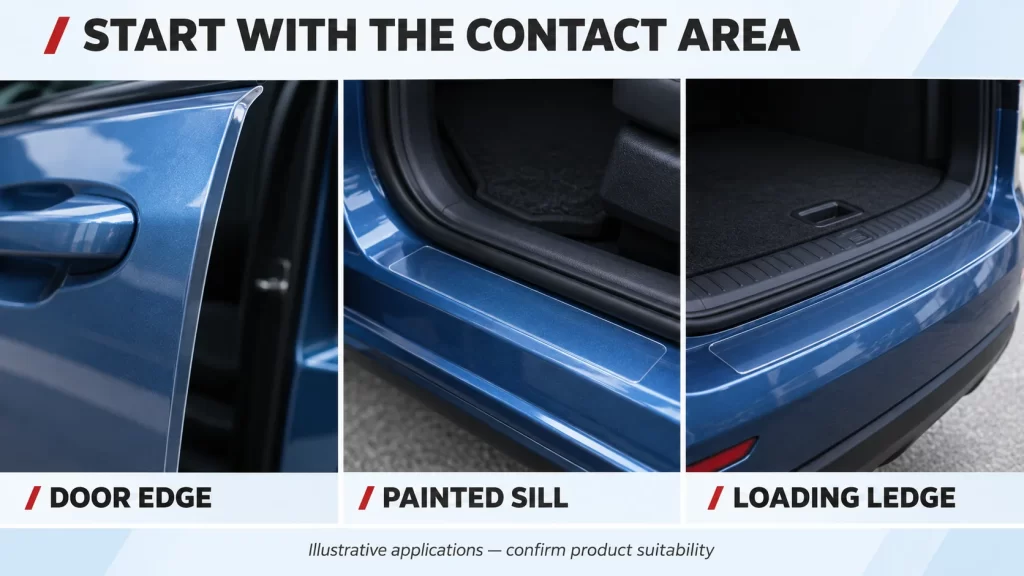
Painted door edges are a common starting point. The strip can be considered where the edge makes light contact during ordinary use, provided the product supports the shape and paint. It should not be sold as a way to prevent every door dent or as permission to open a door forcefully against another vehicle.
Door sills and painted entry areas are another useful discussion. Shoes, bags and everyday loading can contact a small, repeatable zone. Look at the actual marks on a used vehicle or observe the movement on a clean demonstration vehicle. A strip that follows the contact area may be more useful than a decorative rectangle placed where it merely looks tidy.
A painted rear loading ledge may also benefit from an appropriately specified film shape. Here, check the path of luggage and the width of the surface. A very narrow strip might miss much of the contact, while a shaped piece could fit better. Film does not make the ledge load-bearing or compensate for dragging heavy objects across it.
Door-handle recesses, complex bumper corners and wider rocker areas illustrate the limits of a tape format. They may call for a precut shape or a larger film section instead. The goal is a suitable protected area, not using narrow tape for every possible application simply because it is convenient to stock.
Map the contact area before choosing a width
Measure the surface that needs protection and examine the surrounding features. On a door edge, consider the intended return around the edge and the clearances when the door closes. On a sill, check whether the film ends where a shoe will repeatedly catch it. A straight ruler gives a starting dimension, but the finished piece must suit the contour.
Make a simple coverage sketch with the installer. Mark the start and end points, adjacent trim and any opening that must remain unobstructed. Do not bridge moving panel gaps or treat protective film as a replacement for seals. The planned shape should allow the vehicle’s doors and fittings to operate normally.
For repeat work, record the approved pattern or dimensions by vehicle and application. Small differences between trim versions can affect the useful coverage. A strip that fits one model should not automatically become a universal kit. This is especially relevant when a business supplies customers who expect a ready-to-fit product.
Allow for practical fitting and cutting waste when ordering. As an illustration, ten straight pieces at 0.8 metres each consume eight metres before any allowance for trimming, trial fitting or rejected pieces. That is a planning calculation, not a suggested strip length for a particular car. The actual job determines the dimensions.
Material and thickness: read beyond the headline
TPU means thermoplastic polyurethane, a material commonly used in automotive protection-film products. Nevertheless, the complete construction includes the adhesive and may include a surface coating or other layers. Ask for the exact film specification rather than treating “TPU tape” as a full description of its behaviour.
Request the installed thickness and the components included in that figure. Release liners and temporary protective sheets are normally removed; they should not be confused with the material left on the vehicle. One mil equals one thousandth of an inch, or 25.4 micrometres. Consistent units make quotations easier to compare.
Thickness alone does not settle the choice. A film also needs to follow the intended shape, maintain an acceptable appearance and bond appropriately to the surface. A stiff strip that resists a tight return may be less suitable than its headline thickness suggests. Ask for evidence relevant to the application instead of assuming the largest number wins.
Finish matters too. A clear glossy strip can look different on a matte painted surface, and an opaque strip intentionally changes appearance. Examine a representative sample with the owner before a visible installation. “Clear” should mean the underlying color remains visible, not that every film edge and reflection will disappear under every light.
Adhesion is more useful when the test conditions are known
An adhesion number without context is difficult to use. Ask which substrate was tested, how it was prepared, how long the tape remained in contact and which test method was followed. A result on a laboratory metal panel is not automatically a result on your repaired door edge or textured interior trim.
ASTM D3330/D3330M addresses peel adhesion of pressure-sensitive tape. ASTM D3654/D3654M addresses shear adhesion. They examine different aspects of the adhesive bond; neither number, by itself, is a complete suitability decision for a vehicle application. Mentioning a test method also does not establish that a particular Decowell product has been tested to it.
For purchasing, request traceable product data and define the acceptance criteria with the supplier. Keep the proposed service and future removal in the same discussion. More aggressive adhesion is not automatically better when the underlying finish needs to remain serviceable. The aim is an appropriate bond for the actual use, with a supported installation and removal process.
Check the surface before committing to the strip
Inspect the paint for chips, corrosion, loose clearcoat and previous repairs. A protective strip cannot stabilise weak paint or cure an underlying bodywork problem. If the edge is already chipped, establish what repair is appropriate before considering film. Covering the area immediately may conceal the condition without addressing it.
Ask about coatings, waxes, sealants and previous adhesive products. They may change the surface presented to the new adhesive. Preparation should follow the selected product’s instructions and remain compatible with the vehicle finish. Avoid choosing an aggressive cleaner simply because a different tape would not stick.
Repainted parts need particular attention to the paint system and its cure requirements. There is no single waiting period that makes every repair suitable for every film. Likewise, textured plastic, rubber and coated interior surfaces require their own compatibility confirmation. Approval for smooth painted metal does not automatically extend to them.
Where a trial is appropriate, agree on a representative, non-critical test area or a suitable separate sample, including how it will be removed and assessed. A small trial can inform a decision, but it does not guarantee years of performance across every surface on the vehicle.
Installing PPF tape: a practical sequence
Plan and prepare
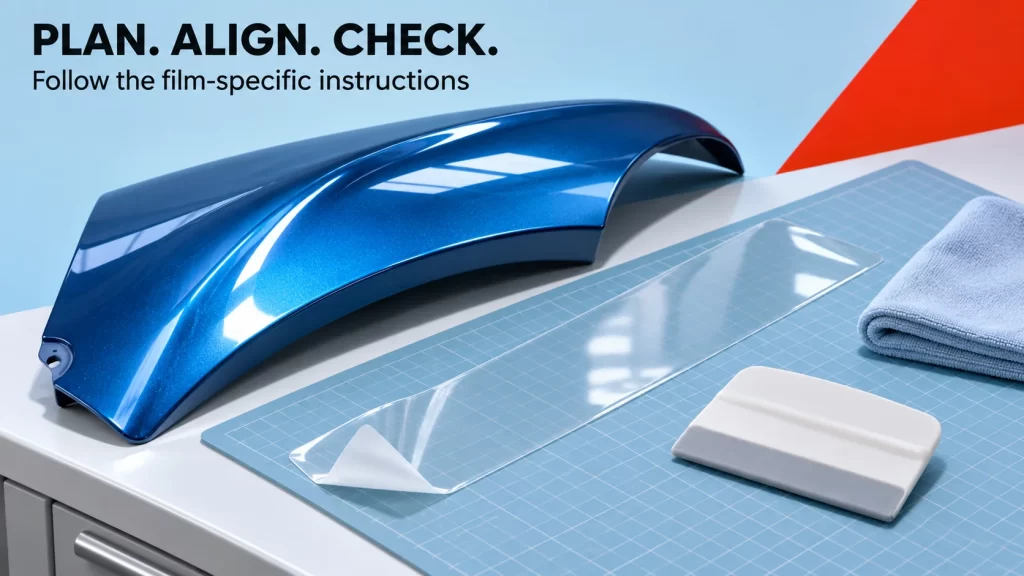
Read the instructions for the exact product before cutting. Confirm whether application is wet or dry, the required preparation and any temperature or handling limits. The tape-like format does not establish the method. An edge-protection strip and a wider PPF sheet may use different procedures even when both are intended for automotive surfaces.
Clean and inspect the area as specified, and arrange the piece before exposing the adhesive. Keep the liner and film away from dust and loose fibres. Cut loose material on a suitable work surface away from the painted vehicle, or use an approved precut shape. Do not use the paint as a cutting board.
Align without forcing the material
For a supported dry-applied strip, a controlled reveal of the liner can make positioning easier. Follow its instructions for pressure and any permitted repositioning. For wet-applied material, use the specified fluid and method instead. Do not add water or a homemade mixture to a product simply because another installation video uses it.
Work with the contour and the intended termination. Avoid stretching the film merely to reach the end of an underestimated measurement. If the strip repeatedly lifts, wrinkles or resists the return, reassess the product, shape or technique. Repeatedly forcing it into place is not a substitute for resolving the reason it will not fit.
Inspect and record
Check the full edge, not only the centre of the strip. Look for trapped debris, creases, areas that have not contacted the surface and interference with adjacent parts. Do not assume every bubble is temporary moisture, especially when the product was not wet applied.
Give the owner the relevant aftercare and first-wash guidance. Record the product, installation date and any planned follow-up. There is no universal setting period for every product sold as PPF tape. The correct instructions are more useful than a familiar number copied from another film.
Why narrow strips sometimes lift at the edges
An exposed edge gives repeated contact, washing or contamination a place to start a problem. Possible contributors include unsuitable preparation, a poorly supported substrate, fitting tension or a termination in a high-contact spot. These are diagnostic possibilities, not a conclusion that every lifted edge proves faulty material.
Photograph the issue before attempting a repair and explain when it appeared. Was the strip lifting immediately, after the first wash or after regular contact from luggage? That history helps the installer distinguish a placement problem from a handling or service issue. Retain the product and batch information where available.
Do not make extra glue, a second tape layer or uncontrolled heat the default remedy. Those changes can alter the system and complicate removal. Ask whether the piece needs to be replaced with a better shape or a different approved product. In some locations, a purpose-made guard or a larger film section may be the more suitable solution.
Tape, precut pieces or a wider PPF roll?
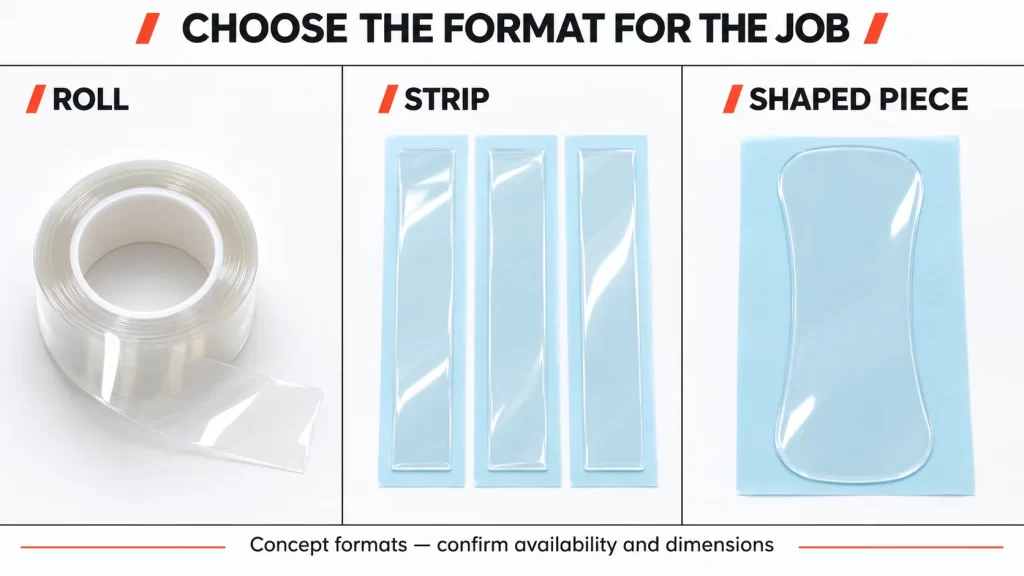
Narrow rolls are useful when a repeatable strip suits the job and the cutting process is manageable. Precut pieces can be attractive when customers need a defined shape or when the installer wants consistency across repeat applications. Wider film offers more freedom to produce different coverage shapes, but it introduces its own planning and conversion work.
Consider the customer’s installation skill. A consumer kit may need clear part identification, orientation and application instructions, while a professional workshop may prefer flexible material formats. A short roll without supporting guidance is not automatically an easier product for the end user.
For wholesale sourcing, ask whether narrow widths, slitting or precut formats are actually available for the selected film. Confirm width tolerances, usable length, liner construction, packaging and traceability. A company that supplies full-width PPF does not necessarily offer every converted format. These capabilities should be confirmed before they are advertised to your customers.
Compare PPF tape cost on a consistent basis
Roll price is only meaningful with width, length, construction and intended use beside it. Price per linear metre helps compare equal-width products. When widths differ, area can provide another reference, although it still does not account for fitting efficiency or suitability. Keep the same unit basis throughout your quotation comparison.
For example, a 50-millimetre-wide roll with ten metres of usable length contains 0.5 square metres of material. That calculation does not say how many door edges or sill sections it will cover. Piece length, shape, waste and preparation determine the actual yield. Treat this as an arithmetic example, not a Decowell product specification.
An installed quote also includes labour, preparation and the agreed support. A low material cost cannot compensate for repeated rework or unclear responsibility when a piece fails. For a shop, compare the cost of a satisfactory finished application and a manageable customer experience, not merely the cheapest roll that arrives at the counter.
Care, replacement and removal
Use the film’s approved washing routine once cleaning is permitted. Remove loose grit before wiping and avoid directing concentrated cleaning force into exposed edges. Inspect areas that receive frequent shoe or luggage contact. A small protective strip can be easy to overlook because it is not visually prominent.
Self-healing, if offered, should be understood as a product-specific response to certain surface marks under defined conditions. It does not repair a torn strip, missing material or chipped paint underneath. Similarly, water beading is not evidence that the film is immune to staining or that its adhesive remains sound.
Arrange assessment when a strip tears, discolors, becomes persistently dirty at lifted edges or no longer provides acceptable coverage. Replacing a worn sacrificial piece can be part of sensible maintenance. Avoid keeping damaged film in service simply because a general warranty period has not expired.
For removal, use the supported procedure and consider the underlying finish. Stop if paint or a coating begins to lift. Adhesive residue, if present, needs a compatible removal method rather than scraping or improvised solvents. A claim of easy removal should be tied to the specified product, surface and service conditions, not treated as a promise for every vehicle.
A simple qualification plan for trade buyers
Define the use before requesting samples: exterior painted door edge, painted entry sill or another specific surface. Choose a representative application and agree what will be evaluated. Useful observations include appearance, fitting behaviour, edge stability, normal cleaning and removal from the intended substrate. This is a purchasing framework, not a substitute for formal performance testing.
Record the sample code, batch, width and instructions used. If the finished product will be slit or die-cut, evaluate that format as well as the original material. Packaging, handling and conversion can introduce practical differences that an untouched full-width sample does not reveal.
Ask how repeat orders will be identified, how specification changes are communicated and how technical concerns are handled. Confirm shelf life and storage conditions, then organise inventory so older material is not forgotten. These details are often more useful to a growing installation business than adding another unverified feature to a label.
FAQ: PPF tape
1. Is PPF tape the same as ordinary clear tape?
No. Clear appearance is not a material or durability specification. Automotive protection film should be selected for the intended surface, exposure and protective role. Packaging tape or a general household adhesive product should not be assumed suitable simply because the paint remains visible through it.
2. Is PPF tape suitable for door edges?
It can be when the specific product supports the paint, edge shape and intended use. Check the coverage and closing clearance, and inspect existing damage first. Film may help with certain minor scuffs or chips; it does not guarantee protection against dents or forceful impacts.
3. Can I put PPF tape on door sills or a rear loading ledge?
Evaluate the actual contact area and substrate. Some locations suit a strip; others need a wider or shaped piece. Cover the relevant area without blocking openings or affecting moving parts. Do not assume approval for painted surfaces also covers textured plastics or rubber trim.
4. Does thicker PPF tape always protect better?
No single thickness defines the best product. Confirm the installed thickness, then consider material construction, fit, appearance, adhesion and relevant performance evidence. Extra thickness does not help if the film cannot follow the required contour or remain properly installed.
5. Should PPF tape be applied wet or dry?
Follow the exact product instructions. Both the material and the application influence the method. Do not infer the process from the word tape, and do not borrow a solution recipe or setting time from an unrelated film. Ask the supplier before installation if the instructions are unclear.
6. Can clear protective tape hide existing scratches?
It is not a paint repair. It may change how a small mark looks, but it does not rebuild missing paint, repair corrosion or stabilise loose clearcoat. Assess damage first and agree on the expected appearance before putting adhesive film over the area.
7. Will the strip be completely invisible?
Do not expect that under every viewing condition. Edges, gloss differences, texture or accumulated dirt may make a transparent strip noticeable. Evaluate a sample on a representative surface and choose a coverage boundary the owner is comfortable seeing.
8. Can I use PPF tape over an existing ceramic coating?
Only proceed when the surface preparation and film system support it. An existing coating changes the bonding surface, so tell the installer what was applied and obtain guidance. Adding more pressure or heat is not a reliable way to solve uncertain compatibility.
9. Is filament cutting tape also a protective tape?
It has a different job: helping trim compatible film during installation. It is not the finished protective strip described in this guide. Confirm both the cutting tool and film requirements, including any additional support or testing specified by their manufacturers.
10. Can I use automotive PPF tape on a bicycle frame?
Treat that as a separate application. Confirm compatibility with the frame’s paint or coating, contact conditions and geometry. Do not assume an automotive specification covers every frame finish, and do not use film to conceal a suspected structural crack or other damage that needs inspection.
11. How long will PPF tape last, and will it remove cleanly?
Both questions depend on the product, substrate and exposure. Request the relevant warranty, inspection guidance and removal procedure. A long material warranty does not establish damage-free removal from every repaired surface or mean a worn strip should remain fitted indefinitely.
12. What should I send a supplier when requesting a quote?
Send the intended surface and use, finish, required width and usable length, estimated quantity and destination. Include any conversion, labelling or packaging needs. Ask for a specific product recommendation, instructions and commercial terms rather than requesting an unspecified roll of strong tape.
Discuss targeted paint protection with Decowell
Decowell’s paint protection film range provides a starting point for businesses planning automotive surface-protection products. If your customers need door-edge strips, sill coverage or other small-area protection, explain the finished application and ask which film is appropriate before deciding on a format.
Use the Decowell website to review its automotive film categories, then send a specific sourcing brief. Narrow-roll availability, slitting, precutting and custom packaging need direct confirmation for the proposed product and order. A general PPF catalogue should not be treated as proof that every tape format is already stocked.
Decowell’s contact page focuses on bulk industrial enquiries. For a repeat installation programme or distributor project, contact Decowell with your PPF tape requirements and include the dimensions, application and quantity. The RFQ above gives both sides a clear basis for discussing suitable film, evaluation and supply.