
Home » Nardo Grey Matte: How to Get the Look Right with Color PPF
Recent Posts
Nardo Grey Matte: How to Get the Look Right with Color PPF
Nardo grey matte has a quiet appeal: a solid grey body, softened reflections and clear body lines without a mirror finish. Getting that result takes more than choosing a name from a color chart. Here is how to select the shade, compare wrap materials and plan a finish you can enjoy beyond collection day.
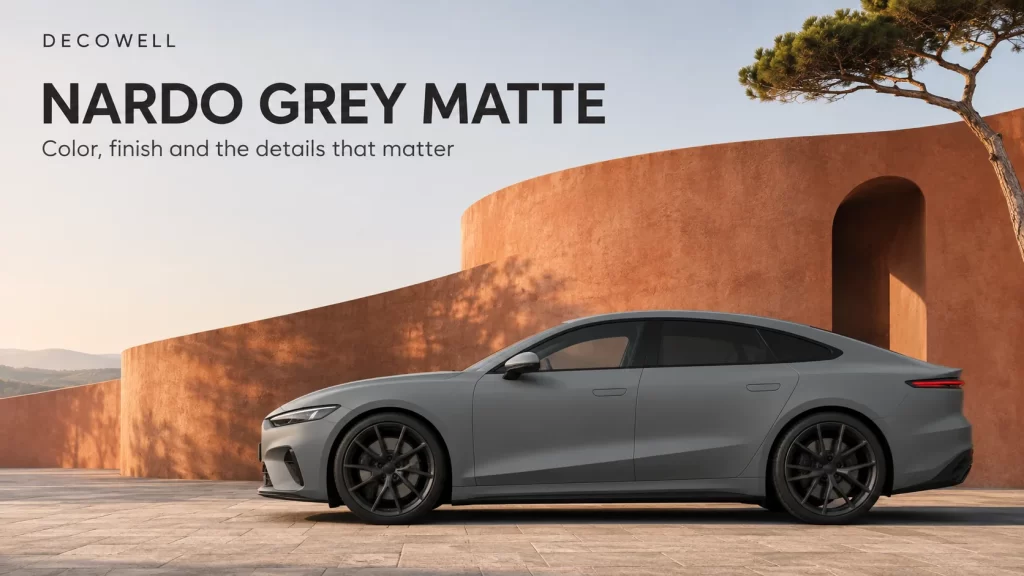
Table of Contents
What does Nardo grey matte actually mean?
In wrap shopping, Nardo grey usually points toward a solid, non-metallic grey look. Matte describes the surface sheen. They answer different questions: what color do you want, and how should light reflect from it? A solid color can be glossy, satin or matte. The absence of metallic sparkle does not make a finish matte by itself.
You may also see Nardo gray matte, matt Nardo grey, cement grey wrap or flat grey car wrap. Some are spelling variations; others describe a broader visual family. None should replace a film code and an approved physical sample. Similar names can lead to noticeably different shades, especially when samples are viewed side by side.
For this guide, Nardo grey matte means the desired appearance, not a claim that every film carrying the name matches a single factory paint or a universal color formula. If exact matching matters, provide a physical reference and ask what the supplier can support. A familiar name is a useful starting point for a conversation, not a finished purchase specification.
Why this grey looks different from silver or charcoal
The attraction is often the balance between color and shape. A medium solid grey can leave room for a strong shoulder line, curved rear quarter or simple wheel design to stand out. The lower sheen softens bright reflections, so the body can look more sculptural. Whether that suits a particular vehicle remains a matter of taste, not a performance advantage.
Silver generally suggests a lighter, often metallic appearance; charcoal suggests a darker grey family. A cement-grey description may suggest a flatter visual character, but it does not define an exact hue. Ask whether the proposed film has metallic or pearlescent effects rather than trying to settle the question from the name alone.
Look at the grey beside the car’s existing details. Gloss black trim, brushed metal, dark wheels and bright window surrounds all change the overall impression. You do not have to replace every contrasting part. Decide which details should remain accents and which you want included in the wrapping scope before the installer prepares a quotation.
Matte, satin and gloss: choose the reflection you prefer
A glossy grey usually shows a clearer image of the surroundings. Satin retains a soft sheen, while matte produces a less distinct reflected image. These are useful shopping descriptions, but the boundaries are not identical across film ranges. A sample advertised as matte may have more visible sheen than you expected from a photograph.
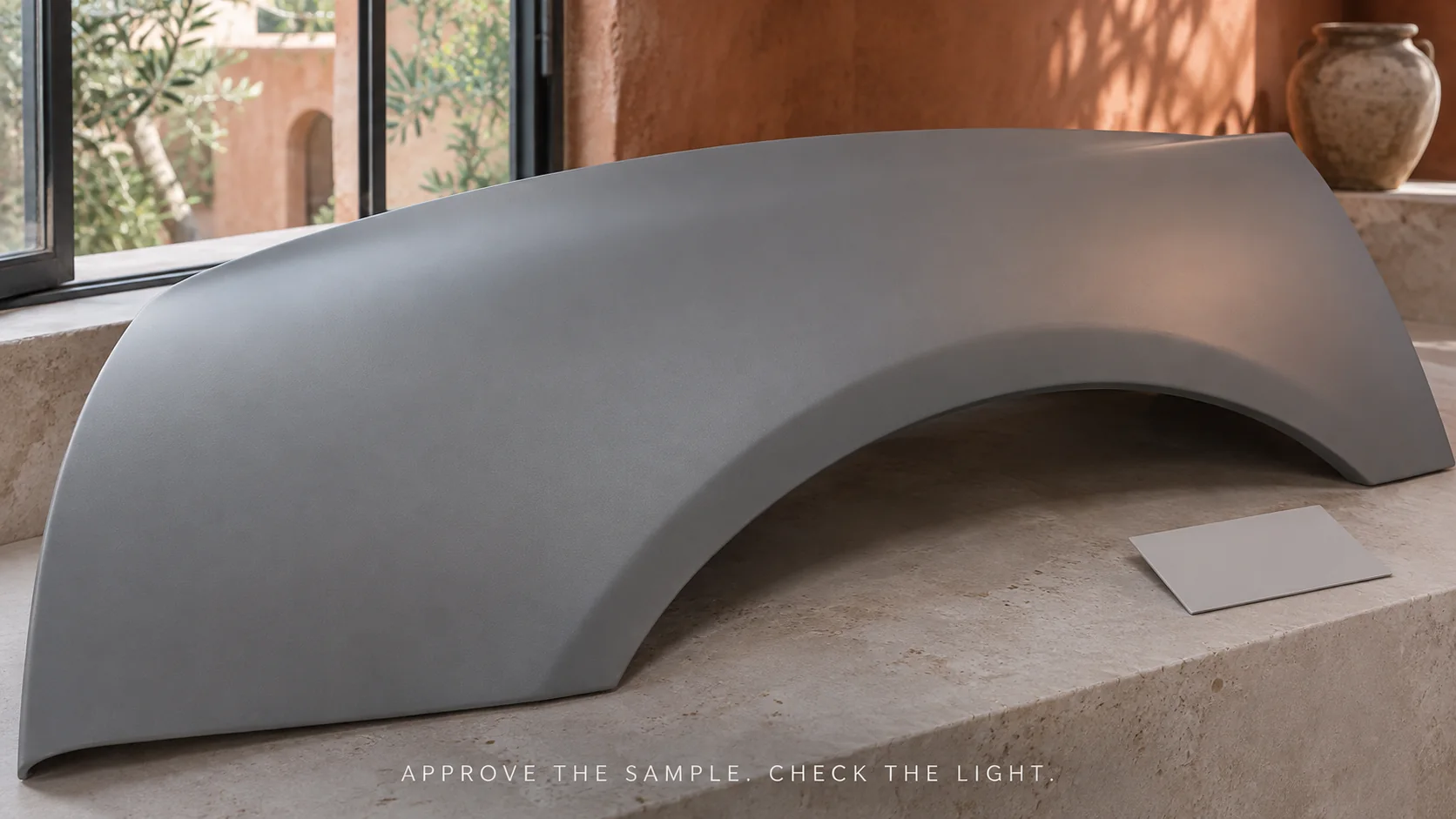
Try a simple comparison: view candidate finishes on similarly curved panels under the same light. Move your head and watch the reflection of a window or bright opening. Consider the whole surface, including texture, rather than judging only the darkest patch. A hood facing the sky can look different from a vertical door even when both use the same film.
For trade purchases, gloss data can help if the method and measurement geometry are stated. ASTM D523 covers specular gloss measurement using defined geometries. Its existence does not assign one compulsory gloss value to every product called matte. Agree what is acceptable and retain a visual reference; a gloss number cannot describe every difference in color and surface character.
Three ways to approach a matte grey conversion
Colored matte PPF
If the vehicle is currently a different color and the goal includes paint protection, opaque colored PPF is a relevant category to evaluate. It combines a new visible color with a protective film construction. Ask what the specific product is made from, which surfaces it supports and what evidence backs its protective claims. A listing title alone does not settle these details.
Clear matte PPF over existing grey paint
If you already like the underlying grey, transparent matte film may offer a route to softer reflections while leaving that color visible. It will not turn a red or white vehicle into a solid grey one. Even on grey paint, the finished appearance can change, so approve a sample on a representative surface before committing to the whole car.
Matte vinyl wrap
A decorative vinyl wrap may be worth considering when appearance is the main objective. Do not assume its construction, thickness or protective performance is identical to colored PPF because the finished photographs look similar. Compare the actual products and their supported uses. The right decision depends on the project, available colors, installation requirements and the protection you expect.
Buying two layers is another decision, not an automatic upgrade. Applying clear matte film over a separate color wrap creates a combination that both material suppliers need to support. It also changes the cost, fitting and removal discussion. If a suitable single colored protective film meets the brief, compare that option before specifying a layered system.
Approve the grey in more than one light
A phone picture is useful for explaining a direction, but it is a poor final color contract. Exposure, white balance, editing and the viewing screen can all change the impression. A cool-looking grey in an online image may feel warmer when a real sample is beside the vehicle. Keep inspiration photographs separate from approved material references.
View the sample in daylight, open shade and the lighting where you usually see the car. Compare candidates together rather than from memory on different days. Changes in illumination can affect whether two materials appear to match; this is one reason color evaluation should not rely on a single room. The practical aim is a grey you like in ordinary use.
Use a sample large enough to see the finish across a curve if the supplier can provide one. A tiny flat swatch can help narrow the shortlist, but it tells less about a broad panel. Confirm whether the supplied sample represents the proposed product and current production, then record its identification with the quote.
For repeat business orders, discuss color tolerance and the measurement procedure. ASTM D2244 addresses calculation of color differences from measured coordinates. It does not provide a universal pass mark for every matte automotive film. Visual acceptance, measurement conditions and the agreed reference should work together. Do not turn an unspecified color-difference number into a promise of an invisible repair.
What to check in a matte grey PPF specification
Begin with the complete construction. TPU means thermoplastic polyurethane, but the base film is only part of a finished adhesive product. Surface coating, color layer where applicable, adhesive and liner all have roles. Ask for the specification of the exact item being quoted, especially when a supplier offers several material families within one catalog.
Check how thickness is reported. The installed film is what remains after removable liners or temporary protective sheets have been taken away. A figure including packaging or release layers is not directly comparable with installed thickness. One mil equals 25.4 micrometres, so convert units consistently before comparing offers. Thickness should support the application, not substitute for evidence of overall performance.
For an opaque conversion, discuss coverage over the existing paint. Ask how the approved appearance is maintained on representative contours and whether handling direction matters. A suitable trial can reveal practical appearance issues before a full installation. It should follow the product’s permitted fitting method rather than deliberately stretching a sample beyond its limits to see what happens.
Self-healing, hydrophobicity, stain resistance and weathering are separate claims. Request the relevant conditions and supporting information instead of treating them as a single quality score. A surface that sheds water can still need prompt cleaning. A film that responds to some fine marks cannot rebuild missing material or repair a dent underneath. No performance percentage follows simply from the phrase matte grey PPF.
Plan the color change around edges and openings
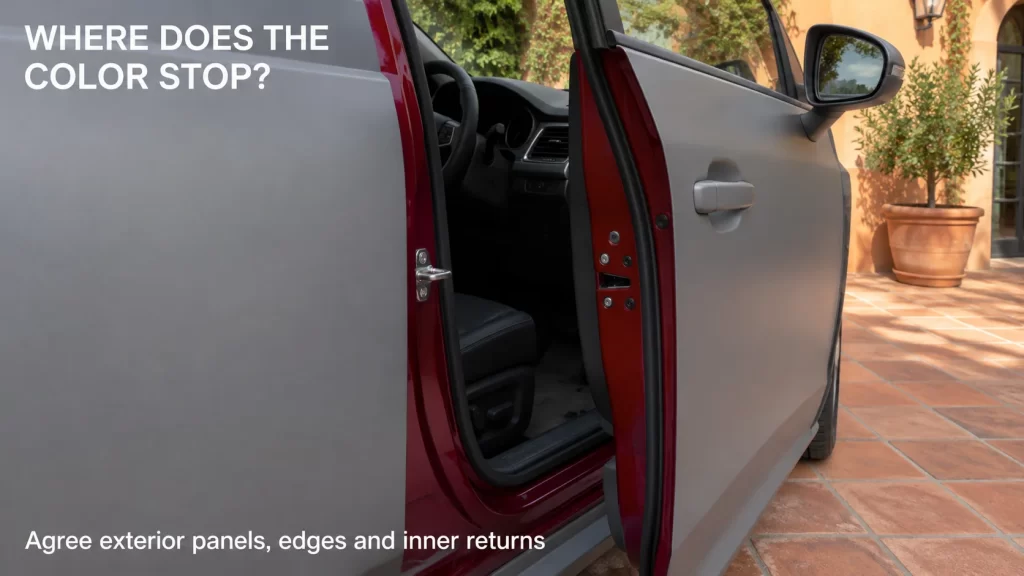
The original color matters most where the new finish stops. A dark original body may be less noticeable at some boundaries than a bright contrasting one, but that does not make coverage planning unnecessary. Ask to see where the film will end around the bonnet, doors, handles and rear hatch. Agree on what is included before comparing prices.
Door jambs deserve their own conversation. A quote for exterior panels does not automatically include every painted inner return. Open the doors and decide whether the contrast is acceptable. Extending coverage can add material, labor and access requirements. The installer should explain a realistic scope rather than promising that no trace of the original color will ever be visible.
Discuss seams on difficult shapes and the treatment of badges or removable trim. Some pieces may need an agreed joint or a different fitting approach. Also identify components that should remain uncovered, such as lights, cameras, sensors and functional openings unless a specific approved procedure says otherwise. Color styling should preserve the operation of the vehicle’s equipment.
Partial coverage can work when it is intentional. A matte grey roof or accent panel is a design choice; an unexpected change in sheen halfway across a visible panel is a different result. For a uniform conversion, write down the panels and finish treatment. The phrase full wrap is too broad to resolve every edge, recess and detachable component by itself.
Installation details that affect the finished appearance
Start with an honest surface inspection. Chips, loose paint, corrosion and poorly bonded repairs do not disappear because the chosen film is opaque. Mark existing damage and discuss any repair before work begins. Freshly refinished panels need compatibility and cure guidance from the relevant paint and film systems, not a universal waiting period borrowed from another job.
Preparation must account for waxes, sealants and existing coatings. These can change the bonding surface. A professional installer should use the specified preparation and application method for the selected material. Do not assume every colored PPF uses the same fluid, temperature limits or technique as a clear film or decorative vinyl product.
On a low-sheen finish, uneven handling or excessive stretch may create visible appearance differences. The installer needs to manage contours within the material’s limits and keep orientation consistent where required. A larger piece is not always better if forcing it around a complex shape harms the finish. Discuss a sensible seam before insisting on an unrealistic one-piece solution.
At handover, inspect the car in more than one lighting condition. Walk around it, open the doors and check the agreed boundaries. Ask which temporary installation effects are expected and when they should be reviewed, rather than assuming every mark will disappear. Keep the product code, batch details where available, invoice, care instructions and follow-up arrangement together.
Nardo grey matte wrap cost: compare the complete job
A meaningful quote needs the vehicle, chosen film, coverage and surface condition. Material price is only one part. Preparation, difficult contours, trim access, inner returns, finishing work and support also affect the total. Two quotes can differ substantially because they describe different work, even when both use the words matte grey wrap.
Ask each installer to identify the product and list the same included areas. Clarify whether existing film removal or paint repairs are separate. Check who handles an edge that needs attention and whether inspection after installation is included. Written scope makes a price comparison more useful than a headline figure with no explanation of the finished result.
For wholesale purchases, compare usable width and length, construction, packaging, freight and commercial terms on the same basis. Allow for cutting layout and trial work instead of dividing a roll’s area by an assumed vehicle area. Local quotations are the right source for current installed pricing; a universal online figure would hide too many differences between projects and markets.
Everyday care without chasing extra shine
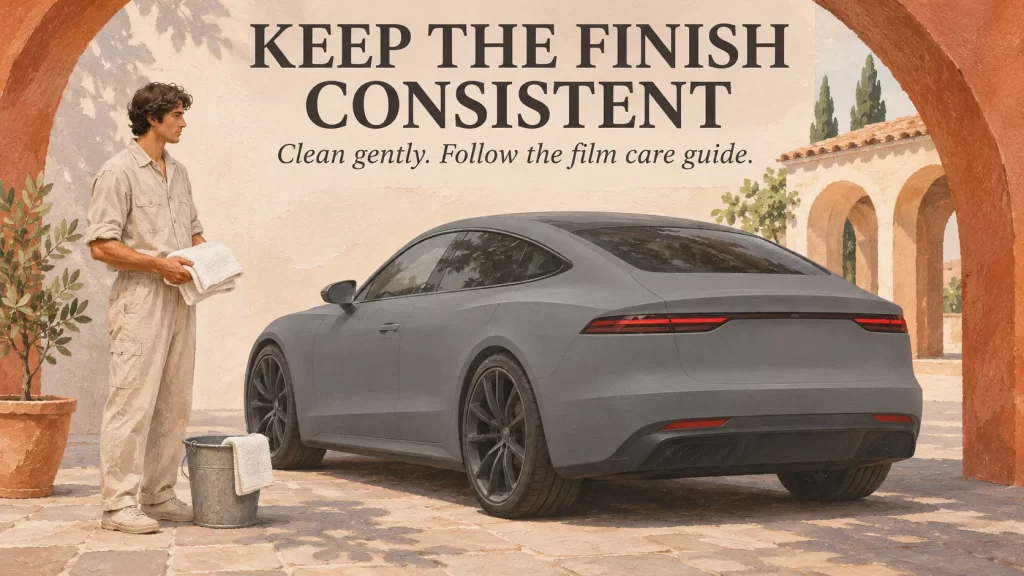
The point of a matte finish is its chosen surface appearance. Treating every visible mark as something to polish away can change that appearance. Follow the film’s care instructions, use compatible washing products and rinse loose grit before contact cleaning. Avoid dry rubbing dust across the surface just because the grey makes it less obvious at a distance.
Wash in suitable conditions and dry with clean, appropriate materials. Address bird droppings, insects and other contamination promptly using the approved method. If a deposit persists, ask for product-specific advice before escalating to stronger chemicals or harder scrubbing. A method suitable for one film may be unsuitable for another coating or for nearby exposed paint.
Do not use abrasive compounds or machine polishing on a matte film unless its manufacturer expressly supports a defined procedure. A locally shinier patch can be harder to accept than the original mark. Waxes, detail sprays and ceramic coatings also need compatibility confirmation because they may change sheen or appearance. Test an approved combination on a representative sample first.
Inspect exposed edges during routine cleaning and follow the product’s pressure-washing restrictions. Get advice if an edge lifts or dirt begins collecting underneath it. The maintenance goal is a consistent, clean surface, not a constantly wet-looking finish. Water beading can be attractive, but it is not a substitute for checking film condition and cleaning carefully.
Service life, panel replacement and future removal
No single lifespan applies to every matte grey film. Exposure, climate, parking, maintenance, installation and product construction all matter. Ask for the written warranty for the quoted item, including covered defects, exclusions and claim procedure. A warranty term is not a guarantee that every panel will look unchanged for that entire period under every use condition.
If a panel is damaged, replacement matching needs assessment. Fresh material and weathered adjacent panels may not look identical. Retaining the original product code and batch information helps the discussion, but stored spare material still has its own storage requirements and shelf life. Avoid promising customers a perfect match years later merely because the color name stays the same.
Plan removal as part of ownership. The condition of the paint and any repairs influences what is sensible, especially after prolonged use. Use the supported removal process and qualified help where appropriate. Film is a removable surface treatment, not a guarantee that every underlying finish will tolerate removal without damage. Keep the car’s paint history with the installation record.
A better buying brief for installers and distributors
Translate the visual request into a short specification: solid grey appearance, intended matte or satin level, vehicle types, expected coverage and target market. Include the approved sample reference. This prevents a purchasing conversation from getting stuck on several different meanings of Nardo grey. A color name should lead to a product selection, not replace one.
For a new range, arrange a representative evaluation before a large commitment. Review appearance, fitting, routine care and the technical documents with the supplier. Agree how batches are identified and how changes are communicated. Custom color, packaging, minimum order quantity and evaluation samples are commercial questions to confirm, not features to assume from a general product category.
FAQ: Nardo grey matte wraps and PPF
1. Is Nardo grey automatically matte?
No. The grey describes a color direction; matte describes surface sheen. A solid non-metallic appearance can still be glossy. Specify both the color and finish, then approve a physical sample of the actual film instead of relying on the name or a single photograph.
2. Are Nardo grey and Nardo gray different colors?
Grey and gray are spelling variants, not proof of different products. However, two suppliers using those names may offer different shades. Product identification, physical samples and agreed acceptance criteria matter more than the spelling in a search result or catalog title.
3. Can clear matte PPF make a white car Nardo grey?
No. Transparent matte film changes reflection while allowing the underlying color to show. A white vehicle needs a suitable opaque color-change material to achieve a solid grey appearance. Confirm both opacity and the finished look on a representative surface before ordering.
4. Should I choose matte or satin grey?
Choose by comparing real samples under the same light. Satin usually retains more soft sheen, while matte looks flatter, but naming varies. Think about the complete car, its trim and how you like the reflections across a curved panel. Neither label alone guarantees an exact appearance.
5. Is matte grey colored PPF the same as vinyl wrap?
They can create similar visual results, but their construction and supported protection may differ. Ask for the specific material, installed thickness, application guidance and warranty. Compare the products against your priorities instead of treating every adhesive color-change film as technically equivalent.
6. Does matte grey hide scratches and dirt?
It can make some marks less noticeable under some conditions, but it is not a cleaning or repair solution. Oil, stains, abrasion and uneven sheen may remain visible. Existing paint damage still needs assessment, and the film requires suitable washing and inspection throughout use.
7. Can I polish a matte PPF scratch out?
Do not apply ordinary paint-polishing techniques without explicit product guidance. Abrasion can change the intended finish. If self-healing is specified, follow that product’s conditions and limitations. A cut, tear or missing section of film may require replacement rather than a surface treatment.
8. Can I apply ceramic coating over matte grey PPF?
Only use a combination confirmed compatible with the selected film and desired finish. A coating may alter the appearance even when it is intended for low-sheen surfaces. Evaluate an approved sample and follow the application requirements. Coating does not replace the film’s physical protective layer.
9. Will the original paint show when I open the doors?
It may if the installation covers exterior panels only. Door jambs and inner returns need a separate scope discussion. Ask the installer to identify termination points on the actual vehicle, then decide whether the contrast is acceptable or additional coverage is worthwhile.
10. How much film does a full conversion require?
There is no universal roll quantity. Vehicle dimensions, contours, film width, orientation, included areas and waste allowance affect consumption. Have the installer plan the layout before ordering. A nominal roll area cannot guarantee a complete vehicle installation with the agreed coverage.
11. Will every roll called Nardo grey match?
Do not assume so. Naming is not a shared film formulation, and production or ageing can also affect appearance. Approve an identified reference and discuss batch consistency. If repairing an existing wrap, compare the candidate material beside the installed surface before promising an exact match.
12. Can Decowell supply the shade I want?
Decowell lists matte colored PPF as a product category. The exact Nardo-style shade, construction, availability and order terms need direct confirmation. Send a physical reference or a clear color brief and request the closest suitable options. A category listing is not proof of a specific stocked color.
Find the right matte grey direction with Decowell
A successful Nardo grey matte project begins with an approved shade and a practical film choice. Explore Decowell matte colored PPF as a starting point for low-sheen color options, and use the Decowell colored PPF range to discuss other finishes when the brief is still taking shape.
For installers and distributors, the useful next step is a specific enquiry: describe the grey, the finish, the application and the expected order. Exact shade matching, sample arrangements and supply terms should be confirmed for the selected product. This keeps the conversation focused on a film you can evaluate and confidently present to your customers.
Decowell’s contact page focuses on bulk industrial orders. If you are planning a commercial matte grey offering, send Decowell your colored PPF requirements using the RFQ above. A clear brief gives both sides a better basis for discussing suitable material, sample approval and the next order.