Home » PPF Is No Longer a “Luxury Extra”: What the 2026 Automotive Film Market Is Actually Telling Installers and Car Owners
Recent Posts
PPF Is No Longer a “Luxury Extra”: What the 2026 Automotive Film Market Is Actually Telling Installers and Car Owners
Something shifted in the paint protection film conversation over the past eighteen months. It is no longer just the Porsche owner asking about a clear bra, or the dealership adding a line item to the back-end menu. Independent shops are stocking color PPF next to clear film. Everyday drivers are asking about matte black for their trucks. And insurance brokers are suddenly fielding questions about whether a film counts as a “modification.”
That shift is not marketing noise. It shows up in market data, in product launches, and in the practical decisions installers and vehicle owners are making right now. This piece walks through what is changing in the PPF category, why it matters beyond the showroom, and where the real opportunity sits for shops and distributors looking at the next twelve to twenty-four months.
Table of Contents
The Market Grew Up, and the Customer Base Changed With It
The global paint protection film market was estimated at roughly USD 946.1 million in 2025, with projections putting it near USD 1.04 billion in 2026 and a long-run CAGR in the 10.1% range through 2035. Different research houses slice the numbers differently—one report places the 2025 figure closer to USD 575 million with a 5.8% CAGR—but the direction is consistent: steady, double-digit or high-single-digit expansion, not a pandemic-era spike that collapses afterward.
The more interesting number is regional. Asia Pacific accounted for 38.5% of the global PPF market in 2025, which means the supply side of this industry is increasingly Asian, even as demand remains strong in North America, Europe, and the Middle East. For buyers and installers outside Asia, that translates into more manufacturer-direct sourcing options and more price competition at the mid-tier of the market.
But the customer story matters more than the market-size story. Avery Dennison’s senior product manager for automotive put it bluntly in a 2026 trade interview: PPF has gone mainstream, and the most compelling reason for optimism is that it is no longer just a high-end luxury purchase—everyday drivers are buying it. Two forces are doing the heavy lifting: social media has demystified what PPF actually does, and vehicle transaction prices have climbed high enough that protecting the finish feels less like a vanity upgrade and more like asset management.
That reframing is important. When a car owner starts thinking about PPF as “an insurance policy for the paint” rather than “a fancy accessory,” the conversation changes. It becomes about repair avoidance, resale positioning, and long-term ownership cost—not about whether the film looks cool on day one.
Repair Costs Made the Economic Case for PPF Harder to Ignore
Here is the number that installers should keep in their back pocket. CCC Intelligent Solutions reported that average total repair costs for vehicles reached more than USD 4,700 during 2024, and the trend has not reversed. Multi-layer coatings, metallic and pearl finishes, and the labor required to blend modern paint systems mean that a relatively minor front-end incident can turn into a four-figure repair bill without touching anything mechanical.
PPF does not prevent collisions. What it does is absorb the everyday damage that otherwise forces paintwork: stone chips on the bumper and hood, road debris on the lower panels, light abrasions from parking, and the slow accumulation of surface defects that make a three-year-old car look older than it is. The film becomes a sacrificial layer, and the economic logic is straightforward—if the cost of repainting a bumper and blending a fender is climbing faster than the cost of a quality PPF installation, the math starts to favor protection for a much wider range of vehicles than it did five years ago.
Resale data reinforces the same point from a different angle. A national survey of U.S. dealership decision-makers found that 92% believe vehicles with PPF applied to all exterior surfaces when new would have a higher resale value as pre-owned inventory, and 70% estimated the resale lift at up to 15%. Survey data like this is not a guarantee of what any individual car will fetch at trade-in, but it tells you how the people who actually price used inventory are thinking. They see PPF as a condition-preservation tool, and condition is what drives wholesale value.
Color PPF Changed the Category’s Addressable Market
For years, PPF was clear. That was the whole point—invisible protection. The rise of color PPF broke that assumption, and it is arguably the single biggest product shift in the category since self-healing top coats became standard.
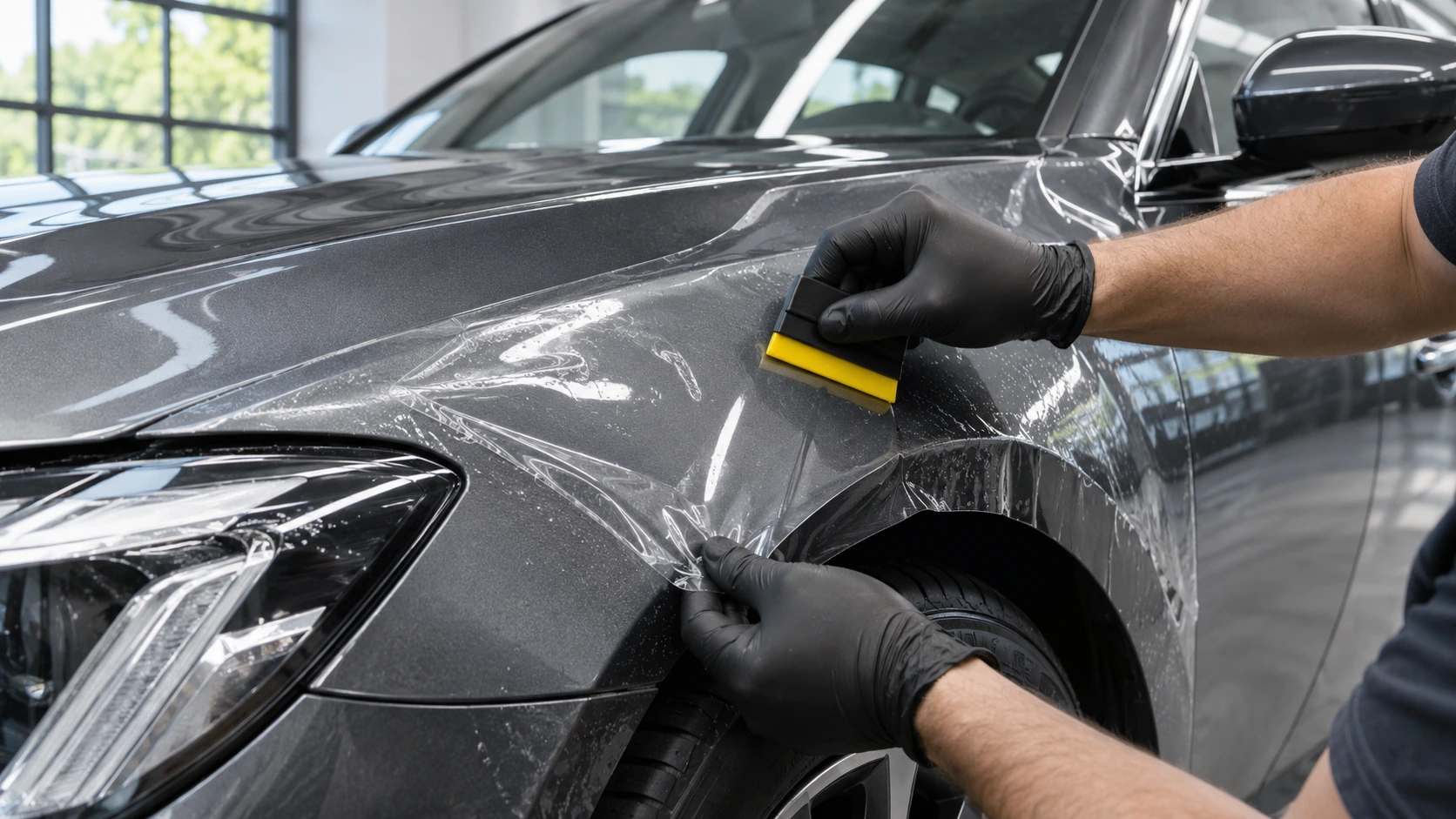
Color PPF lets an owner change the exterior appearance while keeping the protective function of a urethane film. In practical terms, it collapses two aftermarket decisions—color change and paint protection—into one installation. Avery Dennison launched its Neo Matte Black PPF and previewed a dry-apply color PPF line at SEMA 2025 specifically to help shops capture the “high-margin color change market while offering the superior protection of PPF”. XPEL expanded its color PPF portfolio in late 2025 with more than fifteen colors and finishes, combining an approximately 8-mil construction with self-healing surface technology.
Matte finishes, in particular, have found a commercial home in the truck and SUV segment. Installers report that matte black and satin black finishes are the volume leaders in the matte color PPF space, with matte black especially popular on full-size trucks and aggressive SUV builds. One shop’s installation mix put satin black at roughly 60% of color PPF volume, gloss black around 25%, and matte black around 15%, with matte black concentrated in trucks and SUVs. Tesla owners are also cited as a demand driver for matte conversion films, which suggests the appeal is not limited to traditional off-road or muscle-car buyers.
The caveat is maintenance. Matte PPF shows water spots and fingerprints more readily than gloss, and it requires matte-specific care products. But the commercial upside for shops is real: color PPF commands higher tickets than clear film, and it brings in a customer who might otherwise have gone to a vinyl wrap shop. As one industry CEO put it, color PPF with self-healing and hydrophobic performance is “poised to capture a portion of the traditional vinyl wrap market”. That is not a niche within a niche. That is a share shift between two aftermarket categories.
The Insurance Conversation Is Messier Than Most Owners Expect
If there is one operational issue that keeps coming up in 2025 and 2026 owner forums and broker guidance, it is insurance disclosure. The short version: PPF is generally treated as a modification, and failing to declare it can create problems at claim time.
Lockton, a global insurance broker, addressed this directly: PPF is considered a modification unless it was installed by the manufacturer during production, which is extremely rare. If an owner does not declare the film, “some insurers are declining to pay claims”. That does not mean every undeclared PPF claim gets denied. The same guidance notes that under certain scheme policies, a claim will not be declined purely because PPF was not declared—but the insurer may exclude the PPF itself from coverage, meaning the film will not be replaced after an accident or included in a total-loss settlement.
The practical takeaway for anyone selling or installing PPF is simple: tell the customer to notify their insurer. It takes five minutes, it can prevent a frustrating claim dispute, and it positions the installer as someone who understands the ownership experience beyond the shop floor. For distributors and manufacturers, it is also a credibility signal—a brand that talks about insurance disclosure is a brand that understands the product is a long-term investment, not a one-off transaction.
What “Good PPF” Means in 2026 Is Different From 2020
The technology has not stood still. The baseline expectations for a quality film have moved upward in three specific areas.
Self-healing is getting faster and less conditional. Heat-activated self-healing has been standard for years—park the car in the sun, minor scratches flow out. Solar Gard’s Clearshield Pro ACTIV introduced a topcoat that triggers self-healing immediately upon scratching, without requiring external heat or water. That matters in real-world use because not every scratch happens on a sunny day, and not every owner wants to break out a heat gun to chase a light scuff.
Hydrophobic topcoats are now table stakes at the premium end. A hydrophobic surface repels water, mud, and road grime, which makes maintenance easier and reduces the risk of contaminants bonding to the film. Avery Dennison’s color PPF line, Solar Gard’s ACTIV film, and Ceramic Pro’s Shift color PPF all emphasize hydrophobic topcoat technology alongside self-healing. For the end customer, the benefit is not just “easier to wash”—it is slower surface degradation and a longer window before the film itself starts to look tired.
Warranty length has become a competitive signal. Seven-year warranties are common on premium color PPF, and Solar Gard backs its ACTIV film with a 10-year warranty against yellowing, hazing, cracking, peeling, and molding. Warranty terms are not a perfect proxy for film quality—installation and climate matter enormously—but they do tell you what the manufacturer is willing to put its balance sheet behind.
There is also a quieter shift happening on the materials side. Covestro introduced a TPU with approximately 34% plant-based content by mass for protective film applications in 2025, and manufacturers are exploring bio-based feedstocks to reduce reliance on fossil-derived polyurethane components. This is early-stage for PPF specifically, but it signals where the material science is heading: performance parity with a lower material footprint.
The Installer Bottleneck Is Real—and It Shapes Sourcing Decisions
One constraint does not get enough airtime in market forecasts: installation complexity. A quality PPF job requires surface prep, accurate pattern cutting, controlled stretching, edge finishing, and moisture management. Complex bumpers, mirrors, and curved panels add time. A poor installation produces bubbles, lifted edges, visible seams, or contamination under the film—and a bad PPF job is worse than no PPF at all from a customer-satisfaction standpoint.
This is why the supply side of the industry is consolidating around installer networks and training programs. Solar Gard explicitly points to “stronger installer programs” as a growth driver, alongside product improvement and color expansion. Avery Dennison frames PPF as a category that “requires professional installation” and therefore generates consistent business for shops that invest in the skill.
For a shop or distributor choosing a film brand, the practical question is not just “what is the cost per roll.” It is “does this manufacturer support me with patterns, training, installer certification, and replacement stock when something goes wrong.” That is where the difference between a commodity film and a partner-level film becomes visible at the unit economics level.
Where Decowell Fits Into This Picture
This is the part where we stop pretending to be neutral.
Decowell has been manufacturing automotive films for over twenty years, and the PPF line reflects what a vertically integrated, factory-direct operation looks like in 2026. The company runs a 10,000-square-meter facility with imported optical-grade adhesive systems on precision coating lines, holds IATF 16949 certification for automotive quality management, and serves more than forty countries with PPF, window film, and wrap film.
On the product side, the PPF range covers premium TPU in 6.5mil, 7.5mil, 8.5mil, and 9.5mil thicknesses, with hydrophobic or hydrophilic topcoat options and heat-activated self-healing. The line includes transparent PPF, black PPF, matte PPF, and a color PPF range spanning crystal, chameleon, metal, pearlescent, matte, diamond sparkle, and laser finishes. Base materials are sourced from Lubrizol-grade TPU, with Ashland adhesive systems on certain lines and tensile elongation figures in the 200–300% range depending on the product tier.
The color PPF catalogue is where the factory-direct model becomes commercially interesting for installers and distributors. Decowell offers glossy, matte, satin, metallic, chameleon, and custom colors, with OEM/ODM services for private-label packaging and logos. For a shop that wants to test the matte-black truck/SUV opportunity without committing to a premium-brand buy-in, or for a distributor looking to fill a mid-tier color PPF gap, that flexibility matters.
Decowell also publishes its matte white and transparent black matte use cases with a level of specificity that is unusual for a manufacturer page—acknowledging that matte finishes require different care, that white-on-white color matching needs physical samples, and that TPU labels alone do not guarantee identical installation behavior across rolls. That kind of operational honesty is more useful to an installer than another hero shot of a sports car.
If you are sourcing PPF for a shop, a distribution business, or a dealer program, the fastest way to evaluate whether Decowell fits your book is to request current roll pricing, the color PPF catalogue, and sample swatches against your top three SKUs. The company’s stated model is factory-direct with ample stock and OEM/ODM support—which means the conversation can move from “what does a roll cost” to “what does a program look like” fairly quickly.
FAQ
Is PPF worth it on a daily driver, or only on expensive cars?
The economics have shifted. With average repair costs above USD 4,700 and dealership survey data pointing to a resale lift of up to 15%, PPF is no longer only rational for six-figure vehicles. A partial-front kit on a mainstream sedan or crossover often lands in the USD 900–2,500 range depending on coverage and market, while full-body installations can run from roughly USD 5,000 to USD 12,000 on larger or more complex vehicles. The decision is less about the car’s sticker price and more about how long you plan to keep it, how much highway driving you do, and what paint repair costs look like in your area.
Does PPF void my car insurance?
PPF does not automatically void a policy, but it is generally treated as a modification and should be declared. Some insurers will exclude the film itself from coverage if it was not disclosed—meaning they will repair the car but not replace the PPF. A smaller number of insurers have declined to insure vehicles with PPF, so the practical step is to notify your insurer before installation and confirm how they want it documented.
What is the difference between clear PPF and color PPF?
Clear PPF protects the existing paint without changing its appearance. Color PPF carries pigment in the film, so it changes the vehicle’s color while providing the same protective layer. Color PPF is typically thicker and more expensive, and matte color finishes require specific maintenance products. The trade-off is that color PPF replaces a separate vinyl wrap and PPF installation with one product.
Is matte black PPF harder to maintain than gloss?
Yes, but not unmanageably so. Matte finishes show water spots, fingerprints, and smudges more readily than gloss, and they cannot be polished or waxed with standard products. Matte-specific cleaners and sealants are required. In exchange, matte black delivers a finish that gloss film cannot replicate, which is why it has become the default choice for a significant share of truck and SUV color PPF work.
How long does PPF actually last?
Warranty terms range from five to ten years depending on the film tier and manufacturer. Premium films with hydrophobic topcoats and UV-stable TPU generally carry seven- to ten-year warranties against yellowing, cracking, and peeling. Real-world lifespan depends heavily on climate, parking exposure, and maintenance—a car that lives outdoors in a high-UV environment will age film faster than a garaged car in a temperate climate.
Can I install PPF myself to save money?
It is possible to buy film and attempt a DIY install, but the failure rate is high on complex panels. Bumpers, mirrors, and curved fenders require stretching and edge work that take practice. A poor installation can trap moisture, lift at the edges, or leave visible seams—and removing a badly installed film can cost more than the original install. For full-front or full-body coverage, professional installation is the realistic route.
What should I ask a supplier before committing to a PPF brand?
Ask for current roll pricing across the SKUs you actually sell, the full color catalogue with physical swatches, adhesive and base-material specifications (TPU source, elongation, topcoat type), warranty terms in writing, and replacement policy for defective rolls. If the supplier offers OEM/ODM, ask for minimum order quantities and lead times on private-label runs. A supplier that cannot answer those questions clearly is not set up for a program-level relationship.