
Home » Paint Protection Film for Headlights and How to Choose It
Recent Posts
Paint Protection Film for Headlights and How to Choose It
A bonnet and a headlight can meet the same piece of motorway grit, but protecting them calls for different checks. A bonnet needs a sound finish. A headlight also needs to send the right light onto the road. Any film placed over its outer lens becomes part of that optical path.
Paint protection film for headlights is intended to add a replaceable barrier against light abrasion and some road-debris damage. It can be useful on a suitable lamp, provided the film is approved for that surface, the lens is in good condition and the finished installation meets the requirements where the vehicle is used. It is not a repair for a cracked lens or a way to make a failing headlight perform like new.
For an owner, the decision starts with the actual lamp. For an installer or distributor, it starts with a documented product specification. This guide explains the practical differences between headlight film, ordinary body PPF and cosmetic tint, then sets out the questions to ask before fitting or ordering film.
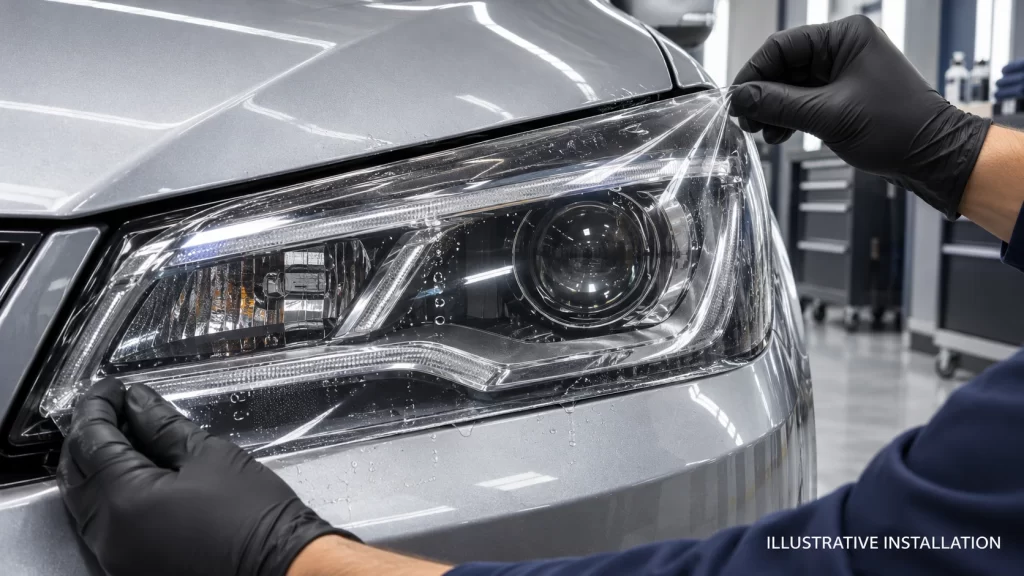
Table of Contents
What headlight protection film is meant to do
Picture a daily commute on a road used by construction traffic. Fine grit reaches the front of the car, insects collect around the lamps, and cleaning adds repeated contact with the outer lens. A suitable protection film puts another surface in front of the original one. Light wear may affect that film first, allowing it to be inspected and replaced when necessary.
The screen-protector comparison is useful, as long as it is not taken too far. A car lamp has a curved surface, an existing coating and a controlled light distribution. A film that looks neat in daylight still needs to be suitable when the lamp is operating. Protection, optical quality and compatibility have to be considered together.
The film does not make the assembly impact-proof. A sharp stone can penetrate it, and a larger impact can damage a housing or mounting point beyond the area it covers. The realistic objective is to reduce some surface wear, not to guarantee that the complete headlight will never need repair or replacement. Headlight-film manufacturers describe this protective role in their product data, which should be checked for the exact film under consideration
Start with the lens and its existing coating
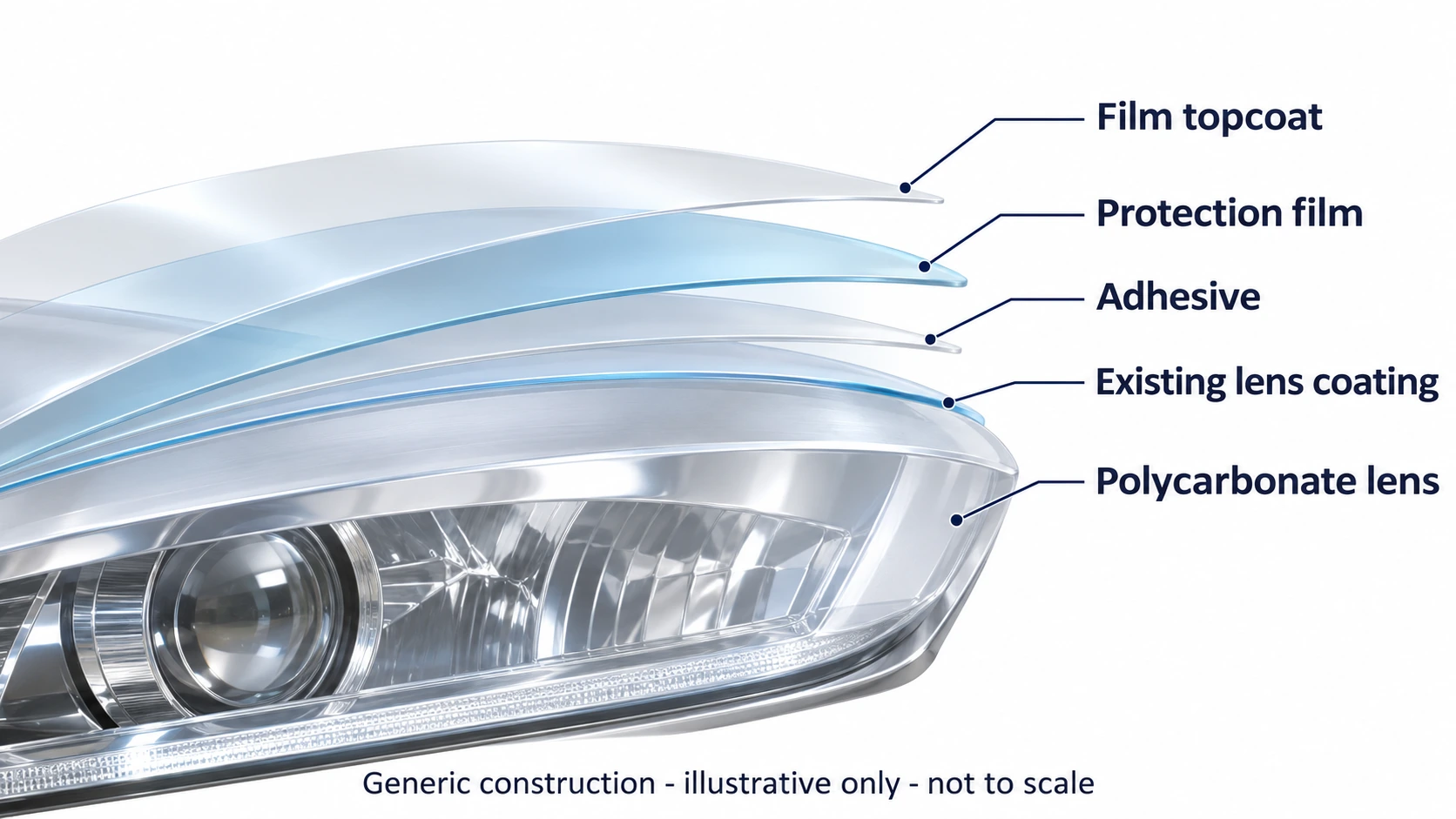
Many modern outer headlight lenses are made from polycarbonate, a lightweight plastic that allows complex shapes. The visible surface may also carry a factory-applied protective coating. That matters because the adhesive normally meets this existing surface rather than an imaginary bare sheet of plastic. HELLA’s technical guidance describes both polycarbonate cover lenses and their special surface coating.
An installer should check for peeling, crazing, deep scratches, previous polishing and restoration coatings before recommending film. Two lamps of the same model can have very different histories. One may be original and sound; the other may have been sanded, recoated or replaced with an aftermarket unit. A vehicle model alone does not resolve those differences.
Do not treat visible yellowing as a single diagnosis. The problem might be at the external surface, within degraded material or elsewhere in the assembly. Likewise, moisture inside a housing is not the same as temporary application moisture beneath a new film. Covering the outside cannot repair a faulty seal, clear internal contamination or replace damaged optics.
Ask for the vehicle or lamp manufacturer’s position on applied films, especially where a warranty is involved. Product approval for a painted panel does not automatically establish approval for a coated lens. If either the lamp guidance or film instructions excludes the proposed application, choose another approach. An adhesive trial alone cannot demonstrate long-term optical performance or warranty acceptance.
Choose a product specified for headlights
TPU means thermoplastic polyurethane. It is used in many protection films because it can be formulated into a flexible layer, but the letters do not define the complete product. The topcoat, adhesive, colour, thickness and intended substrate also matter. There are purpose-made headlamp films with other constructions, so material names alone do not provide a reliable ranking of suitability
A roll left over from a bonnet installation may look like a convenient choice. Before using it on a lamp, check the manufacturer’s application instructions and warranty. Some paint-protection warranties expressly exclude headlights. A familiar brand name or a successful body-panel installation therefore does not answer the headlight question.
Product category Primary purpose Check before installation
Headlight protection film Add a protective layer to suitable lamp lenses Exact substrate approval, optical data, application guidance and warranty
Body paint protection film Protect painted exterior panels Whether the specific manufacturer also approves headlight use
Cosmetic headlight tint Change appearance or transmitted colour Optical effect, intended use and applicable lighting requirements
Lens restoration treatment Address an assessed existing surface defect Repair suitability, replacement protective coating and compatibility with later film
Buy the complete specification rather than a single impressive number. Thickness should state which layers are included and whether a removable liner has been excluded. A self-healing claim needs a test method and defined conditions. Optical data should identify the product tested. Comparing an unsupported claim with another supplier’s measured value tells you very little about how the two films will behave.
Treat clarity and light transmission as separate checks
A sample can look transparent while still absorbing or scattering some light. Visible light transmission, usually abbreviated to VLT, describes how much visible light passes through under the stated measurement conditions. Haze concerns scattering. Surface texture, adhesive marks, contamination and ageing can also influence what a driver sees through the installed lens.
Consider a film advertised at 50% VLT. Under its test conditions, that figure means approximately half the measured visible light passes through the film; it is not a promise that the complete headlight remains compliant. Equally, a high VLT number does not independently prove that beam distribution, colour or every required intensity value remains acceptable. Film measurements and a complete lamp assessment answer different questions.
For a road-going vehicle whose owner wants protection while preserving the original appearance, discuss a clear, headlight-approved option first. Do not assume that a light smoke film has no meaningful optical effect simply because the lamp still looks bright when viewed from the front. Nor should a film be marketed as a cure for glare from an incorrectly aimed or unsuitable light source.
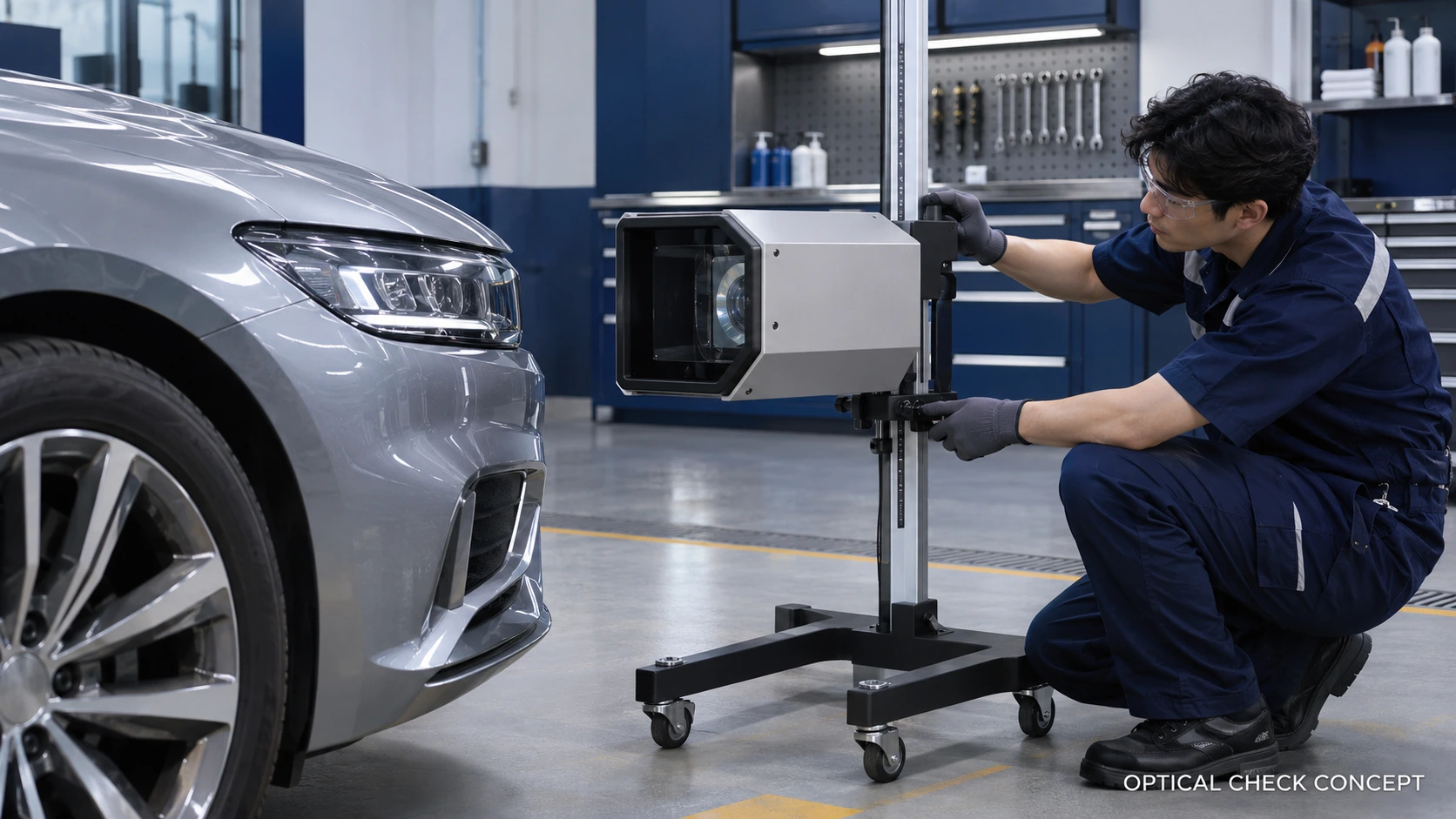
The installation should be checked with the lamps operating, using appropriate equipment and the applicable procedure. A quick photograph against a wall may reveal an obvious problem, but it is not a substitute for a proper assessment. Ask what will be checked and what happens if the installed film produces unacceptable haze, distortion or light output.
Check the rules for the market where the car will be used
There is no useful worldwide answer to whether headlight film is legal. The location, lamp, product and resulting performance matter. Clear material is not automatically exempt from every requirement, and the existence of a product for sale is not proof that every proposed installation is suitable for public roads.
For example, the UK MOT inspection manual lists a product on a headlamp lens that obviously reduces intensity or changes the emitted colour to other than white or yellow as a major defect. That is an example of a specific inspection rule, not an approval statement for every clear film or a rule that can be transferred to another country.
For trade orders, tell the supplier the destination market before choosing an appearance. Request the relevant product documentation and verify the local requirements separately. If a product is described as off-road or show-use only, do not offer it to a customer as a confirmed road-use solution. A sample can help select a finish; it cannot replace regulatory evidence.
Understand the limits of self healing and UV protection
On an appropriately formulated film, self-healing means that certain fine marks in the surface can recover under specified conditions. It does not mean a puncture closes with the original material restored, or that a deep scratch in the headlight lens underneath disappears. A claim about the film topcoat should remain a claim about that topcoat.
The same care is needed with UV language. Resistance to the film’s own yellowing and protection offered to the underlying lens are related but distinct questions. Ask which property was tested, under what exposure conditions, and with what result. A general statement that a material resists UV does not establish a universal percentage of UV rejection or an unlimited service life.
Film also ages in use. Heat, sunlight, washing products, abrasion and the original lens condition all belong in the discussion. Neither a water-beading demonstration nor a freshly installed gloss photograph proves years of optical stability. A supplier’s written data, application instructions and warranty provide a better basis for choosing than an isolated demonstration.
What a careful installation should include
Begin with a documented inspection of both lamps. Recording existing scratches, chips and coating damage helps everyone distinguish an old defect from a later concern. Confirm the lamp identity and agree the coverage before removing a liner. A kit for a similar-looking facelift model may differ around corners, daytime-running-light sections or projecting features.
Cleaning must suit the lens surface and the film system. Do not copy an aggressive paint-decontamination routine onto a plastic lamp. HELLA cautions against dry wiping and unsuitable chemicals on plastic cover lenses. If a coating or residue needs removal, use an approved method rather than experimenting with stronger solvents.
A pre-cut pattern can reduce the need to trim directly on the lens, although fit still needs checking. The installer should follow the specified application method, manage moisture and tension, and avoid unnecessary stretching. Excessive heat is not a remedy for every awkward curve. There is no universal heat-gun temperature that can safely be borrowed from a bonnet installation.
Edges deserve a close look. Film should follow the agreed pattern without bridging an unsuitable gap, trapping dirt or interfering with an adjacent component. Avoid assuming that every edge must be tucked behind a lamp. Some geometries and assemblies require a different termination, and removing parts may be unnecessary or inappropriate.
At handover, inspect the finish and discuss any temporary application effects, the expected settling period and the follow-up procedure. The owner should receive first-wash instructions, approved cleaning guidance and a record of the installed film. The lamps should also receive the agreed operational check. A neat edge and a clear daytime appearance are useful checks, but neither completes the job on its own.
Care for the film without damaging the lens
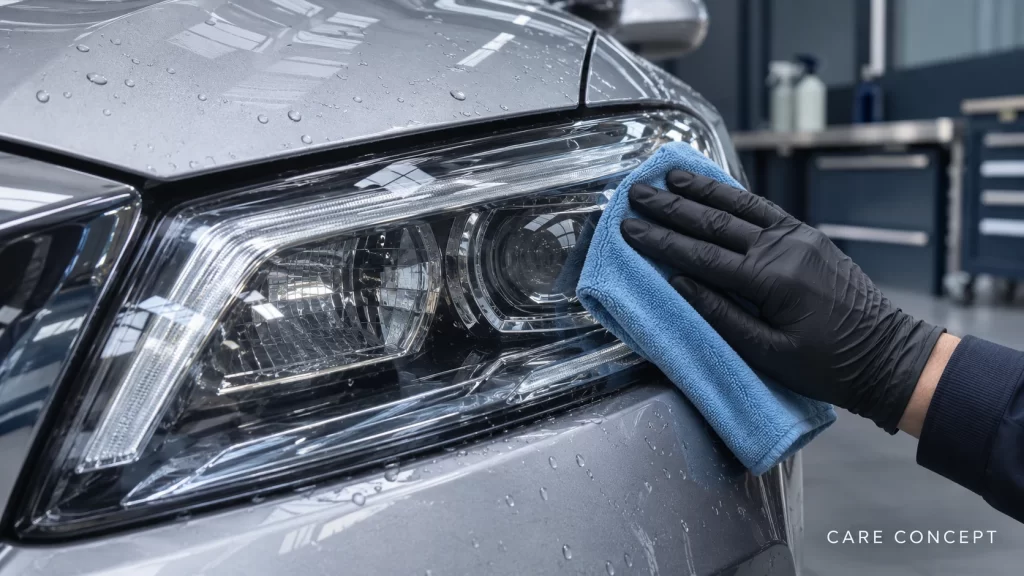
Let the installation settle for the interval specified for that film before the first wash. There is no single waiting time that applies to all products and conditions. Once washing is permitted, soften and rinse away loose dirt before wiping. Work on a cool surface with suitable cleaning products and clean, soft materials.
Remove insect residue promptly using the approved method. Scraping a dried deposit with a fingernail or rubbing it with a dirty cloth defeats the purpose of a protective layer. Avoid forcing a pressure-washer jet into exposed film edges. Body-PPF maintenance instructions can offer useful principles, but the cleaner must also be compatible with the lamp surface.
Arrange an inspection if the film becomes cloudy, yellow, lifted or deeply damaged, or if the light appears different. Do not assume that every change is normal curing. The cause could be the film, trapped contamination, the existing coating or a fault inside the lamp. Identifying the cause is more useful than automatically applying more heat.
Removal also needs a plan. A sound, compatible surface may tolerate removal differently from a deteriorated coating or a previously restored lamp. Ask for the approved procedure and have a competent installer assess the condition first. Replacing worn film should not become an opportunity to scrape, overheat or chemically attack the lens underneath.
Judge value using the actual job
Headlight film is most worth discussing when the lamps are in suitable condition, the vehicle encounters repeated road debris, and preserving the existing surface matters to the owner. A driver covering long motorway distances has a different exposure pattern from someone using a garaged car occasionally. Start with that use pattern rather than a claim that every vehicle needs the same treatment.
Request an installed price that identifies both lamps, preparation, the film, any component removal and follow-up inspection. A low roll price does not describe the finished job. For an existing damaged lamp, compare film with the cost and suitability of restoration or replacement. Film cannot make a necessary repair disappear from the budget.
Avoid calculating savings from an invented replacement-headlight price. Obtain a quote for the actual assembly and include possible film renewal costs. Protection may help preserve the lens surface, but it cannot guarantee that the electronics, seals or housing will never fail. Those are separate reasons a headlight may need attention.
Discuss the specification with DECOWELL
DECOWELL lists a dedicated TPU Car Headlight Film range alongside its body paint protection films. That provides a relevant starting point for installers and distributors sourcing a headlight application. Select the intended appearance and destination market, then request the current technical sheet for the exact product rather than carrying over assumptions from a general PPF catalogue.
Confirm visible light transmission, the stated thickness basis, compatible substrates and application guidance in writing. Where a product name, sample label and published value differ, resolve the difference before approving the order. A trade sample should be traceable to the product being quoted, so the approved material can be matched to the delivered batch.
DECOWELL’s contact page focuses on bulk industrial enquiries. Individual vehicle owners can use their installer to check the lamp and select an appropriate product. Trade buyers can use the RFQ format below to make the request specific enough for a useful technical and commercial response
Evaluate a trade sample before a bulk order
A sample programme is most useful when it reproduces the intended work. Give the installer the correct product identity and current instructions, then choose a representative, suitable lamp. Record the initial surface condition, the preparation used and any difficulty around curves or edges. A perfectly flat sample panel can help compare appearance, but it cannot tell you whether the product fits an awkward headlight shape.
Agree the acceptance criteria before evaluating the result. These might include the agreed coverage, acceptable finish, edge stability and an appropriate optical assessment. Keep photographs under consistent lighting, together with the installer observations. A photograph taken with different exposure settings can make one sample look clearer or darker without establishing a real performance difference.
For repeat orders, retain the approved product code, sample reference and batch details. Confirm how a formulation change or replacement product will be communicated. If a later delivery has a different label, appearance or published specification, resolve it before installation. This is particularly valuable for distributors who need the same description to mean the same product across their stock, quotations and customer instructions.
Keep the warranty record specific
A useful warranty discussion separates the film, the installation and the original lamp. Ask which party handles a lifted edge, visible discolouration, adhesive residue or damage discovered during removal. Confirm whether labour is included in a remedy, what evidence is needed and which surfaces or uses are excluded. Those answers can matter more than the number of years printed on a promotional graphic.
Keep the invoice, product identification and initial inspection record together. For an owner, that makes a later enquiry easier to explain. For a workshop, it helps distinguish a product issue from a pre-existing lens defect or an unrelated lamp fault. Do not imply that a film warranty replaces the vehicle manufacturer’s warranty or automatically covers the complete headlight assembly.
FAQ
1. Can paint protection film be used on every headlight?
No blanket assumption is appropriate. The film must be intended for the lens surface, and the lamp’s condition and manufacturer guidance need checking. A damaged coating, previous restoration or an excluded substrate may change the answer. Start with the exact film and lamp, rather than a general claim that all PPF is suitable for all headlights.
2. Will clear film leave light output completely unchanged?
Do not promise zero change. An added material and adhesive can affect transmission or scattering, and installation quality matters. Ask for relevant optical information and have the completed lamp checked appropriately. Clear appearance is useful, but neither the word clear nor a single VLT value proves that every lighting requirement remains satisfied.
3. Does headlight film remove yellowing or repair cloudy lenses?
It should not be sold as a repair. The cause of yellowing or cloudiness needs assessment first. A deteriorated outer coating, damage within the lens and moisture inside the housing require different responses. If restoration is appropriate, the resulting surface and its protective treatment must be compatible with the proposed film before installation proceeds.
4. Is a thicker film always the better choice?
Thickness can influence a product’s behaviour, but it does not independently establish optical quality, fit or compatibility. Compare tested products for the intended application. Also check whether quoted thickness includes the adhesive, topcoat or a removable liner; numbers based on different layer definitions cannot be compared fairly without adjustment.
5. Can a headlight with film still be cleaned normally?
Routine cleaning remains necessary, but the products and method should suit both the film and the lens. Follow the first-wash interval and approved care instructions. Rinse loose dirt away, avoid dry rubbing, and keep concentrated pressure away from edges. For stubborn contamination, ask the installer before escalating to abrasive products or strong solvents.
6. How long will headlight protection film last?
There is no reliable universal lifespan. The product, exposure, installation, maintenance and underlying surface all matter. Use the current written warranty as a description of covered defects and remedies, not as a promise that the film needs no inspection until that date. Optical deterioration or damage can require attention earlier.
7. Will removing the film damage the factory coating?
Risk depends on compatibility, coating condition and the removal process. An unconditional damage-free promise ignores the difference between a sound factory surface and a weak or previously restored one. Record the initial condition, confirm any warranty exclusions and arrange professional assessment before removing an aged or troublesome installation.
8. Should an owner choose protection film or a ceramic coating?
They serve different primary roles. A compatible protection film adds a physical layer; a suitable coating may help surface maintenance but does not provide the same film barrier against debris. Neither should be applied to a headlight without confirming compatibility. Choose around the lamp’s condition, the expected exposure and the documented performance of the actual product.
Choose protection that respects the headlight
The best headlight-film project begins with a sound lamp and ends with a documented, checked installation. It should preserve the lighting function while adding an appropriate layer of surface protection. For DECOWELL trade enquiries, bring the lamp details, destination market and desired product format to the discussion. Those specifics lead to a more useful decision than a generic promise of perfect clarity or lifetime protection.