
Home » PPF Industry News 2026: Market Signals, Product Choices and What Buyers Should Watch
Recent Posts
PPF Industry News 2026: Market Signals, Product Choices and What Buyers Should Watch
Explore 2026 PPF industry news, from automotive market signals to film choices and installer training. This briefing helps shops and distributors turn recent developments into practical sourcing decisions, with reported facts clearly distinguished from forecasts and buying advice.

Table of Contents
News signal 1: restyling remains an important setting for PPF
In an announcement dated 25 August 2026, SEMA highlighted vehicle restyling and repair ahead of its November show. The association cited more than US$6 billion in annual exterior-restyling spending. That category includes many appearance-related products; the figure is not a measurement of paint protection film sales.
For film buyers, the useful connection is between protection and personalisation. A clear PPF enquiry begins with preserving an existing finish. A matte PPF or colour-change conversation also involves a visible styling decision. A shop serving both needs benefits from explaining them separately, even when the same customer is considering both.
Imagine a customer who likes the original blue paint but wants less shine. Transparent matte film may be relevant. Another customer wants to turn a white vehicle dark green. That requires a coloured product, with its own specification and installation requirements. Treating both requests as “a wrap” makes it harder to quote accurately and easier to disappoint the customer.
Our reading of the restyling signal is straightforward: organise the sales conversation around the intended result. Ask whether the customer wants to preserve colour, change sheen or change colour. Then discuss protection, coverage and care. This gives the installer a clearer brief and gives a distributor a more useful basis for deciding which finishes to evaluate.
News signal 2: electric-car sales are changing the customer mix
The IEA published its Global EV Outlook 2026 on 20 May. It reported that global electric-car sales exceeded 20 million in 2025. Its outlook projected 23 million sales in 2026, or 28% of total car sales. The 2026 figure is a forecast from that report, not a completed full-year result. The electric-car category includes battery-electric cars and plug-in hybrids.
These figures describe vehicles, not PPF adoption. They do not tell us what percentage of owners purchase protective film. They do suggest a sensible question for a local shop: does the vehicle mix in your enquiry book still match the services, cutting patterns and examples you have prepared?
An EV customer may ask for exactly the same practical benefits as any other owner: protection for exposed paint, manageable cleaning and a preferred appearance. The powertrain alone does not establish a need for a special film chemistry. The relevant details are the actual substrate, finish, panel shape, intended coverage and product suitability.
For a distributor, local evidence is more useful than assuming every market follows the global average. Record the models customers bring in, the coverage they request and the quotes they accept. If a particular crossover appears regularly, review pattern availability and material planning for that vehicle. Keep sensors, cameras, trim and any restricted surfaces within the installer’s vehicle-specific assessment. A rise in electric-car sales is a reason to review capability, not a reason to promise protection for every component.
News signal 3: pickups and SUVs deserve a place in the discussion
SEMA’s 30 June 2026 release, drawing on its 2026 Market Report, put 2025 US accessory-and-performance-parts sales at US$52.92 billion. Pickup and SUV modifications represented 43% of that total. This is a broad US aftermarket measure, not a global PPF market estimate.
The practical implication is to look beyond the showroom sports car when planning automotive paint protection services. Larger family vehicles and utility vehicles can generate very different conversations about use. An owner who loads sports equipment may care about a painted loading edge. Someone driving long distances may ask about front-end protection. Another buyer may want a full-body colour transformation.
These are possible use cases, not a claim that every pickup or SUV owner needs the same package. Ask about actual driving, parking and loading habits. Explain which surfaces can be covered and what the film can reasonably help with. PPF is a replaceable protective layer; it should not be sold as armour against every branch, rock or heavy impact.
For stock planning, body size also matters. A large vehicle can require different cutting layouts and more material than a compact car, but the exact amount depends on the pattern and coverage. Review usable yield before promising a fixed number of vehicles per roll. It is easier to price a job properly at the start than to discover an avoidable material shortage halfway through installation.

News signal 4: the 2026 education programme explicitly included PPF professionals
On 1 October 2026, SEMA announced an education programme of more than 90 sessions for its November show, alongside a dedicated one-day conference aimed at window-film, PPF and detailing professionals. The programme announcement covered business development as well as technical subjects. It demonstrates that film businesses were explicitly included in the event’s education offering; it does not establish how many installers attended or how their results changed afterwards.
For a shop owner, that is a useful prompt to review training as part of the buying decision. A new film may have an attractive finish, yet still require different handling, edge work or customer-care instructions. A product trial should give installers time to understand those differences before the shop sells the material at normal production speed.
Business skills matter alongside application skills. A clear coverage diagram, a realistic delivery date and an accurate care sheet can prevent avoidable misunderstandings. Track the reasons for rework and callbacks, then train against the problems that actually occur. A course title or badge alone should not substitute for demonstrated competence on the materials and vehicles your team handles.
Product choices today: clear, matte, satin and coloured PPF
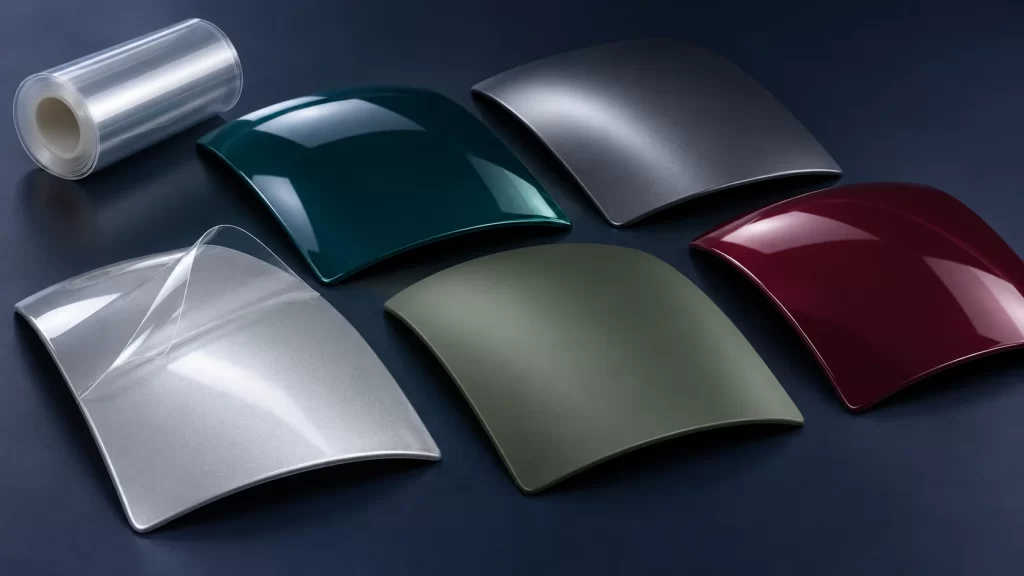
The current buying conversation extends across several distinct product types. Clear gloss PPF aims to protect while retaining a reflective appearance. Clear matte or satin film changes the surface’s visual character while allowing the original colour to remain visible. Coloured PPF adds a colour decision as well as a finish decision. These categories should be compared against the customer’s intended result.
A photograph is a weak basis for approving a finish. Lighting, camera processing and the underlying paint all influence what the image shows. Use representative physical samples, examine them under more than one light source and record the approved product code. For matte and satin finishes, the name alone does not define a universal gloss level.
Decowell’s current paint protection film range includes transparent protection options and a transparent matte TPU product listing. Its coloured PPF categories provide a separate starting point for colour-change enquiries. These are current catalogue observations checked for this briefing, not claims that a new product launched on a particular date.
For buyers, the next step is to confirm the construction and specifications of the exact item. A broad category name does not guarantee that every product has the same base material, thickness, topcoat, adhesive or warranty. Keep decorative appearance and protective performance as separate questions until the documentation supports both.
Installation workflow belongs in the specification
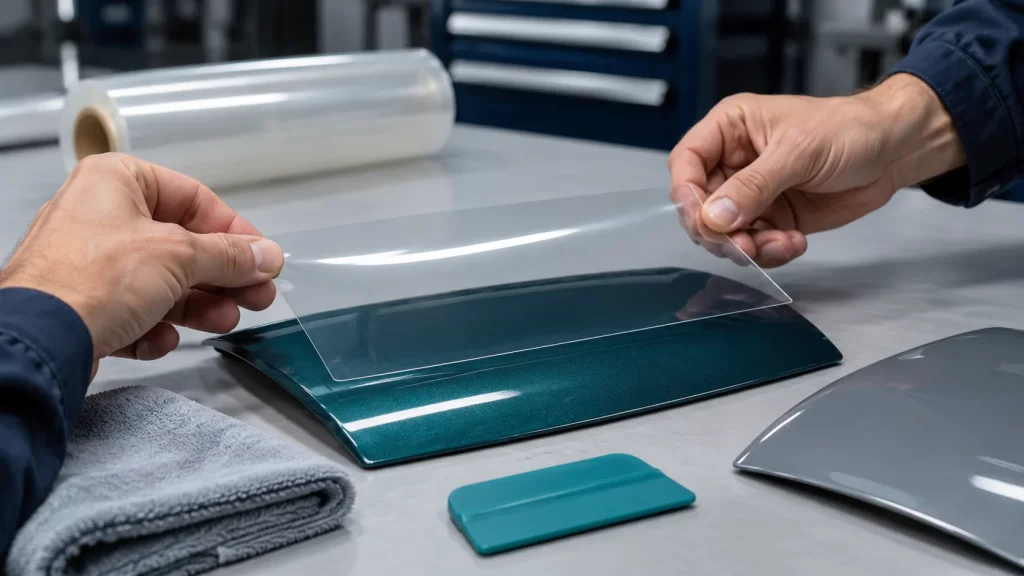
Paint protection film technology is often discussed through surface features, but installation requirements can matter just as much to a working shop. Wet-application and dry-application products exist in the wider market. The correct method is product-specific. Neither label establishes that a film will be faster, easier or more profitable in every workshop.
Ask for the actual application instructions before evaluating a roll. Identify the permitted preparation process, environmental conditions, positioning method and edge treatment. If a supplier recommends a particular solution or tool, confirm the requirements for the selected series rather than transferring a method from a previous product.
A useful trial records complete job time: surface preparation, cutting, application, finishing and inspection. A quick demonstration on a simple panel does not represent every bumper or mirror. Include the learning period in your planning. The relevant comparison is the repeatable quality and total labour your own team can achieve after appropriate training.
Digital cutting patterns can help organise material use and repeat work, but their value depends on the correct vehicle version, coverage options and installer judgement. Check the pattern against the actual car. Treat software compatibility, access fees and update arrangements as practical procurement questions rather than assuming they are included with the film.
Self-healing, hydrophobic coatings and the questions behind the labels
Self-healing PPF and hydrophobic paint protection film attract attention because they address everyday concerns about marks and cleaning. They are also easy to overstate. A self-healing surface may reduce certain fine marks under specified conditions; it does not replace missing film or repair damaged paint. Water beading describes one aspect of surface behaviour, not a complete durability assessment.
Ask what was tested, how it was tested and which product the result applies to. A claim about an entire range is less useful than information tied to a specific construction. Film thickness should have a clear measurement basis, and a gloss reading should identify the measurement method and angle. Comparisons become unreliable when the underlying definitions differ.
Do the same for coating compatibility. A ceramic coating suitable for one film or finish should not automatically be offered on every other film. Confirm how it affects appearance, care and warranty conditions. On matte finishes, preserving an even sheen can be as important to the customer as reducing cleaning effort.
There is also a practical way to communicate these features. Describe what the product is designed to help with, explain the limits and provide the care routine. Customers can make better decisions with a clear explanation than with a promise that the car will remain scratch-free or never need attention.
Market forecasts: check what the number actually measures
Paint protection film market forecasts often appear beside automotive wrap, coating and surface-protection reports. Before using a headline number in a business plan, check its scope. Does it cover automotive applications only? Does it measure film sales or installed retail jobs? Does it include industrial protection film? Which countries and base year are included?
Two forecasts can differ because they count different things. Adding installation labour to material revenue creates a different market value. Mixing a global forecast with a local customer base creates another mismatch. A compound annual growth rate is a projection under assumptions; it does not guarantee the same growth in a distributor’s orders.
For everyday decisions, build a small set of local indicators. Track qualified enquiries, quote acceptance, coverage mix, average material use and repeat orders. Review these alongside wider industry news. If interest rises but bookings do not, the problem may be price, scheduling or an unclear offer. Ordering more film will not necessarily resolve it.
Wholesale PPF buying: measure the cost of a completed job
The lowest roll price is easy to recognise. The lowest cost of delivering an acceptable installation takes more work to establish. Material yield, installation time, rework, freight and replacement support all influence the outcome. Compare quotations only after the product and delivery terms are sufficiently clear.
Here is an illustrative calculation, not a market price or a Decowell quotation. Suppose a material option saves 30 currency units per job, but it causes one additional two-hour rework in every five jobs. At an internal labour cost of 50 units per hour, that labour alone averages 20 units across each job. Replacement film and lost scheduling capacity could reduce the apparent saving further.
The point is to make the assumptions visible. Use your own labour costs and observed rework rate rather than borrowing an attractive example. Record how much usable material remains after cutting, and distinguish a one-off learning issue from a repeat product or process problem.
For international purchases, request the named delivery basis and destination. Separate the film price from freight, applicable import costs and local handling. Confirm packaging, storage requirements and lead time before scheduling customer work. A price that excludes major delivery costs cannot be compared directly with an offer that includes them.
How to evaluate a film before a larger order
Begin with a defined use case. A clear film for daily-driver front ends and a coloured film for full-body transformations may require different evaluations. Write down the intended surface, finish, coverage and customer expectations. Then request technical information and agree on suitable sample or trial-order arrangements.
Keep the trial traceable. Record the product code, batch, substrate condition, preparation method and application conditions. Use a representative flat area and curve where appropriate. Inspect the finished sample after the product’s stated settling period, and retain both photographs and a physical reference.
Look at appearance and handling together. Check clarity over the paint, surface texture, colour consistency, adhesive appearance and edge behaviour. Let the installer record how the film positions and finishes. Follow the approved cleaning procedure during the trial. A single showroom swatch cannot answer all of these questions.
Short trials have limits. They cannot establish years of weathering performance or validate every impact claim. Where test data is supplied, review the method, conditions and acceptance criteria. Agree how a problem will be documented and handled if the supplied material differs from the approved specification. That conversation is easier before the order than after several vehicles have been completed.
Warranty, batch consistency and repeat supply
A professional PPF supplier discussion should continue beyond the first delivery. Ask how the exact product will be identified on future orders and how changes to its specification will be communicated. Retain batch information for installed jobs where practical. It can help investigate a concern and support a more informed replacement decision.
Read the applicable warranty instead of treating the number of years as a complete description of support. Confirm covered defects, exclusions, claim evidence and the roles of supplier, distributor and installer. Ask whether labour is included and which territory or sales channel the terms cover. Installation workmanship and product manufacturing issues may follow different processes.
Also plan for ordinary replacement needs. A damaged panel may need new film while the surrounding material has already aged. Colour and sheen should be assessed before promising an exact match. For coloured inventory, an approved sample and reliable product identification can matter as much as having a wide range of shades available.
A practical 90-day response to PPF industry news
During the first month, review the enquiries and jobs you already have. Group them by vehicle type, requested finish and coverage. Identify the questions customers repeat. If they regularly confuse ceramic coating, vinyl wrap and paint protection film, improve the explanation in your quotations and website before adding more products.
During the second month, test one or two products that address a clear gap. Choose a representative application, record the trial and discuss the results with the installer. Establish the product code, care instructions and purchasing terms. Avoid expanding the range so quickly that your team cannot confidently explain or install it.
During the third month, compare actual outcomes: installation time, usable yield, customer feedback and follow-up issues. Use those observations to adjust stock and training. If a product performs well in the intended application, build a clear offer around it, with genuine photographs and accurate coverage information.
This is an operating recommendation, not a forecast of guaranteed growth. It turns broad industry signals into decisions that can be reviewed. A distributor can use the same approach with a small group of installation partners, provided the trial conditions and feedback are documented consistently.
Frequently asked questions about PPF industry news
1. What does PPF mean in automotive industry news?
PPF means paint protection film: an adhesive protective film for suitable vehicle surfaces. It is also commonly discussed as clear bra or automotive protective film. In this article, PPF refers to the automotive product, not other organisations or financial terms that use the same abbreviation.
2. What are the main PPF business signals to watch in 2026?
Watch customer interest in protection and appearance, the local vehicle mix, installer capability and the quality of product documentation. The dated announcements in this briefing provide context. They do not prove a single worldwide PPF growth rate or establish that every shop should stock the same films.
3. Do growing EV sales automatically mean growing PPF sales?
No. Vehicle sales create a potential customer base, but film purchases depend on awareness, budget, local availability and the offer itself. Track actual enquiries and conversions in your market. Do not apply a national or global EV growth percentage directly to a PPF sales forecast.
4. Are coloured PPF and vinyl wrap interchangeable?
They may address similar appearance goals, but their construction and performance should be checked separately. Confirm the base material, intended use, thickness and supporting data for each product. A colour-change label does not establish that two films provide equivalent protection or use the same installation method.
5. Is matte PPF a different colour from clear PPF?
Transparent matte film primarily changes the reflected appearance while allowing the paint colour to show. Coloured matte film changes colour as well. Ask which type is being offered, and evaluate a sample over a representative paint colour. The terms matte and satin do not guarantee identical sheen across products.
6. Is dry-apply PPF always faster than wet-apply PPF?
No universal speed ranking applies to every film, installer and vehicle. Follow the specified method and compare complete jobs under realistic conditions. Preparation, complex curves, finishing and rework all count. A demonstration on one panel cannot establish the total labour required for a full vehicle.
7. Can self-healing PPF repair a deep scratch?
Self-healing claims generally concern supported surface-level recovery under specified conditions. A deep cut, torn material or damaged paint is a different issue. Ask the supplier to define the feature for the selected product and give customers realistic instructions for inspection, care and replacement when needed.
8. Which PPF market-size figure should a distributor use?
Use figures whose geography, application scope, revenue basis and reporting period match the decision. Broader automotive aftermarket spending should not be presented as PPF revenue. A forecast may be useful context, but local order records and customer research are necessary for practical inventory planning.
9. What should I request from a wholesale PPF supplier?
Request an exact product code, technical specification, application instructions, care information, warranty terms and a complete quotation basis. Include roll dimensions, thickness definition, order quantity and destination. For coloured products, add an approved finish reference and ask how repeat orders will be identified and managed.
10. Is a long warranty enough to prove film quality?
It is one part of the purchase decision. Read the coverage, exclusions and claim process, and evaluate the product for the intended application. A warranty does not replace installation quality or appropriate care. Confirm who handles a problem and what support is included before placing a larger order.
11. Should a new PPF business stock every finish?
Start with a manageable selection that matches demonstrated demand and installer capability. A large catalogue can tie up money and complicate training. Use sample-led enquiries for less common finishes, confirm availability before promising delivery and expand the stocked range when order history supports the decision.
12. How can I turn an industry trend into a useful enquiry?
Describe the actual project behind the trend. State whether you need clear protection, a sheen change or a colour change, then add your application, market, expected volume and purchasing timeline. That gives the supplier enough context to recommend a relevant product instead of sending a generic price list.
Bring your next PPF project to Decowell
Industry news is most useful when it leads to a clear product decision. Decowell’s published ranges offer starting points for transparent protection, matte appearance and coloured-film enquiries. Ask for the specific item suited to your application, then compare its documentation, sample appearance and commercial terms with your actual requirements.
For installation businesses, distributors and bulk trade buyers, contact Decowell about your PPF sourcing project. Include your target market, preferred finish, intended use and expected volume. Decowell’s contact page focuses on bulk industrial enquiries, so a concise business brief is the right starting point for a relevant discussion.
Use the RFQ above to begin with the details that matter. A well-defined enquiry helps move the conversation towards a suitable film, a realistic supply arrangement and a product your team can confidently offer to customers.