
Home » Gloss White PPF: How to Choose the Right White and Keep It Looking Clean
Recent Posts
Gloss White PPF: How to Choose the Right White and Keep It Looking Clean
Gloss white PPF combines a white color change with a protective film surface. The best result starts with more than a bright color card: you need the right shade, a convincing gloss finish and a clear installation plan. Here is what to compare before booking a wrap or placing a wholesale order.
Table of Contents
What is gloss white PPF?
Gloss white PPF is colored paint protection film intended to give suitable vehicle panels a glossy white appearance while adding a sacrificial protective layer. It may also be described as white color change PPF, glossy white protective film or a white PPF wrap. These search terms point to a similar goal, but they do not establish an identical material specification.
That distinction matters when you start asking for quotes. A product sold as white wrap might be a decorative vinyl film, a polyurethane protection film or another construction. Ask for the exact product code, base material, installed thickness and supported application. The words “premium,” “ceramic” or “paint-like” do not answer those questions on their own.
For an owner changing a dark car to white, the film becomes the visible exterior finish. For someone who already owns a white car, the decision is different: keep the original color with clear PPF, or choose a different white using colored film. Neither route should be selected from the product name alone. Start by deciding which appearance you actually want to preserve or change.
White PPF, white vinyl and clear PPF are different choices
A white vinyl wrap is principally a styling choice, with its own application, durability and care requirements. A white protective film is selected for its combination of appearance and documented protection properties. Compare the actual products rather than assuming every film in one category is better than every film in another. A decorative wrap should not be sold as equivalent stone-chip protection without relevant evidence.
Clear PPF over white paint leaves the underlying color visible. It can be a practical option when you like the factory shade and want to protect it. Opaque gloss white PPF supplies a new visible color, which may differ from the paint even if both are called white. Ask to see a sample on the car before choosing partial coverage.
A repaint is a separate bodywork decision. It may be appropriate when repairs or a permanent finish change are the priority, while film depends on a suitable underlying surface and will eventually need attention or replacement. Do not use wrapping to avoid diagnosing failing clearcoat, corrosion or poor repairs. Those problems do not become sound substrates simply because an opaque material covers them.
The useful comparison is therefore based on your objective: preserving an existing finish, changing the exterior color, or repairing the bodywork. Once that is clear, the installer can quote a defined job instead of trying to satisfy three different expectations with one product.
Choose the white in person
White is not a single shade. A neutral white, a slightly warm white and a cooler white can look close on separate screens but noticeably different when placed together. Names such as arctic, snow, porcelain or ice white are marketing descriptions, not universal color standards. Two suppliers can use similar names for different appearances.
Take the sample to the vehicle and compare it with the parts that will remain visible. Black trim, bright metal details, glass and an exposed original paint edge all influence the finished impression. For an already white car, hold the proposed film near an adjacent painted panel. A small mismatch can matter more in partial coverage than in a complete exterior color change.
Use a physical sample large enough to judge, ideally applied to a suitable curved demonstration panel. View it in daylight and under the lighting where the car is normally seen. A phone photograph is a useful conversation starter, but exposure, white balance and the display can change the result. Approval should identify a real sample and product code, rather than a screenshot that everyone remembers differently.
For a commercial order, agree how color acceptance will be handled. ASTM D2244 concerns calculated color differences, while ASTM D1729 addresses visual appraisal under defined conditions. Their public descriptions reinforce a practical point: measured color and visual judgment should be considered together. Citing a standard does not prove that a particular film has been tested or establish the acceptance limit for your order.
Solid gloss white, pearl white and satin white
Solid gloss white is often chosen for a clean, uncomplicated color with a reflective finish. Pearl white introduces an effect that can change with illumination and viewing angle. Satin and matte white alter the sheen. A buyer who says “I want white PPF” may mean any of these, so make the finish part of the written specification.
Pearlescent samples deserve more than a quick look under diffuse office lighting. Examine them under directional light and from several angles, then ask whether the film has a required installation direction. An effect that looks attractive on a small card can become distracting if adjacent panels appear inconsistent. For a solid white product, confirm any direction or batch instructions as well instead of assuming none apply.
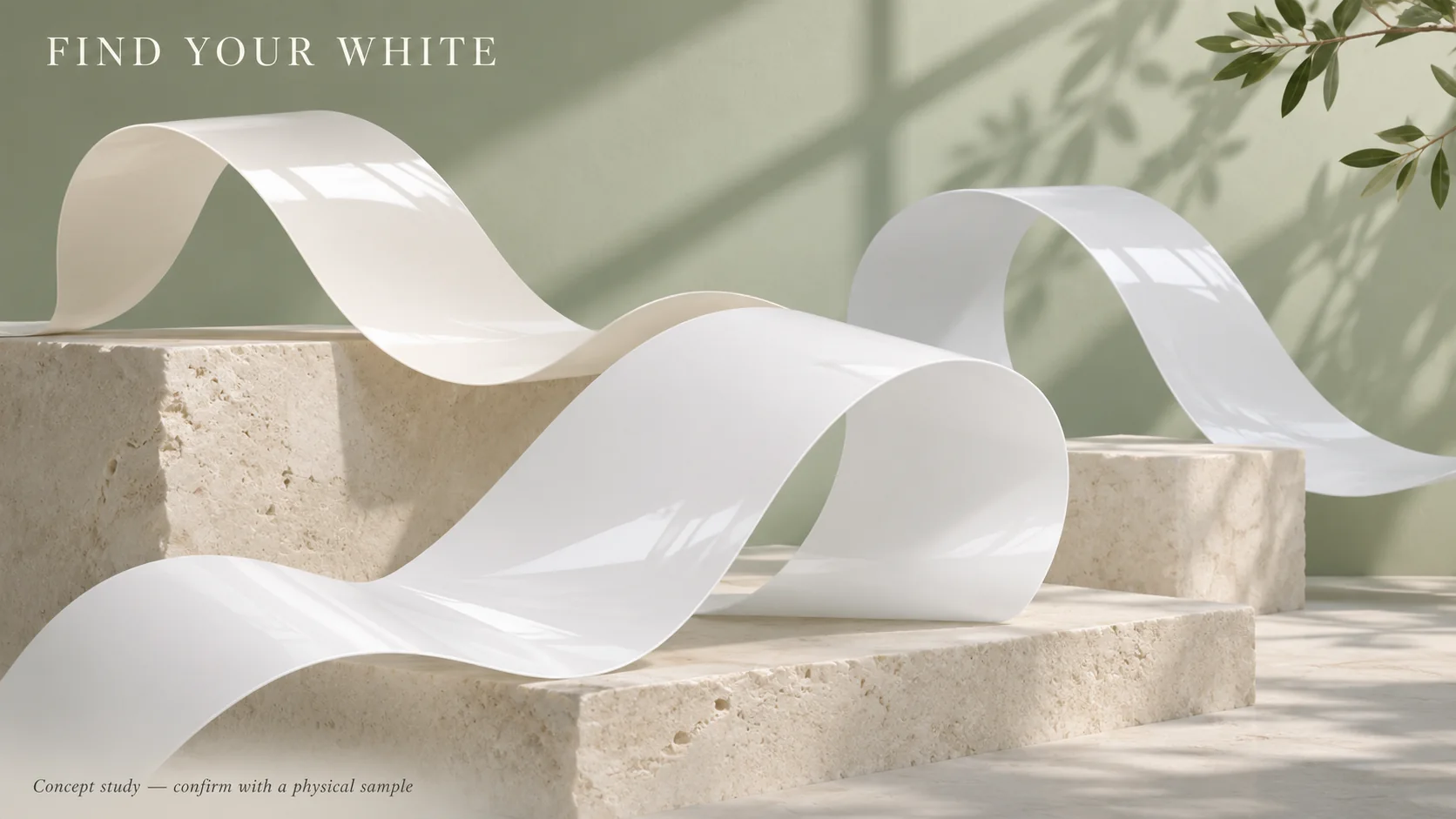
Gloss and color are separate choices. You may prefer a slightly warmer shade with sharp reflections, or a cooler shade with a softer surface appearance. Put the shortlisted samples side by side and judge them as complete finishes. Selecting the brightest-looking patch on a screen is a weak substitute for this short, practical comparison.
Judge the gloss, not just the shine in a photograph
A glossy surface can still show texture, reflection haze or distortion. Look at the reflection of a straight light source on an installed sample and inspect it from more than one angle. The aim is to understand the surface you are buying, including any visible orange-peel texture, before it covers a large bonnet or door.
ASTM D523 describes measurement of specular gloss using defined geometries, including 20, 60 and 85 degrees. A gloss figure is meaningful only with its measurement context. It should not be presented as a percentage of overall quality, and a high reading does not describe every aspect of reflected-image clarity or surface texture.
Ask whether the demonstration sample has been prepared in the same way as the delivered installation. A temporary cap sheet, release liner or unusual lighting setup can make a comparison unrepresentative. Assess the finished surface after any layer that is meant to be removed has been removed according to the product instructions.
On a white vehicle, use contrast to inspect the finish rather than simply increasing light intensity. Reflections from dark surroundings and clean inspection lighting can help you notice differences. You do not need a showroom performance: you need a repeatable view that lets the owner, installer and supplier discuss the same surface characteristics.
Check the material, thickness and opacity
TPU stands for thermoplastic polyurethane, a material commonly associated with automotive protection film. However, a complete colored film also includes its color construction, adhesive and surface treatment. Ask what the actual white product uses. A broad catalogue covering several material types is not enough to identify the roll being offered.
When thickness is quoted, establish whether it includes adhesive and excludes removable liners or cap sheets. One mil is one thousandth of an inch, or 25.4 micrometres. That conversion helps compare units, but it does not turn thickness into a complete performance ranking. Adhesion, conformability, finish quality and the supported use conditions still need consideration.
Opacity deserves attention when the original paint is dark or strongly colored. Ask to evaluate the film on a representative background and on a suitably formed sample prepared within its instructions. The question is whether the planned application gives the intended uniform white appearance. Do not assume that an untouched flat swatch answers how every difficult curve will look after installation.
Also confirm the application method. Colored protective films are not all installed the same way; some are designed for dry application, while other products require a specified wet process. The correct method follows the exact product instructions. Avoid buying a roll first and asking the installation team to invent a workable process afterwards.
What protection should you realistically expect?
A suitable PPF can provide a replaceable surface that helps reduce certain everyday abrasion and minor debris damage to the paint beneath. Its value is easier to understand when the supplier explains the relevant test evidence and the installer sets reasonable expectations. It is not a guarantee that stones will never penetrate the film or that a parking impact will leave no dent.
Self-healing usually refers to particular light marks in a film’s surface treatment recovering under specified conditions. It should not be interpreted as rebuilding a torn sheet or repairing damaged paint. If this feature matters to you, request the conditions and limitations for the exact white film instead of accepting a demonstration of an unrelated transparent product.
Hydrophobic behaviour is another separate characteristic. Water beading may be useful for maintenance, but it does not prove stain immunity, impact resistance or permanent color stability. Treat claims about gloss retention, discoloration, abrasion and chemical exposure as separate subjects. A strong answer provides relevant evidence for each, rather than using one attractive video to imply every form of protection.
Plan the color change at the edges
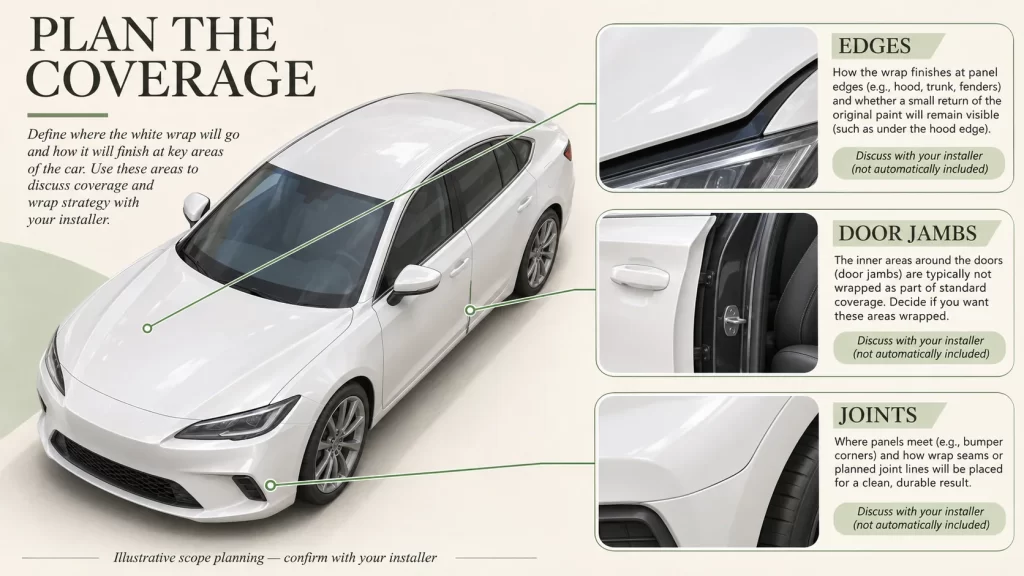
The difference between a convincing white wrap and a disappointing one often appears around the boundaries. On a dark car, a small exposed strip can be obvious when a door opens or when you look closely around a handle. Ask the installer to show the intended coverage of the bonnet, boot, bumpers, mirrors, panel returns and visible recesses before agreeing to the price.
“Full body” should be defined. It may mean the main painted exterior panels, with door jambs and deeper openings excluded. That can be a perfectly reasonable scope, provided it matches your expectations. If you want a more extensive color change, request a separate discussion of access, disassembly, supported substrates and extra labour rather than assuming everything is included.
Decide how seams or inlays will be handled on difficult shapes. A carefully planned joint may be appropriate for a particular product and panel. An excessive stretch undertaken solely to avoid any seam can create a different problem. Review the installer’s supported approach and, where possible, an example of comparable work rather than demanding an unspecified “seamless” result.
The quotation should also distinguish painted surfaces from lights, glass, textured trim and other components. Do not assume a body-film specification applies to every material on the vehicle. A detailed coverage map saves time at collection and gives the shop a clear basis for explaining what was included.
Installation: the finish depends on the preparation
Before the film is cut, document the paint condition and repair history. Point out chips, scratches, repainted panels, weak clearcoat and previous coatings. A glossy white film does not level damaged paint like a body repair. Existing defects may still affect the finished appearance or the suitability of the surface for adhesive application.
Use the product’s preparation instructions and resolve coating compatibility before installation. There is no universal waiting period that makes every fresh repaint suitable for wrapping. The paint system, cure conditions and film requirements need to be considered together. If the substrate is uncertain, have the issue assessed before committing to the job.
Clean handling is especially important when small specks would interrupt a plain white finish. Ask how the team controls contamination, protects the adhesive during positioning and checks the panel before final fitting. These are practical quality questions, not a reason to expect a real workshop to behave like a laboratory cleanroom.
At handover, examine the car in ordinary viewing conditions as well as inspection lighting. Check adjacent panels, reflection quality, recesses, edges and the areas most likely to show the old color. Record any agreed follow-up items, the first-wash guidance and the route for reporting a concern. Clear documentation makes the first days of ownership much simpler.
Gloss white PPF cost: compare a defined job
A meaningful gloss white PPF cost estimate depends on the vehicle, location, product and coverage. A large vehicle, complex bumpers, extensive disassembly or jamb coverage can require a different amount of labour from a straightforward exterior wrap. Ask for an itemised scope so that two quotations describe comparable work.
Include preparation and old-film removal where relevant. If one quote assumes sound, clean factory paint and another includes remedial work, the totals will tell you little without that context. Also establish whether taxes, transport, follow-up inspection and optional coatings are included. An attractive headline price is only useful when you know what it buys.
Consider future costs without inventing guaranteed savings. Film replacement, removal and panel matching may become relevant during ownership. A protective film is not an insurance policy, and its purchase does not establish that the car will gain resale value. Choose it because the finish, protection level and ownership plan make sense for your situation.
For trade buyers, calculate cost per acceptable installation rather than roll price alone. Usable coverage, cutting waste, fitting time, training needs and the handling of problems all affect the result. A lower material price can be less attractive if it introduces uncertainty into a job your team needs to repeat reliably.
Keeping gloss white PPF clean without damaging it
Follow the supplier’s first-wash instructions, then use the approved routine for the specific film. Once washing is permitted, work on a cool surface and remove loose contamination before wiping. Use clean washing and drying materials. Repeated dry rubbing is a poor way to remove a mark from an otherwise glossy finish.
Attend to bird residue, insects and other deposits promptly using a compatible method. White can make some contamination easy to see, which is useful if it encourages earlier cleaning. It does not justify reaching immediately for a strong solvent, abrasive pad or household stain remover. If normal approved cleaning fails, ask the installer how to identify and treat the mark.
Water spots, surface staining and general discoloration are not automatically the same issue. Describe what changed, where it appears and whether it followed a particular exposure or wash. Photographs and a maintenance record can help the supplier understand the problem. Trying several aggressive chemicals first may make diagnosis and remedy more difficult.
If pressure washing is allowed, follow the film’s limits and avoid directing concentrated force into edges. A compatible coating may be an optional maintenance addition, but it requires confirmation and care of its own. Neither a coating nor strong water beading removes the need to wash, dry and inspect the film appropriately.
Yellowing, service life and panel replacement
Ask what “anti-yellowing” means in the product documentation. Request relevant initial and aged appearance data, the test conditions and the warranty wording. An accelerated exposure result can help compare performance under defined conditions, but test hours cannot be converted into outdoor years using a universal multiplier. Climate, exposure and the material itself affect that relationship.
A warranty period is not a promise that every surface will look unchanged for that entire time. Check how the agreement treats discoloration, stains, physical damage, installation workmanship and maintenance. Clarify whether a successful claim provides material only or also includes removal and refitting. The answer matters more than the largest number in a headline.
Plan for a damaged panel while the original job information is available. Record the product code and batch, and ask about the practicalities of future supply. Even the same nominal shade may need to be compared with the installed vehicle after it has been in service. Retained material also has storage and shelf-life limits, so keeping an offcut is useful as a reference, not a guaranteed repair solution years later.
Removal should follow the film’s instructions and take the underlying paint condition into account. Repaired or weak coatings may carry additional risk. Do not accept a universal promise of damage-free removal. If the paint begins to lift or another unexpected change appears, stop and have the situation assessed before continuing.
FAQ: gloss white PPF
1. Is gloss white PPF the same as clear PPF on a white car?
No. Clear film leaves the original paint color visible, while colored white film supplies its own visible finish. If you like the factory shade, evaluate clear PPF first. If you want a different white or a color change, compare physical colored-film samples and the intended coverage.
2. Can gloss white PPF cover a black or dark-colored car?
It may be suitable when the selected product provides the required opacity and the paint is an approved substrate. Evaluate a representative sample and plan edges, recesses and openings carefully. A white exterior wrap does not automatically include every area where the original dark color can be seen.
3. Will white PPF match my factory white paint?
Do not assume so. A familiar color name is not a confirmed match, and gloss or texture differences can remain visible even when the hue looks close. Compare the actual film with the vehicle under appropriate lighting before agreeing to partial coverage or a replacement-panel plan.
4. Does gloss white PPF turn yellow?
Color stability is product-specific, and surface contamination must be distinguished from material ageing. Ask for relevant testing and warranty terms rather than a permanent guarantee. Care, exposure and the condition of the installed film remain important throughout use.
5. Is pearl white PPF better than solid gloss white?
They offer different appearances. Pearl introduces an effect that changes with lighting and angle; solid white provides a more uniform color impression. Choose from physical samples and consider installation direction and future panel matching. “Better” depends on the finish you want, not the name.
6. Does a glossy finish mean the film is more protective?
No. Gloss describes an aspect of appearance. Protection depends on the complete product and the relevant performance evidence. Evaluate finish, abrasion behaviour, impact-related claims and care requirements separately instead of using shine as a shortcut for overall quality.
7. Can scratches in white PPF heal themselves?
Some products have a topcoat designed to recover from certain light surface marks under specified conditions. Deep cuts, torn film and damaged paint are different problems. Obtain the instructions for the exact product, and do not apply uncontrolled heat to test the claim yourself.
8. Is gloss white PPF installed wet or dry?
That depends on the film. Follow its stated application method, including preparation, handling and any finishing requirements. A technique suitable for one colored-film construction should not be assumed suitable for another. Confirm that your installer is comfortable with the selected system before buying.
9. Can I add ceramic coating to gloss white PPF?
Only use a coating that is confirmed compatible with the film’s surface and warranty requirements. Ask when it may be applied and how it should be maintained. It is an optional product decision, not a substitute for suitable film, good installation or regular cleaning.
10. How long will a gloss white PPF wrap last?
There is no single lifespan for every product and vehicle. Review the specific documentation, exposure conditions and replacement guidance. Treat the warranty as an agreement with defined coverage, and inspect the film’s actual condition rather than relying only on elapsed time.
11. Can only one panel be replaced later?
Often a panel-based repair can be considered, but availability, shade, gloss and the aged appearance of neighbouring panels need checking. Keep the original product and batch records. Ask the installer to assess the visible result before assuming new material will match perfectly.
12. What should a wholesale gloss white PPF enquiry include?
Include the target white shade, preferred finish, intended vehicles or customer segment, destination and expected quantity. Request the product construction, optical appearance data, application instructions, warranty and commercial terms. A reference sample is more useful than describing the color only as “very white.”
Build your white PPF offer with Decowell
Decowell’s car colored PPF range is a starting point for discussing a white color-change project. Its broader paint protection film range also provides a route to compare protection options when keeping the original paint color is the priority. Ask Decowell to identify the current product that matches your intended finish and use.
For gloss white PPF sourcing, send a clear shade reference, destination market and estimated order quantity. Request confirmation of the exact material, available white finish, application requirements and warranty. This turns a general color enquiry into a specification that your purchasing and installation teams can review together.
Decowell’s contact page focuses on bulk industrial enquiries. If you are building a distributor range or planning repeat installations, contact Decowell with your gloss white PPF requirements. Use the RFQ above to discuss current availability, suitable evaluation samples and a supply proposal for your business.