
Home » PPF Headlights: A Practical Guide to Clear Protection, Cost and Care
Recent Posts
PPF Headlights: A Practical Guide to Clear Protection, Cost and Care
PPF headlights can be a useful option for protecting suitable headlamp lenses, but the right choice starts with compatibility, clarity and fit. This guide explains what headlight protection film can do, what to check before installation, and how to compare a retail quote or wholesale order without relying on big promises.
Table of Contents
What does PPF on headlights actually mean?
When people search for “ppf headlights,” they usually mean a protective film applied to the outside of the headlamp lens. You may also see it described as headlight PPF, headlamp protection film, clear headlight wrap or paint protection film for headlights. The surface being covered is a lamp lens, however, so a product suitable for painted panels is not automatically suitable for this application.
Think of the film as a replaceable outer surface. With an appropriate product and installation, some everyday abrasion or minor debris damage may affect the film before reaching the underlying lens. That is a practical benefit, particularly for drivers who spend considerable time on exposed roads. It is not a guarantee against a cracked lamp, a heavy impact or damage inside the housing.
The first purchasing question should therefore be simple: is this exact film intended for this exact type of headlamp? Ask for a product code and application instructions, then check the vehicle or lamp manufacturer’s restrictions. A leftover piece from a body wrap is not enough evidence. The adhesive, coating, optical properties and removal process all matter when the surface underneath is part of the lighting system.
Start with the condition of the lens
A clean, sound lens and a tired, yellowed lens need different conversations. Before agreeing to any work, have the lamps inspected with the lights off and operating. Look for cracking, pitting, peeling surface coating, previous restoration, trapped moisture and a difference in appearance between the two sides. Photograph existing defects so that the condition is recorded before installation begins.
Lens deterioration is more than a cosmetic problem. Published automotive research has measured substantial reductions in output from the deteriorated lamps tested. That evidence supports maintaining the lens; it does not prove that adding PPF will restore a damaged lamp or deliver a particular increase in brightness. Keep those two claims separate when reading a sales page.
If cloudiness is inside the assembly, an external film will not repair the cause. If the outer surface has deteriorated, a competent specialist should decide whether restoration or replacement is appropriate before discussing protection. Do not automatically sand a healthy factory finish just to prepare it for film. Likewise, do not assume that a freshly polished lens is ready for adhesive: the restoration system, any new coating and its required curing conditions need to be identified first.
For a shop, this inspection is also the beginning of a better quotation. A customer with two sound lenses may need a straightforward assessment and application. A customer with one repaired lamp and one original lamp may need a different product decision, additional preparation or a decision not to proceed.
Clear headlight PPF, tint and coatings: different jobs
Clear headlight protection film is chosen primarily for protection while keeping the original appearance as closely as the approved application allows. Smoked, yellow or color-shifting film changes the appearance and may alter transmitted light. Those are different specifications, even when the products sit next to one another in a catalogue. A photograph of an attractive dark lamp does not establish its suitability for road use.
A headlight coating is another category. A compatible coating may be selected for surface maintenance or as part of a restoration system, depending on its instructions. It is not interchangeable with a sheet of protective film. Compare the actual purpose, substrate approval and maintenance requirements instead of treating every product described as “protection” as equivalent.
Combining products needs its own approval. A ceramic coating underneath a film can change the bonding surface. A coating applied over the film must be approved for that film’s topcoat. Ask the installer to identify both products and explain the intended order. Avoid an improvised stack of polish, sealant, coating and film just because each item sounds beneficial on its own.
For a buyer who wants the factory look, an appropriate clear product is the sensible starting point for evaluation. It still needs compatibility and compliance checks. “Clear” describes appearance; it is not a universal certificate of safety, legality or zero optical change.
Read optical specifications without getting lost in percentages
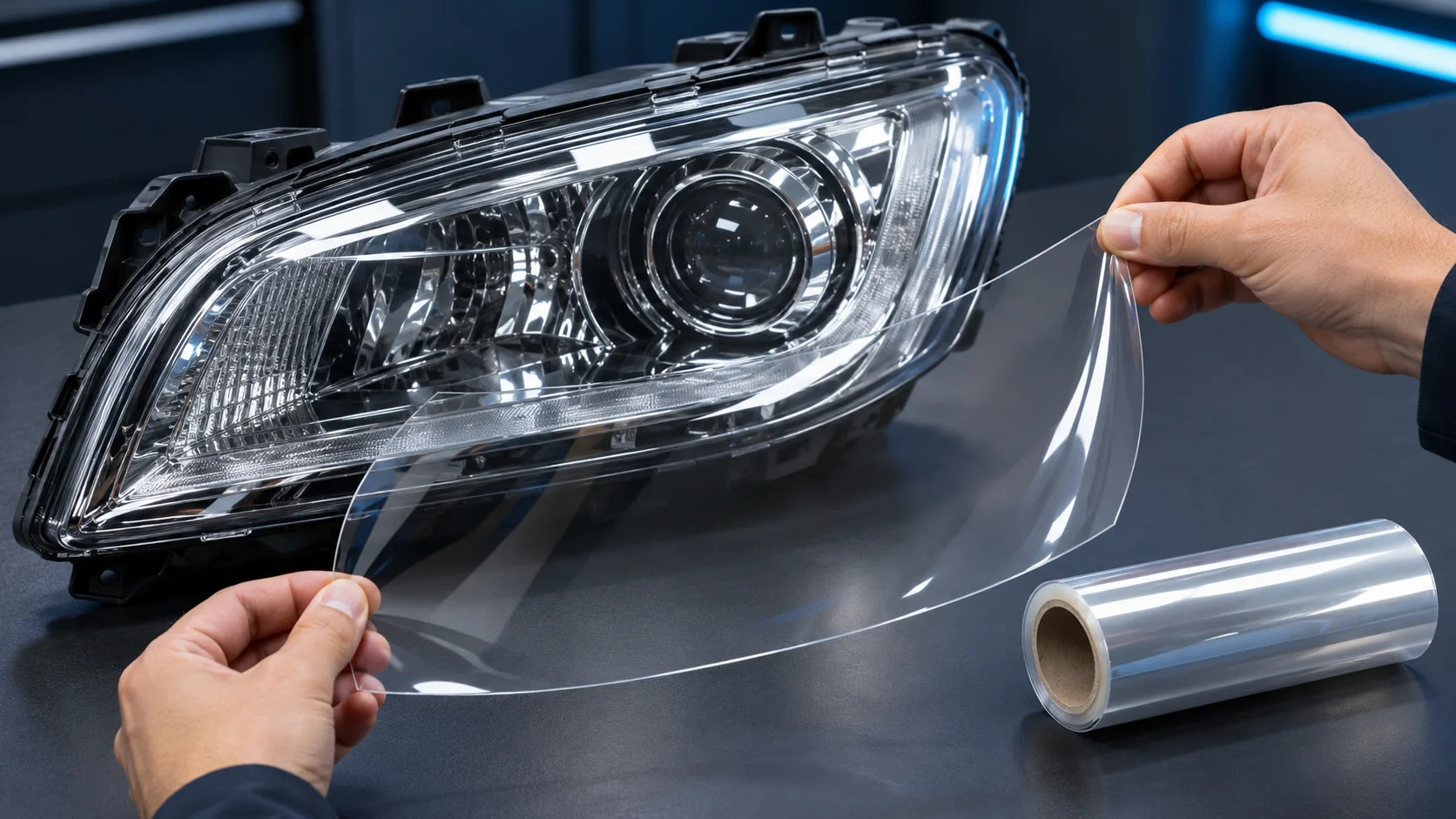
A roll of film can look transparent on a desk and still deserve careful evaluation on a lamp. Ask about luminous transmittance, haze and visible color, and whether the reported values represent the finished adhesive film or only one component. Also ask which test method, sample thickness and conditioning were used. Figures from different methods or different sample constructions may not be directly comparable.
ASTM D1003 addresses haze and luminous transmittance in transparent plastics. It can help buyers understand what an optical report measures, but a result from a flat material sample does not certify a completed headlamp. The installed film, curved lens and lighting assembly form a different evaluation problem.
For purchasing, request traceable reports rather than an isolated number in a brochure. Identify the product code, report date and tested construction, then ask whether any ageing or weathering results are available. A fresh sample tells you about its initial condition. It does not, by itself, establish how the same material will look after sustained service in your climate.
For installation, make clarity part of the acceptance discussion. Visible creases, contamination, persistent cloudiness or unusual color deserve investigation. If the beam or perceived lighting performance changes, have the assembly assessed with appropriate equipment. A photograph against a garage wall, especially with automatic phone exposure, is not a measured comparison or a road-use approval.
Compatibility comes before thickness
TPU, short for thermoplastic polyurethane, is widely used in protective-film discussions. Yet the material name alone does not tell you whether a complete product is appropriate for a particular lamp. The film’s construction includes more than its base polymer, and the surface of the lens may include a factory hardcoat or a repair coating that affects adhesion and removal.
Ask a supplier to state the total installed thickness and explain what is included. Some figures refer to the film and adhesive; others may describe only a base layer. Release liners and removable protective sheets should not be confused with material that stays on the lamp. Comparing two thickness numbers without this detail can produce a misleading conclusion.
More thickness is not automatically a better choice. The application also needs suitable conformability, optical quality, edge stability and documented use conditions. A thicker material that cannot be installed cleanly on the intended lens is not an improvement. Avoid selecting the “strongest” sounding specification while ignoring whether the supplier supports that application.
There is no single heat setting or cleaning formula that should be copied across every headlamp and film. Obtain the relevant instructions before work starts. For a trade buyer, include the intended lamp types, operating environment and climate in the enquiry so the supplier can respond to the actual application rather than a generic request for automotive PPF.
Check road-use requirements before choosing a finish
Lighting rules depend on the market and the circumstances of installation. In the United States, FMVSS No. 108 contains requirements concerning lighting impairment and features in front of headlamp lenses. Older federal interpretations also address transparent covers. These are good reasons not to accept a blanket claim that every clear film is lawful everywhere. They are not a product-specific approval for a particular adhesive film.
In Great Britain, the MOT inspection manual addresses products on headlamp lenses that reduce intensity or alter emitted color, alongside other lighting checks. Passing an inspection is not a substitute for establishing all applicable requirements. A window-tint transmission rule should not be reused as a headlight rule.
Before offering a product for road vehicles, confirm the requirements with the relevant authority or a qualified local specialist, and check the vehicle manufacturer’s position. Trade customers should tell their supplier where the film will be sold and how it will be used. Keep this information with the product record rather than relying on an unqualified “road legal” line copied from a marketplace listing.
What a careful headlight PPF installation should include
Start by agreeing on the scope. Confirm the vehicle year, lamp version, lens condition and exact film. Establish whether the quote covers both headlights, whether any old material must be removed and how existing damage will be handled. Headlamps that look similar in a listing may have different contours or surrounding trim, so a pattern should be checked against the actual car.
The work area should allow the installer to see contamination and control the application. Preparation must follow both the lamp and film requirements. Avoid aggressive experimentation on the lens: a cleaner that works on paint may not be appropriate for the lamp’s surface. Protect nearby areas as needed, while avoiding practices that trap heat over illuminated lamps.
An approved precut pattern can reduce the need for trimming on the vehicle, but it does not remove the need for skill. The installer still has to align the material and manage compound curves without leaving obvious tension, fingers or creases. Bulk-film work needs an equally clear cutting plan. Ask how the lens and surrounding surfaces will be protected from tool contact.
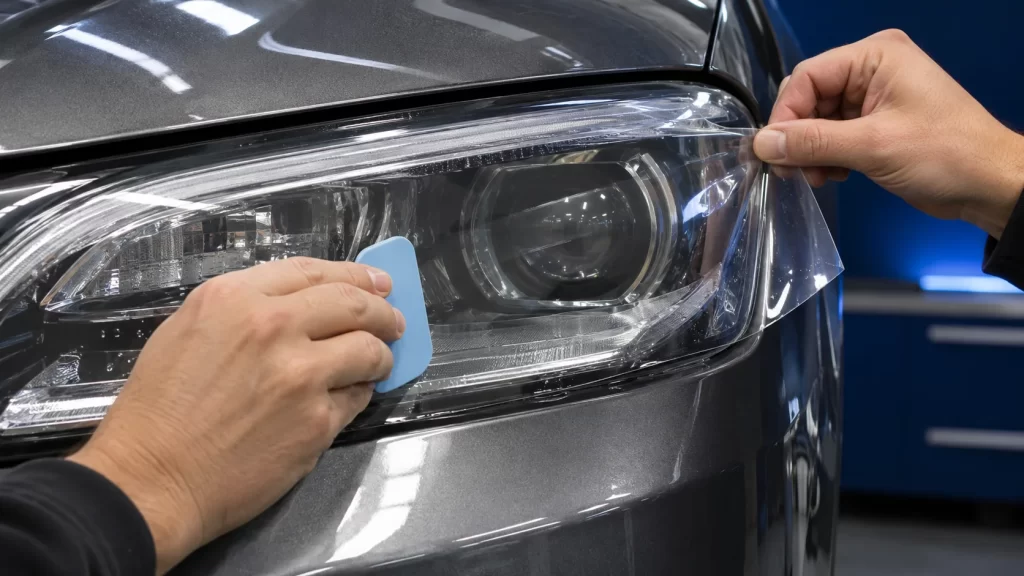
If the selected film uses wet application, the installer should follow its specified fluid and handling instructions. Do not borrow a mixture or technique from an unrelated product. The same applies to stretching, heat and edge finishing. A product-specific procedure is more useful than a universal internet recipe.
Finally, review the finish together. Check the central lens area, the perimeter and any area near a lamp seam. A film edge should not be improvised into a sealant for the housing. Agree on the curing expectations, the first permitted wash and the timing of any follow-up inspection. Put those details on the job sheet so the owner has something clearer than “be careful for a while.”
Edges, bubbles and the first inspection
An edge that looks tidy in a photograph may be less convincing when examined closely. Ask the installer to explain the coverage boundary and any deliberate gap before the work begins. There may be a good application reason for a particular termination, but the owner should know what is being purchased rather than discover it at collection.
Some wet-applied products have a specified period during which residual moisture or a temporary appearance change may settle. That does not mean every bubble, crease or cloudy area is normal. Request guidance for the exact product and photographs of anything that needs monitoring. If a defect affects the emitted light or seems to be worsening, arrange prompt assessment instead of waiting on a general promise that it will disappear.
Do not press dirty edges down, puncture bubbles or apply extra heat without the installer’s advice. These attempts can turn a reviewable installation issue into additional damage. A useful handover includes who to contact, what photographs to send and how a workmanship concern is handled.
Headlight PPF cost: compare the whole job
There is no useful worldwide price for “PPF headlights” without knowing the car, location, film and condition of the lamps. A low quotation may cover a simple pair of lenses with minimal preparation. Another may include old-film removal, a more difficult shape, a follow-up visit or additional workmanship support. Ask for those differences in writing before comparing the totals.
Separate restoration from protection in the quote. If restoration is required, identify the process, the new surface treatment and whether subsequent film application is supported. If the lamps are unsuitable for wrapping, a clear explanation is more valuable than a cheap installation that conceals the problem temporarily.
Consider the ownership period as well. A film that eventually needs replacement carries future removal and fitting costs. Ask whether those costs are included in any warranty remedy. Do not assume that a material warranty includes labour, lens repair, shipping or compensation for unrelated damage.
For a business, the same logic applies to a headlight protection film roll. Compare usable yield, application time, waste, storage requirements and the support offered for installation problems. The lowest roll price may not produce the lowest cost per acceptable finished pair. Build your comparison around work your team can deliver consistently.
Looking after headlights with protective film
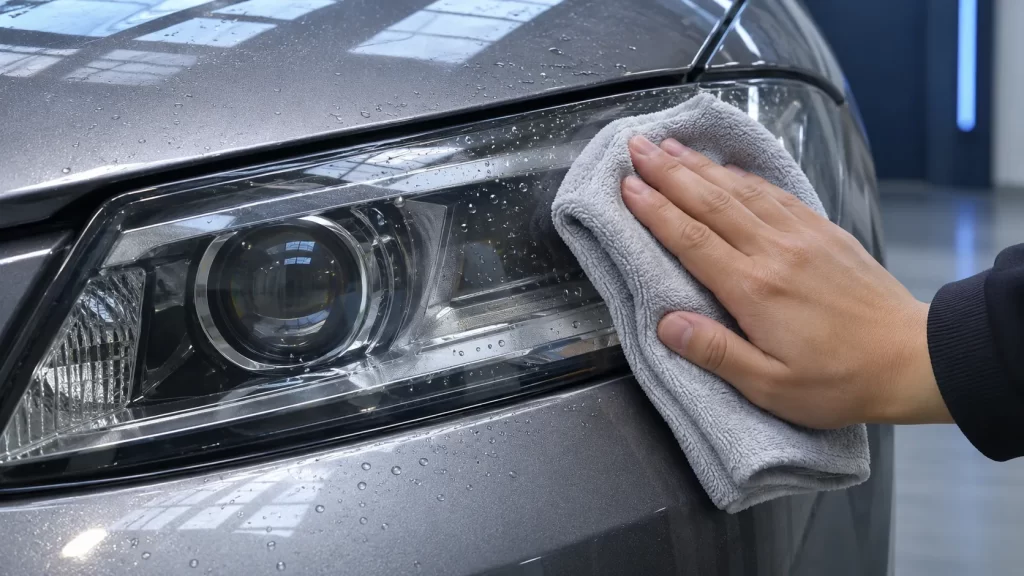
Follow the product’s handover instructions for the first wash and normal cleaning. Once washing is permitted, use the approved cleaning method and remove loose grit before wiping. A soft, clean cloth is a better starting point than repeated dry rubbing. Do not introduce a strong solvent, abrasive polish or unfamiliar bug remover simply because it worked on another part of the car.
Pay attention to film edges during washing. Use the supplier’s pressure-washing limits if that method is allowed, and avoid directing concentrated force into the perimeter. If the film has already lifted, arrange inspection rather than trying to force the edge back down with a towel or brush.
Self-healing and hydrophobic are useful terms only when their limits are clear. A topcoat may be designed to recover from certain light surface marks under specified conditions. It cannot be assumed to repair a deep cut, missing material or a damaged lens. Water beading is also not proof of impact resistance, optical performance or remaining service life.
Inspect the lamps periodically after cleaning. Look for a change in transparency, stubborn staining, scratches, lifting and a different appearance from one side to the other. An owner who checks these details can ask for help early, before a small maintenance issue becomes a larger discussion about the entire installation.
Service life, warranty and eventual removal
“How long does headlight PPF last?” is a reasonable question, but the answer needs an exact product and application. Exposure, climate, cleaning, driving conditions and the state of the lens all belong in that conversation. A warranty period printed for a body-film range should not be treated as a promised lifetime on every headlight.
Ask which defects are covered, which applications are excluded and what evidence is needed to make a claim. Is the remedy replacement material only? Does it include removal or reinstallation? Who decides whether a mark is a covered defect, impact damage or an installation issue? Clear answers are especially useful when the distributor and fitting shop are separate businesses.
Removal deserves planning before installation. Adhesive film interacts with the surface beneath it, so assess the risk to a factory coating or restored finish and follow the supported removal procedure. A promise of damage-free removal on every lamp is too broad. If the coating begins to lift or the surface changes during removal, stop and obtain a specialist assessment rather than continuing blindly.
A better buying process for installers and distributors
Start with a small, structured qualification process before committing to a larger purchase. This is a practical buying recommendation, not a claim that every supplier follows the same system. Choose representative applications for your intended market, confirm that they are suitable, and define what your team will examine before a sample arrives.
Your evaluation sheet can record the product code, batch reference, storage condition, handling behaviour, visual appearance and installation observations. Record the process used as well. If two installers use different preparation methods, a comparison of their results may say as much about the process as it does about the film.
Set acceptance criteria with the supplier rather than inventing pass marks afterwards. Discuss how optical reports relate to the delivered product, how the film should be stored and what change notification is available if the construction changes. For repeat orders, retain the relevant documentation and an identifiable reference sample where practical.
Commercial details belong in the same discussion: roll dimensions, packaging, order quantity, lead time, destination, shipping terms and the route for technical questions. Private-label packaging or a custom specification should be requested explicitly and confirmed in writing. Do not assume that every option shown in an article is available for every order.
FAQ: PPF headlights
1. Is PPF on headlights worth it?
It can be worth evaluating when the lenses are suitable, the proposed use is permitted and the product addresses the owner’s exposure and maintenance needs. Compare the complete installation and future replacement cost with your priorities. It is a poor starting point if the real problem is internal moisture, damaged optics or an unsuitable surface.
2. Can regular paint protection film be used on headlights?
Only when the exact product is supported for the relevant lens and application. A film marketed for body panels does not automatically carry headlamp compatibility or warranty coverage. Ask for written instructions and check restrictions from the lamp or vehicle manufacturer before treating a general-purpose roll as a headlight product.
3. Will clear headlight film reduce brightness?
Do not assume zero optical change. Evaluate the relevant optical information and the finished installation, including any effect on emitted light. A transmission figure from a material sample does not fully describe the performance of a complete lamp. Any concerning change should be professionally assessed.
4. Does headlight PPF stop yellowing forever?
No permanent guarantee should be inferred from the word protection. Ask for product-specific weathering evidence and warranty terms. The film can age, and the lens or its coating can have separate deterioration issues. A film that looks clear when new is not proof that every underlying lens will remain unchanged indefinitely.
5. Can PPF be installed after headlight restoration?
Possibly, if the restoration process, finished surface and film are compatible. Identify any applied coating and its curing requirements first. Do not use a single waiting time for every restoration system, and do not treat film as a substitute for the surface protection required by that system.
6. Is smoked headlight PPF the same as clear protection film?
No. A smoked product changes the optical specification as well as the appearance. Check intended use and applicable requirements rather than assuming a light tint is automatically acceptable. The fact that a supplier offers several shades does not establish that each is suitable for public-road vehicles in your market.
7. Should I choose a precut kit or bulk film?
Choose according to the available pattern, lamp shape and installer’s supported method. A correctly matched precut kit can simplify preparation, while bulk material offers fitting flexibility. Neither format guarantees a good result. Confirm coverage, cutting practices and the expected edge finish before deciding.
8. Can I install headlight protection film myself?
Assess the application honestly. Small lenses can still have difficult curves, sensitive coatings and tight working space. Read the complete product instructions before purchasing a kit. If you cannot establish compatibility, manage the application or assess the finished result, use a qualified installer instead of learning on an expensive lamp.
9. Are bubbles normal after installation?
The answer depends on the product and what the apparent bubble contains. Some temporary moisture effects may be addressed in the instructions; contamination, creases and edge lifting need a different response. Send clear photographs to the installer and follow the agreed inspection schedule. Do not puncture the film yourself.
10. Will installing PPF affect my headlight warranty?
Check the actual vehicle, lamp, film and installation warranty terms. They are separate agreements and may treat alterations or resulting damage differently. Obtain clarification before work begins, especially on a new or recently replaced assembly. A verbal statement that “everything stays covered” is not a substitute for the applicable wording.
11. When should headlight PPF be replaced?
Arrange assessment when damage, discoloration, loss of clarity, peeling or other deterioration appears. Follow any product-specific replacement guidance, and act promptly if lighting performance is affected. Do not keep an unacceptable film in service solely because the headline warranty period has not expired.
12. What should I request from a wholesale supplier?
Request the exact product specification, supported applications, optical information, installation and care instructions, warranty scope and commercial terms. Include your destination market and intended customers. A useful supplier response addresses the proposed use and evidence required, instead of offering only a thickness figure and a price.
Discuss your headlight film requirements with Decowell
Decowell lists a dedicated TPU Car Headlight Film range alongside its broader paint protection film products. For a distributor or installation business, that provides a starting point for discussing headlamp protection and body-film sourcing with the same supplier. Confirm the exact product and application details before placing an order.
Send Decowell your market, intended lens applications, quantity and documentation requirements. Ask about suitable clear options, technical evaluation arrangements and the commercial terms for your business. Decowell’s contact page focuses on bulk industrial enquiries, so a specific company requirement is more useful than an unspecified request for a single sample.
Ready to build a headlight protection film offer your customers can understand? Contact Decowell with your headlight PPF requirements and use the enquiry template above to start a focused discussion about product suitability, supply and support.