
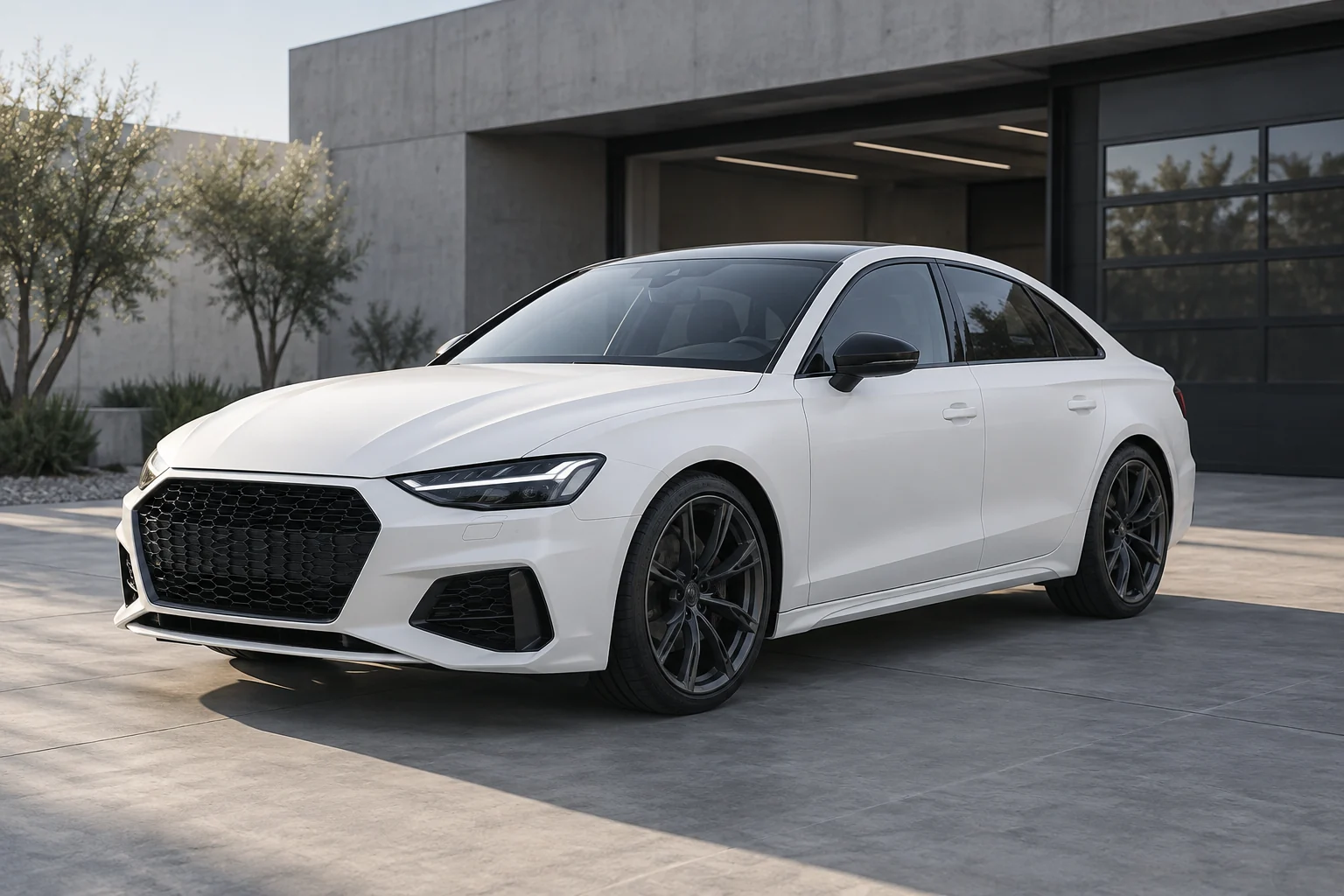
I’d put the sample on the car before doing anything else. White seems like an easy color to order until you have two whites next to each other. One looks creamy, the other almost blue, and suddenly the choice on the screen doesn’t look so convincing. Add a matte finish and you have another decision: how flat do you actually want it?
That is the appeal of matte white paint protection film, or PPF. You can change a familiar-looking car quite a bit without repainting it. There is a protective layer over the bodywork, too, which is useful if the car spends its weekdays on the road rather than waiting for the next photo. Decowell has several white finishes to consider. The rest of the decision involves the car you have now, the sort of driving it does and the person who will be fitting the film.
1. First decide whether you need white film
Here’s a detail worth sorting out on the first phone call. A transparent matte film over white paint gives a matte white result. The same film over blue paint leaves you with blue. Colored white PPF supplies its own color, so it can be used for a conversion as well as a change of sheen.
For an owner who likes the original white, I’d first look at transparent film. There’s no need to cover a color you want to keep. On the other hand, changing a red car to white means looking through the colored range.
TPU is the abbreviation you’ll see on many PPF specifications. The full name is thermoplastic polyurethane. Think of the construction in layers, with an adhesive against the paint and a top coating on the exposed face. Two rolls described as TPU need not behave identically under an installer’s squeegee, because that label doesn’t describe the whole construction.
2. Why the sample matters so much
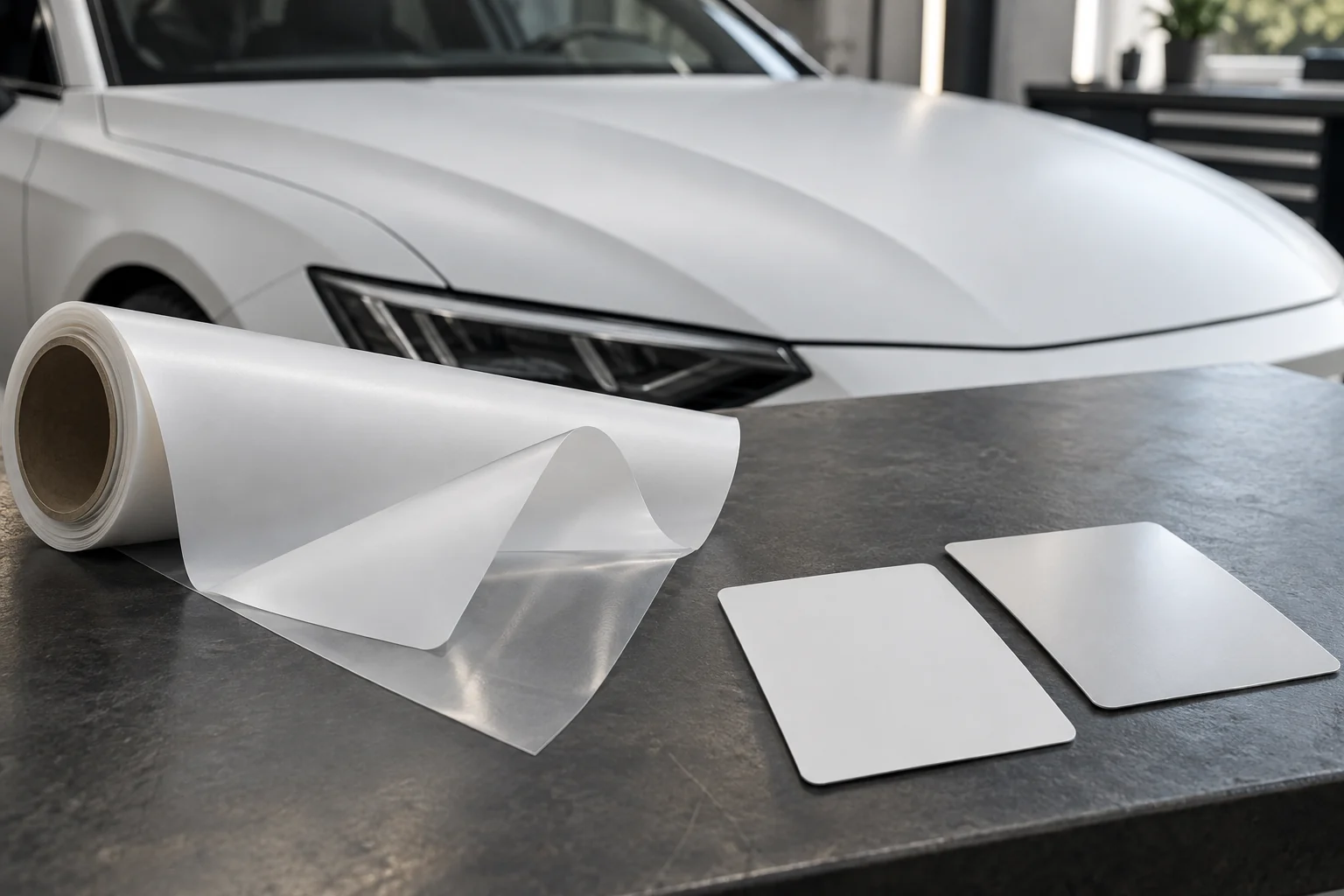
Here’s the thing about white cars: they’re everywhere. I don’t think that makes white a boring choice. It just means the finish has more work to do if you want your car to feel a little different.
Try looking at a white car through the reflection of a building beside it. On gloss paint, the windows can form quite sharp shapes. Matte film diffuses that reflected light, so instead of following the windows you may find yourself following the curve of the door. I like that effect on a simple body shape. It is still a matter of taste, and a car doesn’t become better finished merely because it has less shine.
I’d take the samples out to the car, even on an overcast day. First beside the black trim, then by an unwrapped door opening, with a look from a couple of steps back as well. If you’re choosing a pearl white, though, finding out how it looks in sunlight before ordering seems time well spent.
3. Protection without expecting miracles
If you’re tired of finding another little mark on the hood after a motorway trip, the protective side of PPF has an obvious attraction. The film takes the contact first. The outcome you’re hoping for is a mark on the film with sound paint below it, allowing that piece to be replaced. Small impacts are the relevant concern here. With a larger stone or a dent, the repair may involve the panel as well as the film.
Self-healing is about marks nearer the surface. Imagine a faint handling scuff, rather than a cut made by a sharp object. On a film with a suitable top coating, that shallow mark can recover under the maker’s specified conditions. If warmth is required, the care instructions should explain how to apply it. I’d show a deep cut to the installer; increasing the heat isn’t going to put missing material back.
Water beading is easy to demonstrate on a sample. What I’d want to know afterwards is how to clean the road film off it and which product to keep in the garage. The water-repellent surface can help with washing, but rain isn’t a complete cleaning routine. Insect residue and bird droppings still have to be removed.
Has the car had a respray? Tell the fitter where and, if you know, when. Film can later be removed, but a poorly bonded repair is a concern when anything adhered to it is pulled away. I’d rather have that panel assessed before paying for a wrap than discover the problem at removal time.
4. PPF vinyl and coating are different purchases
A lot of people lump these together. They shouldn’t. There is some overlap in what they do, but the distinction is useful when you have a budget and a particular result in mind.
| Product | What you get | The main limitation |
|---|---|---|
| Matte white PPF | A white finish with a protective film over the paint | Impact protection has limits and damaged film may need replacing |
| Matte vinyl wrap | Chosen mainly for its color and appearance | Less protection from flying stones in most comparisons with PPF |
| Ceramic coating | A surface treatment applied as a liquid and allowed to cure | Useful for cleaning and chemical resistance; very little impact protection |
I’d get a vinyl quote if the color change were the whole point. If chips on the front of the car were the main annoyance, I’d start with PPF. A coating could still be useful on either finished job, provided the combination is approved and gives the sheen you want.
Coverage changes the comparison. Put matte white film on the front half of a gloss white car and you may be left looking at the difference between the two halves. A full exterior conversion costs more because there is more car to cover. Door openings, trim removal and paint preparation can add work that isn’t obvious in a headline price.
5. The Decowell whites to look at
Decowell’s matte colored PPF catalogue includes Super Matte White, Matte Ceramic White and Matte Pearl White. Those are useful names to take into an enquiry. They give the supplier a much clearer starting point than ‘the white one in the photo.’
For an owner, the first job is choosing the appearance. For a shop buying rolls, there’s a second job: finding out how the material installs. A strip on a flat board won’t show you how a stretched corner looks. A trial piece around a curved test panel gives the fitter something more useful to work with.
This matters when the original car is dark. The white needs to cover that base color, including where the material has been stretched. That ability comes from the film construction. A white adhesive is not a feature you should assume every product has, and the words ‘white PPF’ don’t tell you where the pigment sits.
One other detail is easily forgotten after a successful installation: the roll label. Keep its product and batch information with the invoice. If a bumper is repaired later, the person matching the replacement has a record to start from. Age and exposure can still create a difference between old and new film.
6. What happens in the fitting bay
Allow time for the fitter to inspect the car at the start of the job. An old chip that looks small to you, or a ceramic coating applied last summer, may change the preparation required. Cleaning comes first; any polishing should be agreed for the paint in front of them. Factory matte paint, for example, should not simply receive the treatment used on a gloss panel.
Watch a wet installation and quite a lot of it is positioning. The sheet has to sit correctly before the fitter squeegees the solution out and deals with the awkward shapes. A wide, nearly flat hood and a bumper recess aren’t equivalent pieces of work. How much the material can be stretched, what solution to use and where heat is appropriate all belong to the instructions for that roll.
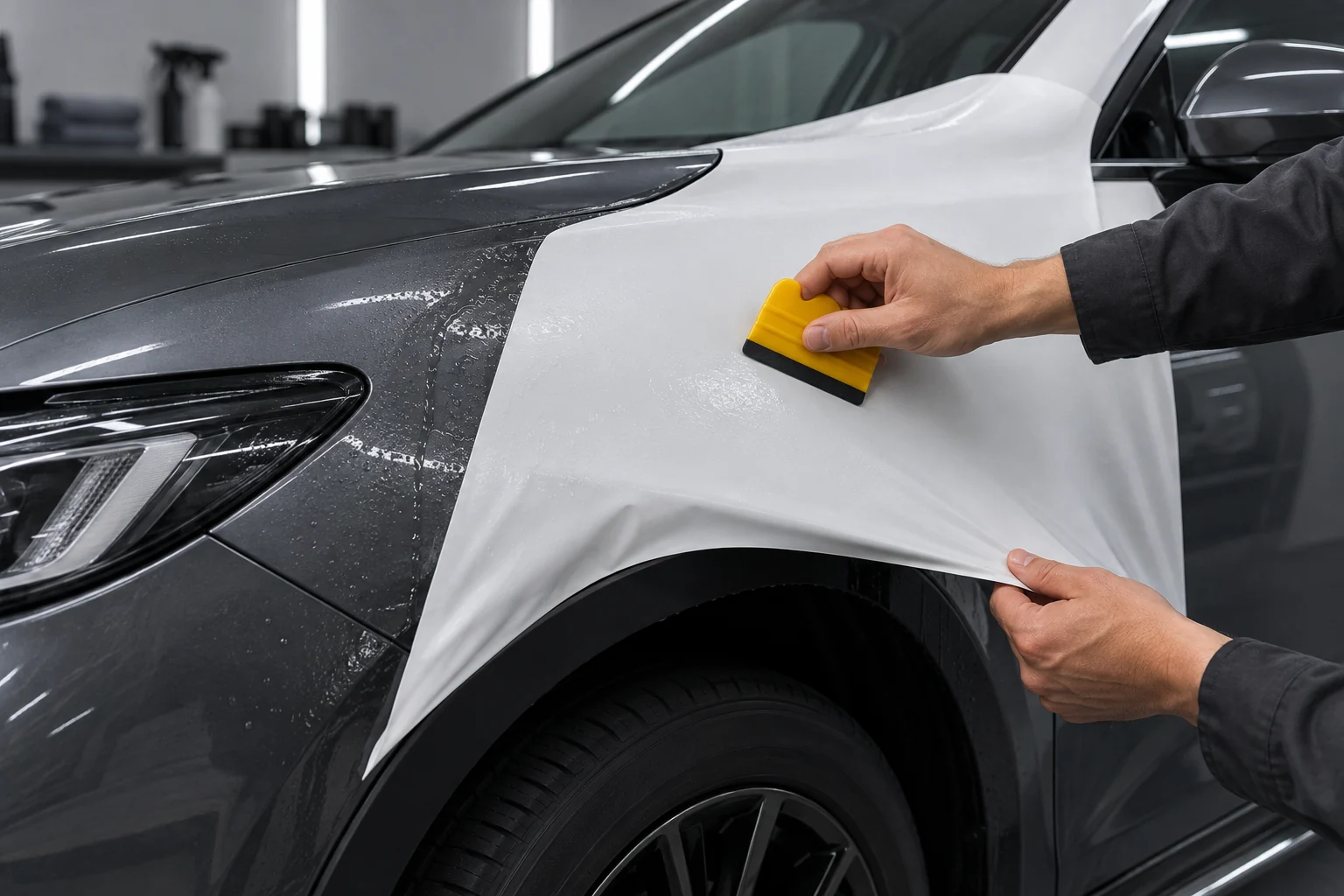
An edge is a small detail until it shows the old color. I’d go round the parked car with the fitter and agree on the stopping points: the door opening, the edge beside a badge, the recess under a handle. Some edges can be wrapped, while a difficult shape may need a join. Whether trim comes off can affect the labor charge, so settle that before the job starts.
Don’t leave collection day with ‘wash it later’ as your only instruction. Have the fitter write down when washing can resume and whether they’d like to inspect the edges again. If a corner needs attention, leave it alone and arrange the check rather than repeatedly pulling it up to see underneath.
7. The first few washes
Before the first wash, I’d sort through the bottles already in the garage. The shampoo may be fine; the polish used on the previous car may be exactly the wrong thing. Use the care instructions to choose supplies. It is easier to get the right bottle now than deal with a patch that has changed sheen later.
Give the car a proper rinse before washing by hand. Grit trapped in a mitt is an abrasive, whatever direction you move your hand in. Clean equipment and gentle pressure on a cool panel are what I’d concentrate on. I’d skip the rotating brushes of an automatic wash. A pressure washer also needs care around the film’s edge, with the nozzle kept back by the distance specified in the instructions.
Suppose there’s one stubborn mark in the middle of the hood. On a gloss finish you might be tempted to reach for polish. With matte film, rubbing that spot with an abrasive or a gloss-enhancing treatment can leave it visibly different from the rest of the panel. Stop at the approved cleaning method. Waxes, sealants and specialist cleaners need checking individually, rather than assuming everything in a familiar category is safe.
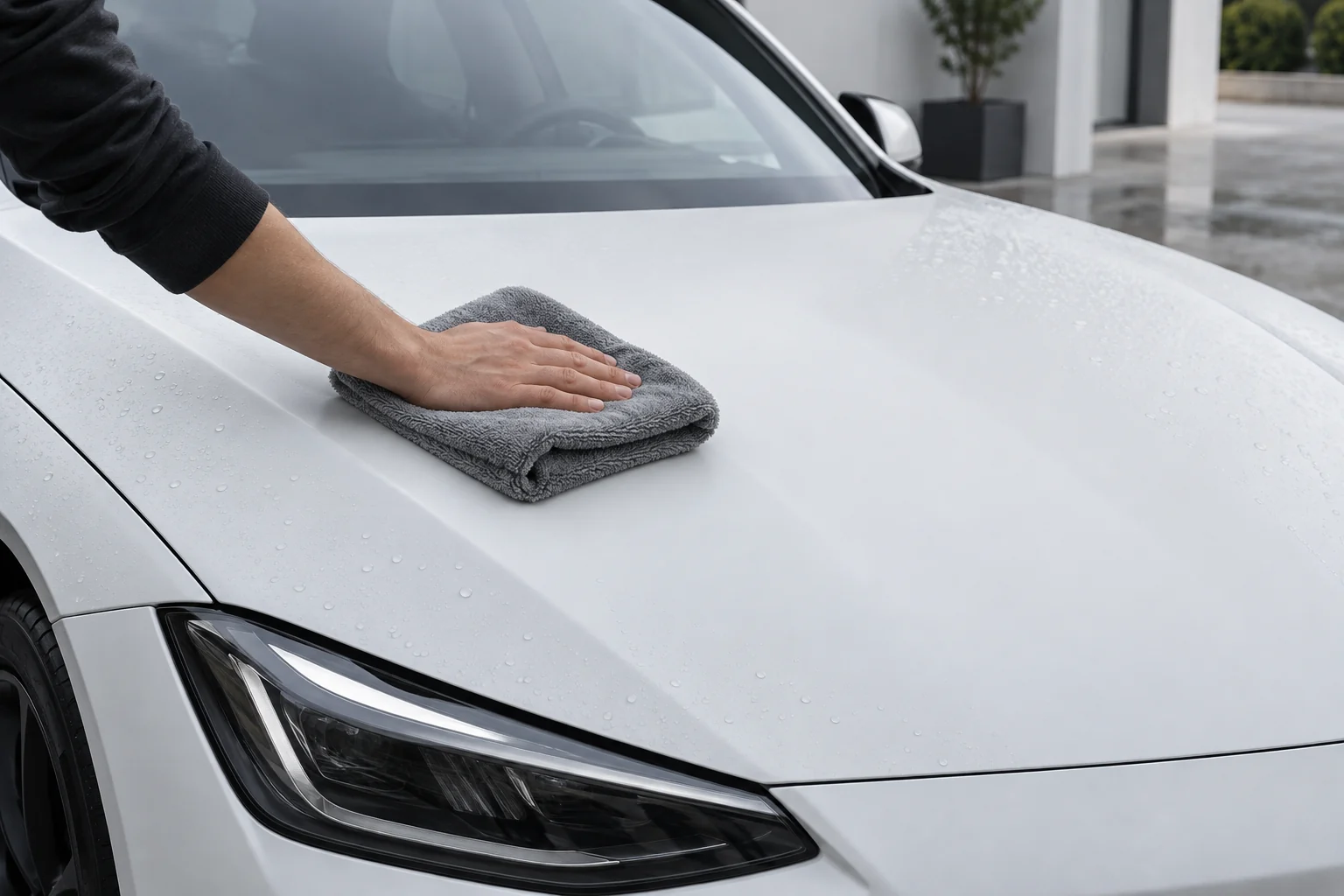
A soft microfiber drying towel is useful to have ready so the wash water doesn’t dry on the panels; an appropriate blower is another option. Between washes, insect residue and bird droppings need prompt cleaning. A remaining stain is a reasonable thing to call the installer about. It doesn’t have to become a home experiment with progressively stronger products.
8. Who will enjoy owning it
A Tesla or BMW appears in plenty of wrap photographs, but that doesn’t make the finish unsuitable for the car you take to work. I’d judge it on the actual body shape and the way you use it. Someone happy to wash by hand may enjoy ownership more than someone who expects the usual brush wash to do everything.
The longer you expect to keep the car, the more time you have to enjoy the appearance and make use of the protection. The calculation is different if you’re planning to sell soon or change colors again in a few months. PPF may help preserve the paint, but recovering the entire installation cost at resale is another matter.
If the shop can show you an older job, take a look. I’d be interested in the lower doors and the bumper as well as the hood, and in whether that car lives outside. It won’t predict the life of your own wrap, but it is a more useful reference than looking only at the day-one photographs.
9. Getting a useful Decowell quote
A message that says ‘white PPF price’ leaves quite a lot for the supplier to ask. Include the model and year, say what color the paint is now and name the white sample you liked. Photos and a description of the coverage help, along with any repair history. For a shop enquiry, include roll quantity, width and delivery location.
The quote should identify the film. Have the selected product’s specification, warranty and fitting requirements alongside it. An installer may provide a separate workmanship warranty, so keep that too. The person you contact about a lifted edge may not be the person who supplied the roll.
For a 2026 project, Decowell’s range gives you several ways to approach a white conversion. For me, the next step would be getting samples of the whites I liked from the catalogue. Once one of them works beside the trim and paint, the installer can quote the agreed coverage. That leaves fewer surprises between ordering a roll and collecting the car.
10. Questions that come up before booking
How long does matte white PPF last
I wouldn’t put a removal date in the diary just by reading the number on a warranty. The relevant product’s warranty tells you its coverage; the condition of the film tells you when it needs inspection. A car parked outside all year has a different life from one kept in a garage. Have cracking, lifting or a change of color looked at when you notice it.
Can it cover a car that is not white
Yes, a suitable colored white film can. Transparent matte film cannot supply the white. On a dark car, agree on the door openings and other exposed areas as well as the outer panels, or the original color may show in places you weren’t expecting.
Is there a fixed premium over clear PPF
I’d ask the same shop to price both jobs. Otherwise you could be comparing one film with another and one preparation package with another at the same time. Even then, make sure both prices include the edges and openings you’ve agreed to cover. There isn’t one percentage to add to every clear-PPF quote.
Is wax always forbidden
Take the name of the wax to the film supplier and check it. There are approved treatments for some matte films, so ‘never use any wax’ is too broad. What I’d avoid is applying an unapproved abrasive or gloss-enhancing product and hoping the finish stays the same.
Does the self healing coating repair everything
No. The description concerns shallow marks in the top coating. If a sharp object has cut through the material, warming it won’t replace the missing film. Show that damage to the fitter and see whether the affected section needs replacing.
Adding a coating over the film
It can, with a compatible system. I’d want to see the approved coating on a spare sample before paying to have the whole car treated, and check that the warranty allows it. Some combinations maintain the matte appearance.
Comparing brands
I’d write the exact product names side by side. XPEL STEALTH, for example, is transparent, as are 3M’s transparent matte offerings. They can change the sheen of a white car, but won’t turn a black one white. For that job, compare colored options, then look at the fitted samples and the support available locally.
Could a white film turn yellow
It is possible for a film to discolor, and yellowing resistance varies by product. A stain is another possible explanation for a yellow-looking area. I’d first use the approved cleaning method, then show any remaining change to the installer. The warranty for that film will say what sort of discoloration it covers.
Is a full wrap a sensible DIY project
Not as a first attempt, in my view. Getting the material around a bumper recess without an unwanted mark is quite a different exercise from laying a small flat sample. Large sheets are awkward to handle cleanly, too. Compare the professional installation quote with the likely material waste as well as the price of the roll.
Choosing between satin and matte
I’d expect more sheen from satin. Exactly how much is harder to answer from the name alone, because ranges differ. With two samples in front of you under the same light, the decision becomes much simpler: which appearance do you want across the whole car?