
Satin PPF changes the way a car catches the light. Reflections become softer, while the body still carries some sheen. For owners who like that balance, the next decision is practical: which film, which coverage and which care routine will deliver the finish they actually want? This guide helps you work through those choices.
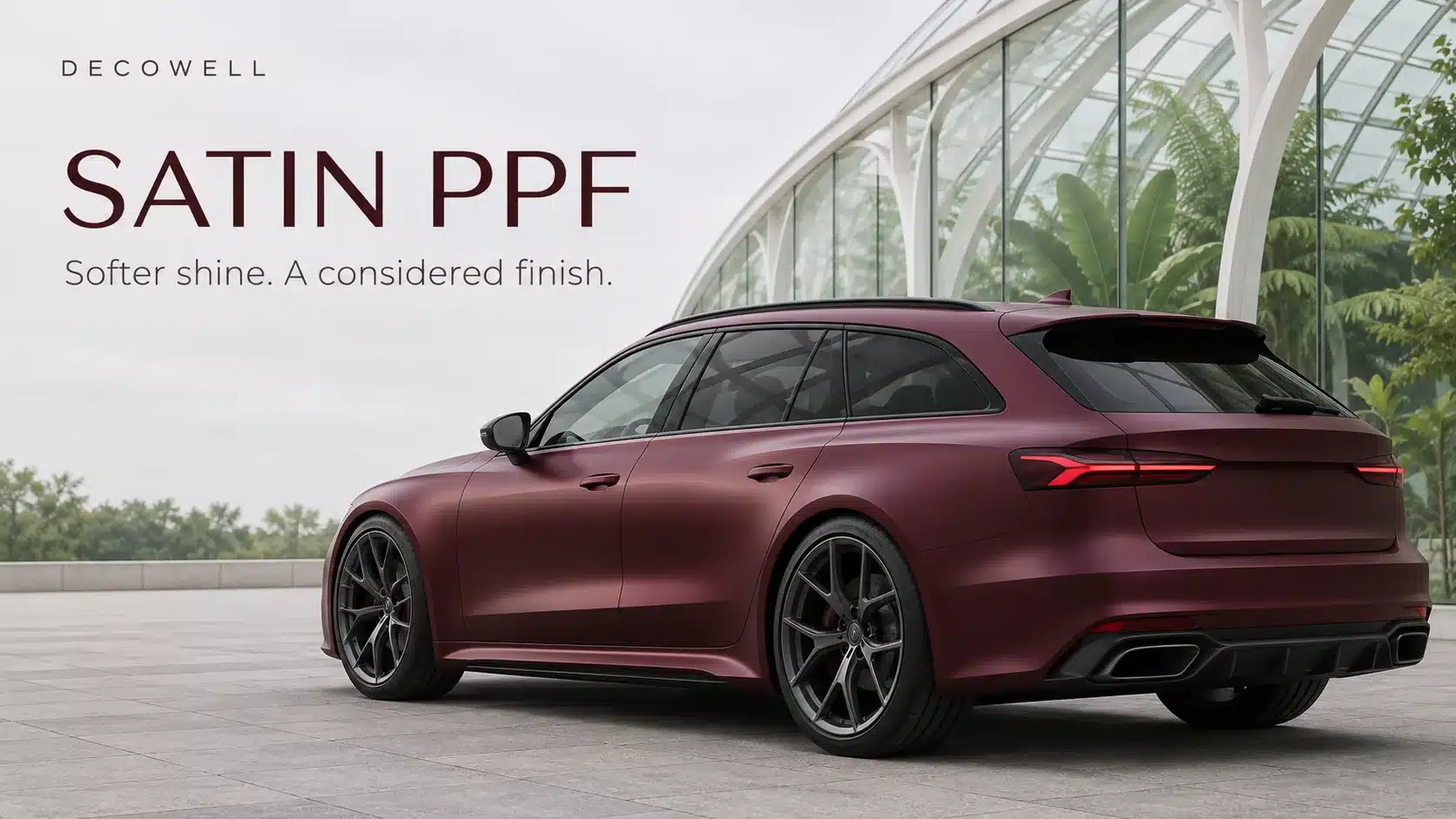
Start with the finish, then choose the film
Satin paint protection film is an adhesive protective film with a low-sheen surface. It is often chosen for an appearance between a sharply reflective gloss and a flatter matte effect. That description is a starting point, not a universal technical grade. The same word can cover noticeably different surface finishes across product ranges.
Think about the result you want when the vehicle is parked outside, not only beneath a workshop’s lights. Do you want to keep the original color with softer reflections, change both color and sheen, or preserve an existing factory satin appearance? These are three different briefs. Resolving that question first makes the material discussion much easier.
The phrase satin car wrap also needs clarification. It may refer to decorative vinyl or to a protective film with a satin finish. A customer sees a look; a supplier needs a material requirement. When asking for a quotation, write satin PPF if paint protection film is the category you intend to evaluate, then identify whether it should be transparent or colored.
What changes when glossy paint gets a satin surface?
A glossy panel can show a relatively sharp reflection of a window, tree or building. A satin surface softens that reflected image while retaining a gentle highlight. Body contours may become more prominent because the reflections are less busy. This is an appearance change, not evidence that the underlying paint has been repaired or improved.
Clear satin PPF lets the existing color show through, but clear does not mean visually unchanged. The perceived depth, brightness and metallic character can look different after the surface finish changes. A dark metallic color may respond differently from a solid white. Judge a representative sample on the intended paint rather than relying on somebody else’s vehicle photograph.
On an already satin or matte painted car, the goal may be closer to preservation than conversion. Even then, an exact visual match should not be assumed. Covered and uncovered areas can differ in sheen or texture. If you plan selective coverage, inspect a sample boundary in the places where the owner will notice it most.
This is why a small finish discussion matters before quoting protection packages. A person asking to keep the car looking original may prefer a different film from someone actively seeking a satin conversion. Both can value paint protection, yet have different acceptance criteria for the final appearance.
Satin vs matte vs gloss PPF: make a useful comparison
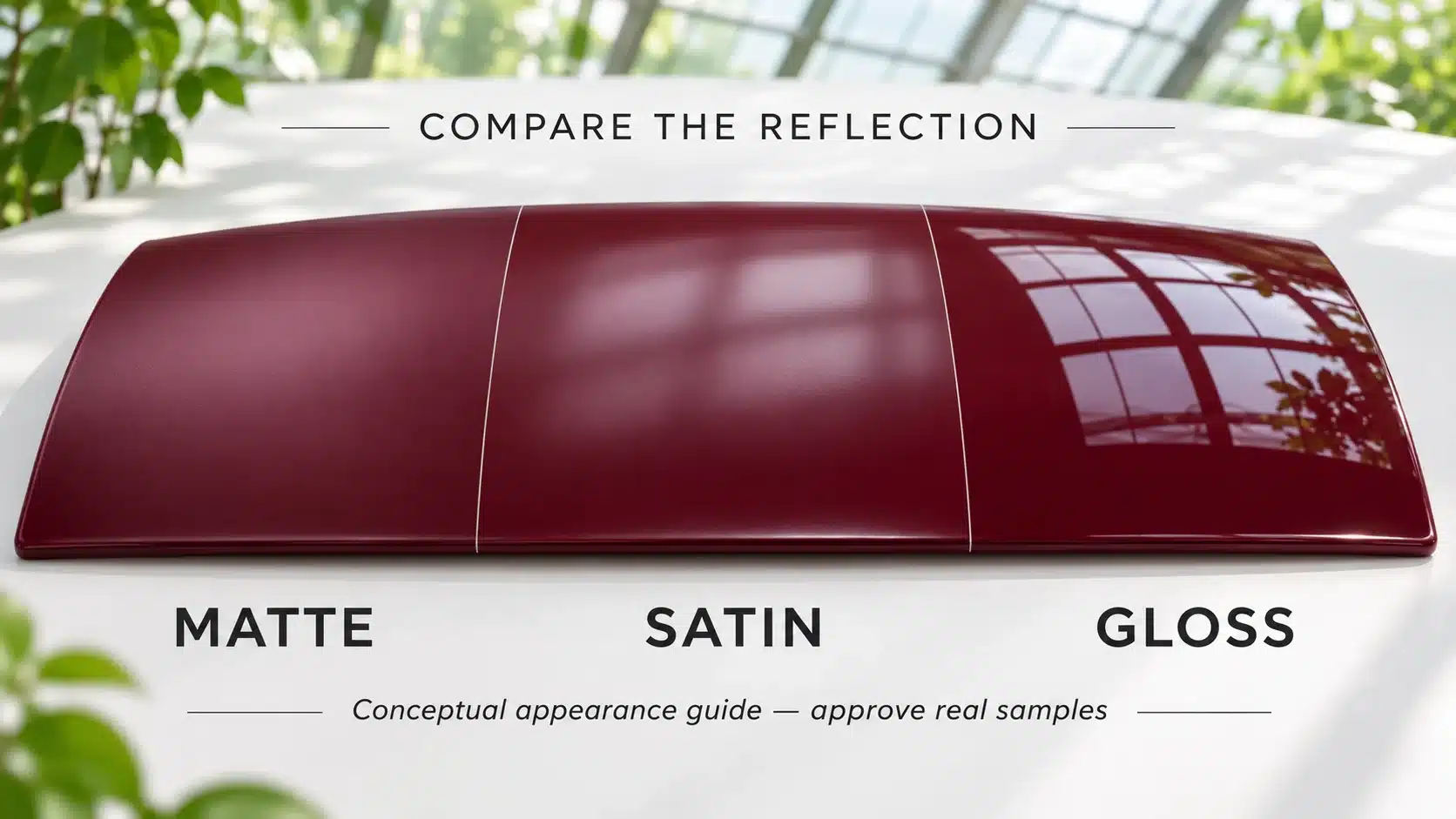
Instead of asking which finish is best, compare the kind of reflection you enjoy. Gloss tends toward more defined reflections; satin retains a softer sheen; matte generally looks flatter. Product names overlap, so do not order from these descriptions alone. Put actual samples next to one another before making the final choice.
View the samples under the same light and on comparable surfaces. Move around them and look across the surface as well as straight at it. A sample that seems understated from above may carry a stronger highlight at a shallow angle. Notice texture, haze and the clarity of reflected objects, not just whether the surface looks shiny.
For a business purchase, gloss readings can support a discussion when the test method and measurement geometry are supplied. ASTM D523 describes specular gloss measurement at defined angles. It does not set one compulsory satin value for all automotive films. Keep an approved physical reference alongside any agreed data, because the instrument reading is only part of appearance.
Avoid turning sample selection into a contest for the lowest gloss number. A flatter finish is not automatically more protective or more durable. The useful question is whether the film achieves the appearance and service requirements of the project. A slightly more visible sheen may be exactly what makes satin appealing to that customer.
Clear satin PPF or satin color PPF?
Keep the color you already have
Transparent satin PPF is the relevant route when the original paint color should remain visible. It can be considered for a full appearance conversion or for protection on an existing low-sheen finish, subject to compatibility and sample approval. It is not an opaque color-change material, so it will not turn a red vehicle into a black one.
For this route, make the actual car part of the selection process. Ask how the candidate looks over its paint and whether exposed painted areas will remain glossy. An attractive sample by itself tells less than a sample that has been assessed against the owner’s expectations for the whole vehicle.
Choose a different color as well
Colored satin PPF introduces a new visible color together with the surface finish. A suitable opaque product can support a color-change project, but its construction, coverage and fitting requirements need confirmation. Ask whether the quoted film delivers the intended color over the existing paint and what limitations apply around contours and edges.
Search terms such as satin black PPF can describe either clear film over black paint or a black colored film over another color. That ambiguity can create an incorrect order. Write down transparency, color reference, finish and product code. A supplier should not have to guess which of those two projects you mean.
Decowell’s low-sheen colored PPF selection includes satin-named styles within its matte colored film category. Use that page to begin a color discussion, then confirm the exact item and current specification. A category name alone does not establish that every film has the same base material, thickness or commercial terms.
Protection, self-healing and coatings are different questions
The protective role comes from the selected film system, not from the word satin. An appropriate automotive PPF creates a replaceable layer over a supported surface and can help reduce certain stone-chip and abrasion damage within its intended use. It cannot make the vehicle dent-proof or prevent every scratch, impact or stain.
Ask for evidence that relates to the quoted product. If a supplier reports impact, abrasion or weathering tests, review the method, exposure and assessment criteria. A laboratory result should not be casually converted into a guaranteed number of years on every car. The proposed climate and use remain relevant to a purchasing decision.
Self-healing, where offered, concerns certain fine surface marks under specified conditions. It does not replace torn film, refill missing material or repair chipped paint below the film. Follow the selected product’s instructions rather than applying uncontrolled heat to chase a mark. Some damage calls for inspection or replacement, even when the film has a self-healing coating.
A ceramic coating is a separate surface treatment. It may be considered for compatible care or contamination-management benefits, but it is not interchangeable with a protective film. When used on satin PPF, both the combination and the resulting appearance need approval. An added coating should not unexpectedly turn the chosen sheen into a different finish.
Read the specification before comparing roll prices
Many automotive protection films use TPU, or thermoplastic polyurethane. Nevertheless, a finished film also involves its surface coating and adhesive, plus removable layers used for handling or release. The material abbreviation is not a complete specification. Request the technical sheet for the exact product, not just a general brochure covering several ranges.
Confirm what the thickness figure includes. Compare installed material with installed material; a release liner is normally removed and should not inflate the apparent protective thickness. One mil equals 25.4 micrometres. Consistent units and layer definitions help purchasing teams compare quotations without mistaking a difference in reporting for a difference in the finished product.
Look for supported substrates, application guidance, storage conditions and shelf life. Adhesion information is more meaningful when the surface and test conditions are known. Likewise, a large elongation-at-break figure is not an instruction to stretch the film that far during fitting. The installer needs working limits and appearance guidance for the actual application.
For repeated orders, identify the reference finish and the process for handling variation. Ask how roll and batch details are recorded, and how a specification change will be communicated. A sample approved once should remain connected to the item being purchased. This matters when a distributor sells the same satin appearance to several workshops over time.
Choose coverage with the visible boundaries in mind
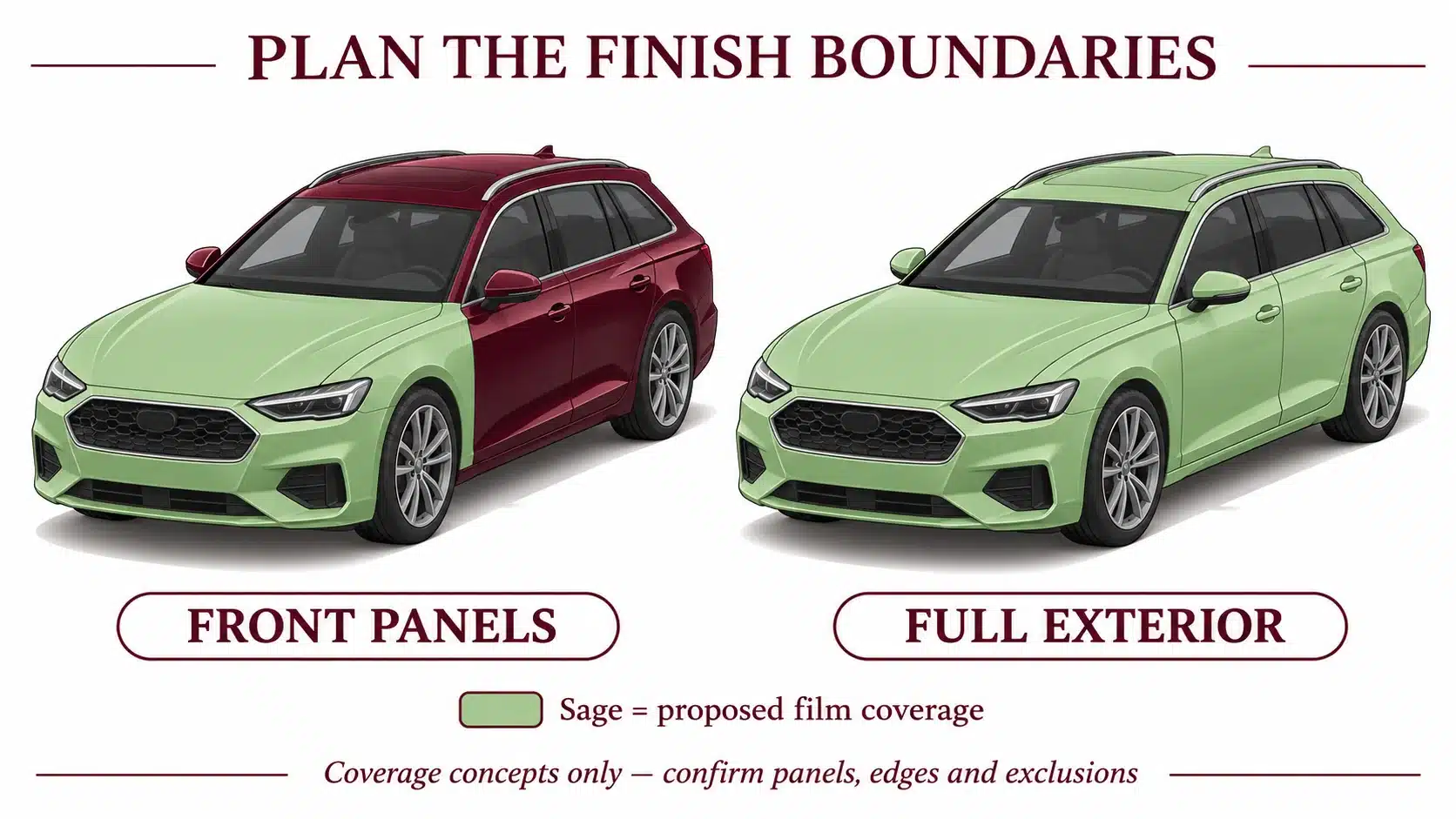
Full-front coverage can make sense as a protection package, but satin over glossy paint also changes the finish of the covered panels. A satin bonnet beside glossy doors may be intentional, or it may be a surprise. Discuss that consequence before treating satin film as a direct visual substitute for clear gloss protection.
For a consistent exterior conversion, list the panels included and agree how adjacent details will look. Gloss black trim, painted mirrors, roof sections and contrasting accents do not all have to receive the same treatment. Deliberate contrast can work well. What matters is that the owner understands the design rather than discovering unfinished-looking transitions at collection.
Edges and recesses deserve attention even with transparent film. The underlying color may match, but an uncovered strip can still reflect differently. Ask about wrapped returns, visible terminations and seams on difficult shapes. A film edge need not disappear completely for a job to be good, but its location should fit the agreed standard of finish.
Door jambs and interior painted returns are separate scope items. Do not assume that full exterior coverage includes every hidden surface. Also keep functional openings and components outside the plan unless their coverage is expressly supported. The installer should explain access requirements, realistic boundaries and any parts that will remain untreated before work begins.
A sample trial that answers real ownership questions
A useful trial is more than briefly holding a swatch beside the car. Agree on a suitable representative sample or test panel, the intended substrate and the product instructions to be used. Observe the finish on a curve, the boundary and the normal viewing distance. If a vehicle test area is proposed, discuss compatibility and removal first.
Look at the sample in daylight and the lighting where the car is usually seen. Ask whether the result is softer without looking duller than the owner wants. For a colored film, assess the shade as well as the sheen. Photographs can document approval, but they should not replace the identified physical reference.
Trade buyers can use the evaluation to check handling and the finished format, not only appearance. Record the film code, batch where available and instructions followed. Agree in advance what observations will trigger a question or rejection. A short trial informs a decision; it does not establish every long-term durability claim or replace formal testing.
Installation and handover: what deserves a closer look?
Good preparation begins with the paint condition. Chips, corrosion, failing clearcoat and uncertain repairs require assessment before film is applied. Satin film is not a filler or a repair system. Repainted areas also need guidance on paint cure and compatibility. There is no single waiting period that makes every refinished surface suitable for every adhesive film.
Existing waxes, sealants and coatings should be disclosed to the installer. Preparation and application must follow the selected film’s requirements while remaining suitable for the vehicle surface. Do not transfer a wetting solution, temperature setting or fitting technique from an unrelated product simply because both are described as PPF.
The installer should manage stretching, repositioning and squeegee work within the material’s limits. Changes in appearance at a heavily worked corner deserve attention. Sometimes a planned seam or revised pattern is preferable to forcing a large piece around a difficult contour. Agree on the result, rather than assuming one-piece coverage is always the best option.
At collection, inspect the exterior under useful lighting and review the coverage plan. Check visible edges, recesses and adjoining panels. Ask which temporary installation effects are expected and when they will be reviewed. Take home written first-wash and care guidance, product identification and a clear contact route if an edge or mark needs assessment later.

Satin PPF cost: ask for the same scope twice
The installed price depends on the vehicle, selected film, paint preparation, coverage and finishing requirements. A quotation for a bonnet and front bumper is not comparable with a whole exterior conversion. Extra work around inner returns, trim and complicated shapes can also change labor and material consumption. Start by making the scope clear.
When comparing two quotations, ask both providers to identify the film and the same included panels. Clarify existing film removal, any paint repair, trim handling and follow-up support. The question is what finished work you receive for the price. A low headline cost can lose its meaning when substantial parts of the agreed appearance are excluded.
For wholesale satin PPF, compare usable roll dimensions, construction, packaging, freight and order terms. Consider trial material and installation yield rather than only the price per roll. Keep the warranty discussion separate from assumptions about installation labor coverage. Current local quotations are more useful than a universal price range that ignores vehicle and market differences.
Caring for satin PPF without changing its character
Use the selected film’s instructions for the first wash and routine care. Once washing is permitted, remove loose contamination before contact cleaning and use compatible products with clean, suitable wash materials. A satin surface still needs attention even if dust is less obvious from a distance. Dry wiping grit is not a shortcut to maintenance.
Deal with bird droppings, insects and other deposits promptly using the approved method. If a mark remains, ask for guidance before trying stronger solvents or scrubbing harder. Product-specific stain instructions can differ, and nearby exposed paint or trim may impose additional limits. A cleaning recipe from another brand should not become your default procedure.
Avoid ordinary abrasive polishing as a way to restore satin uniformity. It can change the surface appearance and leave a patch that reflects differently. Detail sprays, waxes and coatings also need compatibility checks. Their suitability for a glossy finish does not establish that they preserve the satin look you approved. Evaluate any recommended treatment on an appropriate sample first.
Inspect edges during cleaning and observe the film’s pressure-washing guidance. Report lifting or damage before repeatedly washing across it. Keep maintenance records where useful for a commercial fleet or warranty enquiry. The aim is a clean, consistent finish over time, not extra gloss or an impressive water-beading photograph at the expense of suitable care.
Plan for wear, replacement and removal
Ask for the written warranty attached to the selected product and market. Read covered defects, exclusions, proof requirements and who handles a claim. The warranty period is not a promise that every panel will remain visually identical throughout use. Exposure, parking, maintenance and installation all belong in the service-life discussion.
If one panel needs replacement, compare fresh material with the existing installation. Weathering and differences between batches may affect the visual match. Keeping product and batch records helps, but spare film also has storage and shelf-life limits. Do not promise an invisible repair several years ahead merely because the same finish name remains available.
Removal should be planned around the film and the actual paint condition. Obtain the supported procedure and experienced assistance where needed. Previously repaired or weak paint needs particular assessment. Removability is a useful feature of film systems, but it is not a blanket guarantee of damage-free removal from every surface after any period of service.
FAQ: satin paint protection film
1. Is satin PPF the same as matte PPF?
The terms overlap in some ranges, but they do not always describe the same appearance. Satin generally retains a soft sheen, while matte suggests a flatter result. Compare identified samples and supporting specifications. The label alone cannot tell you exactly how two films will look beside one another.
2. Can clear satin PPF change my car’s color?
It leaves the original color visible while changing the surface reflection. That can alter perceived depth or brightness, but it does not provide an opaque color conversion. To change the visible color itself, discuss an appropriate colored film and confirm its coverage on the intended paint.
3. Does satin PPF work on metallic paint?
It can be considered when the product supports the surface, but the finished metallic appearance may differ. Approve a sample over a representative painted panel and view it from several angles. A result on solid paint or a different metallic color is not a reliable substitute for that check.
4. Can I cover only the front of a glossy car?
Yes, as an agreed design and protection choice, but the covered panels will have a different sheen from the uncovered glossy areas. Review where that contrast appears. If the goal is a uniform satin exterior, discuss broader coverage instead of assuming a front package will create it.
5. Is satin PPF stronger than gloss PPF?
Surface sheen alone does not establish protective strength. Compare the specific constructions and evidence relevant to the intended use. A satin finish is an appearance choice; impact, abrasion, adhesion and weathering behavior require their own product information rather than a ranking based on gloss level.
6. Will satin film hide existing scratches?
It may change how some marks appear, but it does not restore missing paint or stabilise a failing surface. Have the paint inspected and agree on any preparation or repair. Opaque colored film also does not remove the need to assess the condition underneath it.
7. Does every satin PPF have self-healing technology?
Do not assume so from the finish name. Ask whether it is offered on the specific product, what marks are covered and under which conditions it works. Cuts, tears and missing film are different from fine surface marks. Avoid improvised heat treatment when the correct procedure is unclear.
8. Can satin PPF be ceramic coated?
Only use a combination confirmed suitable for the film and the intended appearance. Check whether it changes sheen, what preparation is required and how it affects maintenance or warranty terms. A compatible coating can serve a separate purpose, but it does not replace the protective film layer.
9. Can I polish satin PPF if it looks uneven?
Do not use ordinary paint correction techniques without explicit product guidance. Abrasion may create a different reflective patch. Have the cause assessed first: contamination, installation effects and physical damage need different responses. Replacement may be more appropriate than attempting to polish a damaged surface back to uniformity.
10. How long does satin PPF last?
There is no single answer for the category. Review the selected film’s warranty, exposure limits and inspection guidance with the supplier. The vehicle’s environment and maintenance matter. Replace damaged or unsuitable film when assessment calls for it, rather than relying only on an advertised maximum term.
11. Is a satin vinyl wrap an alternative to satin PPF?
It may be an appearance alternative, but do not assume equivalent construction or protection. Compare the particular products against your priorities, including finish, coverage, supported service and removal. If protection is central to the brief, request evidence appropriate to that need rather than selecting from photographs alone.
12. What should a distributor ask before stocking satin PPF?
Confirm the target application, transparent or colored format, reference finish, product code and technical documents. Discuss evaluation, batch identification, storage, claims handling and repeat supply. Then compare commercial terms. A small, well-defined starting range can be easier to support than several vaguely specified satin options.
RFQ: turn a satin finish idea into a useful enquiry
Subject: Satin PPF trade enquiry — [company] / [market]
We are a [distributor / installer / automotive film business] looking for [transparent satin PPF / satin colored PPF]. The intended application is [vehicle types, paint condition and coverage]. Our target appearance is [physical sample reference, color if applicable and preferred sheen]. Please recommend a suitable product and explain how the finish can be evaluated before a bulk order.
Please provide its construction, installed thickness, roll dimensions, supported substrates, installation instructions and care guidance. Please identify any available performance evidence, warranty scope, storage requirements and shelf life. We also need information on batch traceability and how repeat-order appearance consistency is managed.
Initial quantity: [rolls or area]. Estimated repeat demand: [quantity and timing]. Destination: [city and country]. Please confirm minimum order quantity, quotation basis, lead time, packaging, shipping terms and trade evaluation arrangements. Contact: [name, company, email and telephone].
Build your satin PPF offering with Decowell
The best starting point is a finish brief your customer can recognise and a film specification your installer can use. Explore Decowell paint protection film for the broader protection-film discussion, and use the low-sheen color category linked earlier when the project also calls for a new color.
Bring the appearance, coverage and expected order together in one enquiry. Confirm the exact transparent or colored option, sample arrangements and product-specific performance before advertising a service or stocking a range. Decowell can then respond to a defined sourcing requirement rather than a general request for something less glossy.
Decowell’s contact page focuses on bulk industrial enquiries. For an installer programme, distribution project or repeat commercial requirement, contact Decowell about satin PPF with the RFQ details above. That gives both sides a clear basis for discussing material selection, finish approval and supply.
Tags
satin ppf,satin paint protection film,clear satin protection film,satin color PPF,gloss to satin conversion,soft sheen car finish,satin PPF on metallic paint,satin black protective film,transparent satin car wrap,satin PPF versus gloss,satin PPF versus matte,satin film coverage planning,full exterior satin protection,satin PPF sample testing,satin film gloss measurement,satin PPF installation review,satin finish wash care,satin PPF coating compatibility,satin protective film pricing,wholesale satin PPF rolls,satin film batch consistency,Decowell satin film enquiry